Table of Contents
Overview
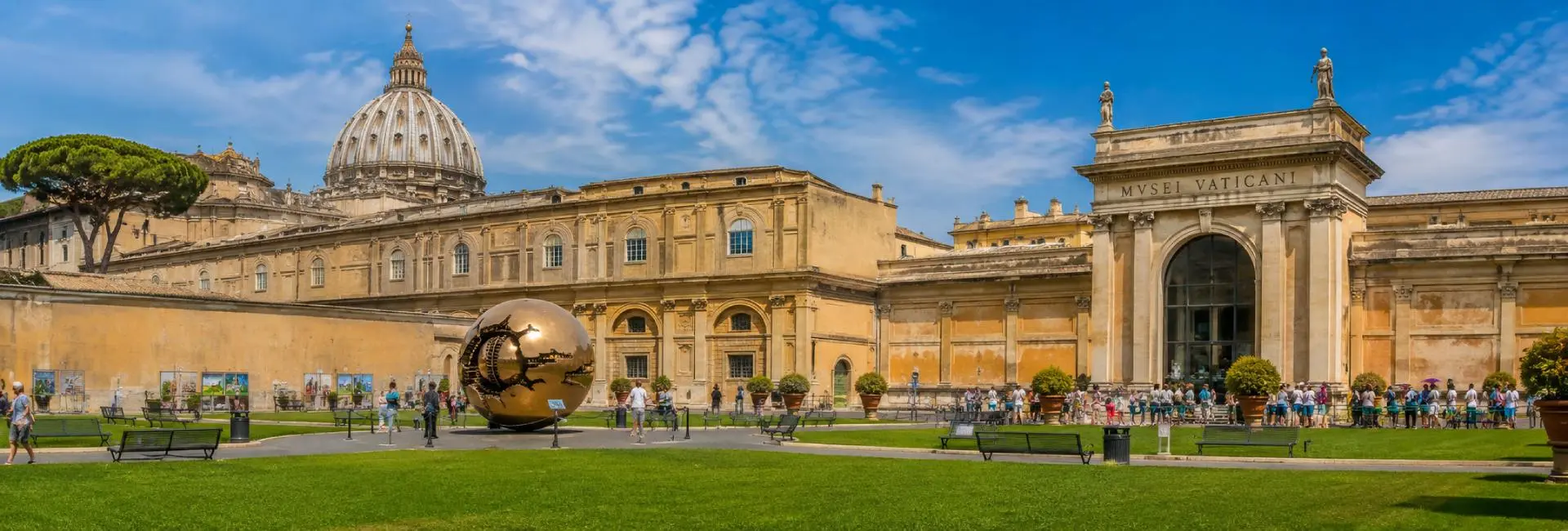
The Vatican Museums are among the largest and most visited museum complexes in the world, spread across roughly 7 kilometers of galleries within Vatican City. Founded on the private art collections of the popes, the museums now hold more than 70,000 works, of which around 20,000 are on public display at any given time.
Visitors come primarily for one reason above all others: the Sistine Chapel, with Michelangelo's ceiling and Last Judgment fresco, which sits at the heart of the museum route. But the complex extends far beyond that single room, taking travelers through Egyptian antiquities, classical sculpture, tapestries, maps, and the Raphael Rooms before reaching the chapel itself.
History
Origins Under Julius II
The roots of the Vatican Museums trace back to 1503, when Pope Julius II placed a small collection of ancient sculpture, including the newly discovered Apollo Belvedere, in a courtyard of the Vatican Palace. He commissioned the architect Donato Bramante to design the Belvedere Courtyard to house and display these classical works, laying the physical foundation for what would become the museum complex.
In 1506, workers unearthed the Laocoön and His Sons near the ruins of Nero's Golden House. Julius II acquired it almost immediately, and it remains one of the most celebrated sculptures in the collection today. That same period saw Michelangelo begin painting the Sistine Chapel ceiling, commissioned by Julius II and completed between 1508 and 1512.
Formal Founding and Expansion
The museums as a public institution were formally founded by Pope Clement XIV in 1771 and substantially enlarged by his successor, Pius VI, through the end of the century. Their joint efforts gave rise to the Pio-Clementino Museum, the oldest dedicated exhibition building in the complex and one of the first anywhere in Europe to open a papal or royal art collection to public viewing.
Subsequent popes added entire new museums to the complex: the Chiaramonti Museum under Pius VII in the early 1800s, and the Gregorian Etruscan and Gregorian Egyptian Museums under Gregory XVI in the 1830s. Each addition reflected the archaeological discoveries and collecting interests of its era, turning the Vatican Museums into a layered record of papal patronage spanning more than three centuries.
Recognition & Status
The Vatican Museums sit within Vatican City, which UNESCO inscribed as a World Heritage Site in 1984. It is the only World Heritage Site to encompass an entire sovereign state, recognized for its unmatched concentration of Renaissance and Baroque art and architecture alongside its role as the spiritual center of the Catholic Church.
- Vatican City inscribed as a UNESCO World Heritage Site in 1984
- Recognized under both cultural criteria for artistic influence and for its direct historical link to Christianity
- Widely regarded as one of the most important art collections ever assembled by a single institution
- Home to work by Michelangelo, Raphael, Bramante, and Bernini, among many others
Key Areas & Collections
Pio-Clementino Museum
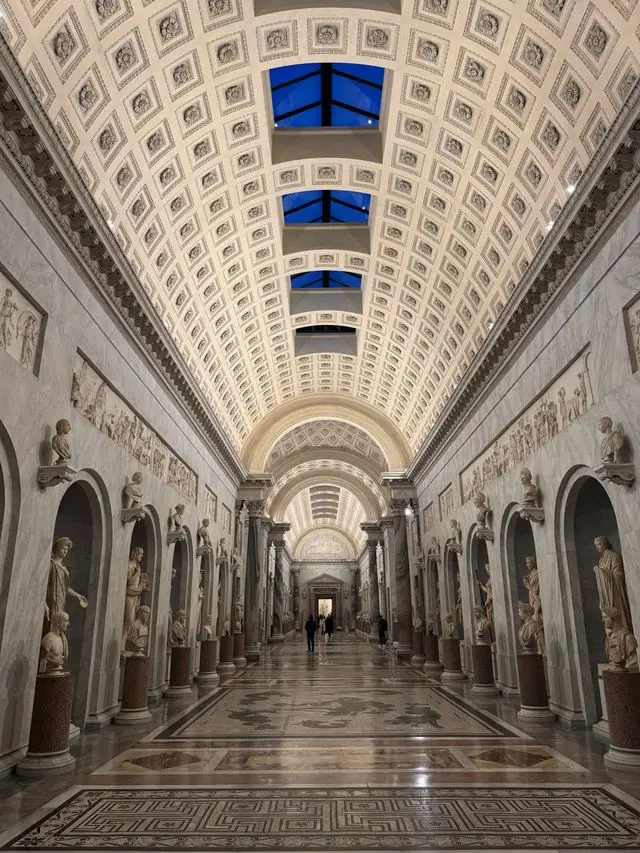
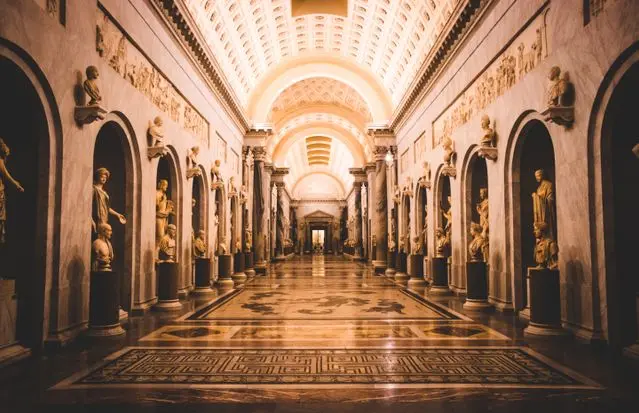
The oldest section of the complex, built around the Belvedere Courtyard, houses the museum's core classical sculpture collection. It includes the Laocoön, the Apollo Belvedere, and the Apoxyomenos, among other Greek and Roman works spanning the third century BC through the first centuries AD.
Gregorian Egyptian and Etruscan Museums
Founded under Pope Gregory XVI in the 1830s, these two museums display Egyptian antiquities including sarcophagi and mummies, alongside Etruscan artifacts recovered from tombs across central Italy, including jewelry, bronzework, and painted ceramics.
Raphael Rooms
Four adjoining chambers decorated by Raphael and his workshop between 1508 and 1524 for Pope Julius II and his successors. The Room of the Segnatura, featuring "The School of Athens," is generally considered the artistic high point of the suite.
Gallery of Maps
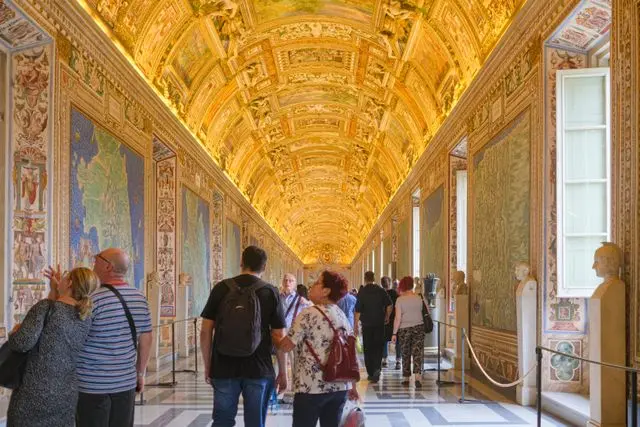
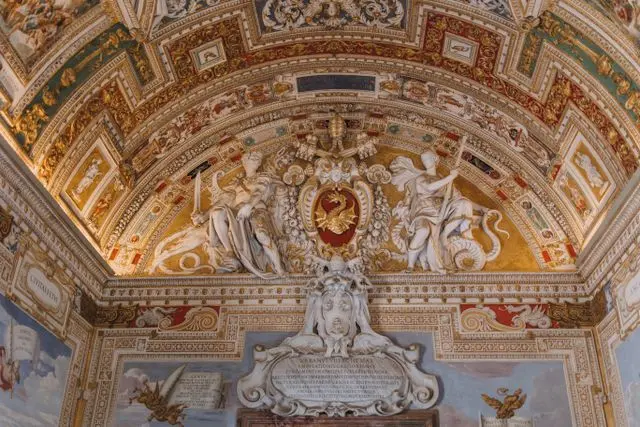
A 120-meter corridor lined with 40 large frescoed maps of Italy's regions, commissioned in the late 16th century. The gilded, vaulted ceiling above the maps is itself considered one of the museum's finer decorative achievements.
Sistine Chapel
The final stop on the standard museum route and the most visited single space in the complex, discussed in detail as a highlight below.
Notable Highlights
- The Sistine Chapel ceiling - Michelangelo's frescoed ceiling, painted between 1508 and 1512, depicting scenes from Genesis including the Creation of Adam
- The Last Judgment - Michelangelo's altar wall fresco in the Sistine Chapel, completed between 1534 and 1541 for Pope Paul III
- Laocoön and His Sons - a dramatic marble sculpture depicting a Trojan priest and his sons attacked by sea serpents, discovered in 1506
- The School of Athens - Raphael's fresco in the Room of the Segnatura, portraying classical philosophers gathered in an idealized setting
- Apollo Belvedere - a Roman marble copy of a Greek bronze original, among the most influential sculptures in Western art history
- Gallery of Maps - a monumental corridor of frescoed Italian regional maps and gilded ceiling decoration
Ways to Experience It
Most visitors follow the museum's fixed one-way route, which winds through the various collections before ending at the Sistine Chapel. The full route can take anywhere from two to six hours depending on pace and how many side galleries a visitor chooses to explore.
- Standard self-guided entry with an included or optional audio guide
- Small-group guided tours led by licensed guides, often combined with St. Peter's Basilica
- Early-access or "before closing" tours that enter before the general public or stay after doors close to the wider public
- Private tours offering flexible pacing and direct access to specific galleries
- Combined tickets that pair the Vatican Museums with the Vatican Gardens or St. Peter's Basilica dome
Best Time to Visit
The Vatican Museums draw large crowds year-round, but timing still makes a noticeable difference. Early morning entry, ideally at opening, tends to offer the thinnest crowds before large tour groups arrive later in the day.
- Weekday mornings are generally quieter than weekends
- Wednesdays can be busier around the city due to the Papal Audience, though this affects St. Peter's Square more than the museums directly
- The last Sunday of each month offers free admission, which draws significantly larger crowds
- Late spring, summer, and the run-up to major religious holidays are the busiest seasons overall
- Late afternoon entry, when offered, can be a quieter alternative to early morning
Visitor Tips
- Book tickets online in advance; walk-up lines can extend for hours during peak season
- Dress modestly with shoulders and knees covered, as the dress code is strictly enforced before entering the Sistine Chapel
- Photography without flash is generally permitted in most galleries, but photography is prohibited inside the Sistine Chapel
- The route is largely one-directional and involves significant walking, so comfortable shoes are worth prioritizing
- Food options inside the complex are limited to a cafeteria-style café, so plan meals accordingly
- Confirm current opening hours, ticket prices, and any temporary gallery closures on the official Vatican Museums website before visiting, as these details change periodically
Nearby Attractions
The Vatican Museums sit within easy walking distance of several other major sights in Vatican City and the surrounding Borgo district, making it straightforward to combine a visit with other landmarks in the same day.
- St. Peter's Basilica and St. Peter's Square, a short walk from the museum exit
- The dome of St. Peter's Basilica, climbable for panoramic views over Rome
- Castel Sant'Angelo, a fortress and museum along the Tiber River
- The Borgo district, known for restaurants and shops just outside Vatican City's walls
Frequently Asked Questions
What is the Vatican Museums famous for? +
It's best known for the Sistine Chapel, home to Michelangelo's ceiling and Last Judgment fresco, along with a vast collection of classical sculpture, Renaissance painting, and Raphael's frescoed rooms.
How much time should I plan for a visit? +
Most visitors spend two to four hours on the standard route, though art enthusiasts or those taking a guided tour often spend closer to five or six hours to see everything at a relaxed pace.
Do I need to book tickets in advance? +
Yes, advance online booking is strongly recommended, since walk-up lines can stretch for hours, especially during peak season and around major holidays.
Is admission ever free? +
The Vatican Museums offer free entry on the last Sunday of every month, though this also means significantly larger crowds than a typical paid-entry day.
What is the dress code? +
Shoulders and knees must be covered, and shorts, sleeveless tops, and revealing clothing are not permitted, particularly for entry into the Sistine Chapel; guards enforce this strictly with no exceptions.
Can I take photos inside? +
Non-flash photography is generally allowed throughout most of the museum galleries, but photography is prohibited inside the Sistine Chapel itself.
Is the Vatican Museums suitable for children or visitors with mobility needs? +
The route involves considerable walking and some stairs, though wheelchair-accessible paths and elevators are available in parts of the complex; families with young children may want to pace visits around nap and meal times given the route's length.
What should I combine with a Vatican Museums visit? +
St. Peter's Basilica and Square sit just a short walk away and pair naturally with a museum visit, and many combined tickets or guided tours bundle the two together in a single day
What's a common mistake first-time visitors make? +
Underestimating the length of the route and rushing early galleries only to feel rushed again at the Sistine Chapel; pacing time evenly, or prioritizing personal must-see sections in advance, helps avoid this.