
Table of Contents
Overview
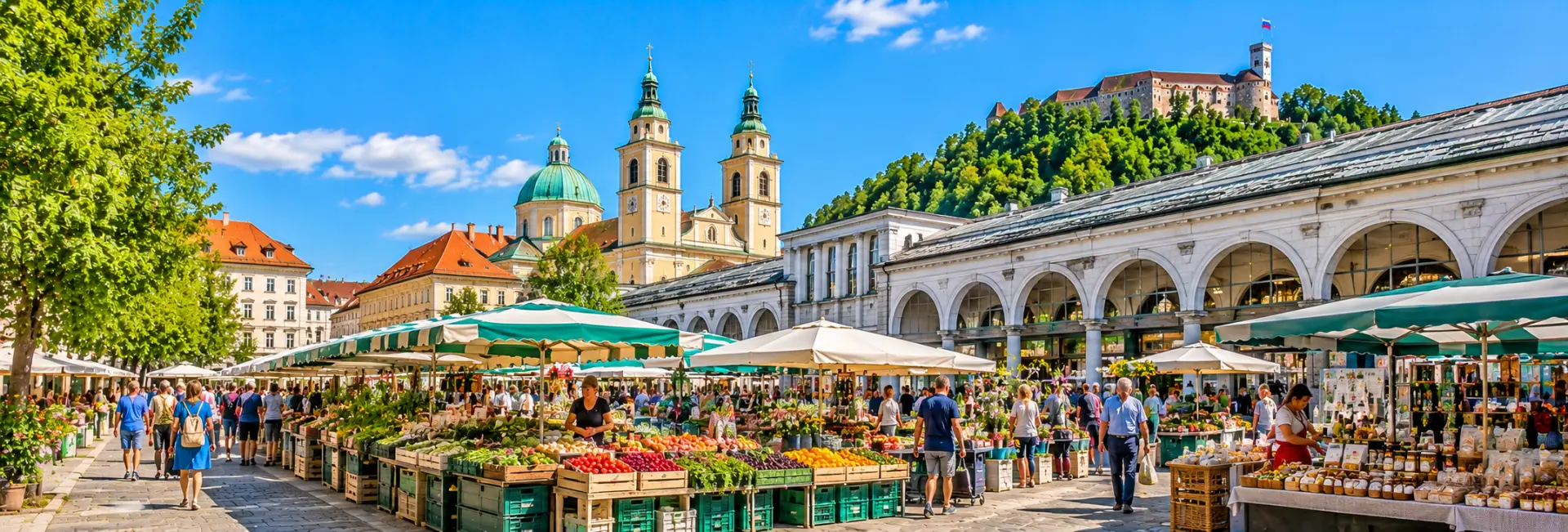
Ljubljana's Central Market is where the Slovenian capital does its everyday shopping, and it has been doing so for well over a century. Stretched along the right bank of the Ljubljanica River between the Triple Bridge and the Dragon Bridge, it brings together open-air stalls, covered halls and a long riverside colonnade in one continuous ribbon of food, flowers and conversation.
What separates it from most European markets is its architecture. The riverside halls were designed by Jože Plečnik, the architect who reshaped so much of central Ljubljana in the first half of the twentieth century, and they now form part of a UNESCO World Heritage listing. People come for the produce, but plenty of them linger for the curving arcades, the views across the water and the chance to watch a working city go about its morning.
The market is not a single building but a connected set of spaces. Open-air stalls fill Vodnikov trg and Pogačarjev trg, a covered hall sits between the two squares, and Plečnik's two-storey halls follow the curve of the river. Together they make a place that is as useful for locals buying lunch ingredients as it is rewarding for visitors who simply want to wander.
History
From College Grounds to Market Square
For a long time the land around today's Vodnikov trg was occupied by religious institutions, including a monastery and a diocesan college. The devastating earthquake of 1895 left those buildings beyond repair, and once the rubble was cleared the open ground began to host outdoor trading.
The city briefly considered other uses for the site, among them a new town hall. That idea faded when officials concluded that the old meat market halls on the nearby embankment no longer met hygiene requirements. A modern, purpose-built market became the priority instead.
Plečnik Takes Charge
Jože Plečnik was brought in to shape the new market, and his design work ran from 1931 through the end of that decade. Construction began in 1940 and was completed within the first half of the 1940s, so the halls rose during the Second World War. When they opened, the riverside building covered around 1,876 square metres.
Plečnik treated the project as more than a place to sell vegetables. He wanted the market to feel like a civic stage on the river, a setting where daily trade and public life could share the same elegant space.
The Bridge That Waited
His original vision included a monumental covered bridge that would have filled the gap between the two market halls and linked the market to the opposite embankment. It was never built in his lifetime. In July 2010 the Butchers' Bridge was inaugurated nearby, and it is often read as a belated answer to that old idea.
Over the decades the market has stayed in continuous use, which is a large part of its appeal. It is a heritage site, but it has never become a museum piece.
Recognition / Status
The market carries two layers of protection and prestige. On the national level, the market and Vodnik Square are recognized as cultural monuments of national significance. On the international level, the market is one of the components of a serial UNESCO World Heritage listing that celebrates Plečnik's work in Ljubljana.
- The listing is titled "The works of Jože Plečnik in Ljubljana - Human Centred Urban Design" and was inscribed in 2021 at the 44th session of the World Heritage Committee.
- It was recognized under cultural criterion (iv), which is awarded to outstanding examples of a type of building or architectural ensemble that illustrates an important stage in human history.
The designation also says something about the philosophy behind the work. Plečnik shaped the city around the scale of the walking person, and the market is one of the clearest places to see that idea in daily use.
Architecture and Design
A Plan That Follows the River
Instead of imposing a rigid block on the embankment, Plečnik let the Ljubljanica dictate the shape. The market was conceived as a two-storey range of halls that bends with the river, so the building feels like part of the waterfront rather than a barrier to it. Walking its length means following a gentle curve, with new views opening at every few steps.
Light, Shelter and Rhythm
The two long faces of the building were handled very differently. On the river side, large semicircular windows draw daylight deep into the halls. On the street side, a colonnade offers a covered promenade that shelters stalls and shoppers from rain and strong sun.
The repeated arches and columns give the market a calm, steady rhythm, and the design shows clear Renaissance influences. The effect is dignified without being heavy, which suits a place that is meant to be used every day.
Details That Reward a Closer Look
- Two open-columned loggias interrupt the building so that people can look through to the river.
- The roof is covered in concrete tiles, a practical choice that reflects the era in which the market was built.
- The lower and upper levels each have their own character, with the fish market and gallery space below and more stalls above.
Key Areas of the Market
Vodnikov Trg
This is the broad open-air heart of the market, named after Valentin Vodnik, an eighteenth-century poet and journalist who helped raise the profile of the Slovene language. Farmers and growers set up here with seasonal fruit and vegetables, along with plants, seedlings and balcony flowers. A flower market also sits where this square meets Pogačarjev trg.
Pogačarjev Trg
The smaller square beside the cathedral continues the outdoor stalls and doubles as the venue for the market's best-known event, the Friday Open Kitchen. Other themed food gatherings and an organic market also take place here at different points in the calendar.
The Covered Hall Between the Squares
Between the two open squares stands a covered market, giving shoppers a sheltered place to browse when the weather turns. It is a practical counterpart to the stalls outside and a good spot for everyday staples.
Plečnik's Riverside Halls
This is the architectural showpiece. The lower level holds the fish market, dried fruit stalls and a small gallery space, along with a modest fish restaurant, while bakery, dairy and meat stalls trade on both levels. At the Triple Bridge end, the colonnade shelters sellers of herbs, spices and handmade crafts.
What to Eat and Buy
The market is an easy way to taste Slovenia without booking a restaurant. Stalls lean heavily on regional and seasonal products, and many vendors are happy to explain what they are selling. Here is a quick guide to what tends to be on offer:
- Fresh fruit and vegetables from local growers, with the selection changing sharply from spring through autumn.
- Dry-cured meats, including Slovenian prosciutto, alongside sausages and other charcuterie.
- Cheeses and honey, which make portable and distinctly local souvenirs.
- Potica, the rolled nut cake that is among the country's best-loved traditional bakes.
- Fish from the lower level of the riverside halls, which is also where a small fish restaurant serves it cooked.
- Dried fruit, herbs and spices for anyone who wants something that travels well in a bag.
- Seasonal forest produce such as mushrooms and berries when they are available.
- Flowers, potted plants and seedlings, many of them sold straight from the growers' stalls.
A good strategy is to graze rather than commit to one meal. Pick up cheese and bread in one hall, a sweet bite elsewhere, and finish with something from the fish counter if you are hungry.
Ways to Experience It
Browse at Your Own Pace
The simplest and often the best approach is to wander. Start at Vodnikov trg, drift through the covered hall, and then follow the colonnade along the river toward the Triple Bridge. There is no ticket and no fixed route, so you can stop whenever something looks interesting.
Open Kitchen on Fridays
From mid-March until the end of October, Pogačarjev trg hosts Open Kitchen, known locally as Odprta kuhna. Chefs from Slovenian restaurants prepare dishes drawn from cuisines around the world, and the square fills with people eating at long tables. The event is cancelled in bad weather, so it is worth glancing at the forecast.
Themed Market Days
Beyond the weekly routine, Pogačarjev trg sometimes hosts thematic and culinary events, such as showcases of rural producers, Italian food gatherings and beer and burger festivals. Dates vary from year to year, so check the current calendar before you plan around one.
Guided and Audio Tours
Walking tours of Ljubljana regularly include the market, either as a stop on a route through Plečnik's creations or as the centrepiece of a food-focused outing. Audio guides offer a lighter alternative for people who prefer to move at their own speed while still learning about the architecture and the neighbourhood.
Best Time to Visit
Time of Day
Morning is the market's natural peak. Stalls are fully stocked, the light pours through the arched windows on the river side, and the mix of regular shoppers and early visitors gives the place its authentic feel. By late afternoon the covered sections wind down, so an early start gives you the full experience.
Day of the Week
The market operates Monday to Saturday and is closed on Sundays and public holidays. Saturday mornings tend to feel especially local, with residents stocking up for the weekend. Friday is the day to choose between mid-March and the end of October, when Open Kitchen turns Pogačarjev trg into a lively open-air food hall.
Season
- Spring brings the first fresh produce, flowers and seedlings, and the start of the Open Kitchen season.
- Summer and early autumn offer the widest range of fruit, vegetables and seasonal forest products, plus the most comfortable weather for eating outdoors.
- Late autumn and winter are quieter. Open Kitchen has finished for the year, but the covered sections remain a cosy place to shop for cheese, cured meats and honey.
Visitor Tips
- Check current opening hours before you go. The open-air stalls and the covered sections do not always keep identical schedules, and hours shift around holidays and in winter.
- Plan for about one to two hours. Allow longer on a Friday when Open Kitchen is running, since queues and the temptation to try several dishes add up.
- Bring a reusable bag. Many stalls sell loose produce, and it is easier to carry cheese, bread and fruit together.
- Ask before photographing vendors or their stock. Most people are friendly about it, but a quick question is good manners.
- Visit the fish market and gallery on the lower level of the riverside halls. They are easy to overlook if you stay on the street side.
- Have a backup plan if rain is forecast on a Friday, because Open Kitchen does not run in bad weather. The covered halls still give you plenty to do.
The official address is Kopitarjeva ulica 2, but the market is spread across several linked squares and arcades. Walking from the Triple Bridge side is the easiest way to take in the whole thing without doubling back.
Nearby Attractions
The market sits in one of the most compact and walkable parts of Ljubljana, so it pairs easily with other sights:
- Triple Bridge and Prešeren Square, just across the river from the market's colonnade, are the traditional starting point for exploring the old town.
- Dragon Bridge, at the opposite end of the market, is one of the city's most photographed crossings.
- Butchers' Bridge, close by, is the modern crossing associated with Plečnik's unrealised idea for the site.
- Ljubljana Cathedral, dedicated to Saint Nicholas, rises beside Pogačarjev trg and is an easy addition to the same stroll.
- Ljubljana Castle overlooks the old town and the market from the hill above, and it rewards the climb with wide views over the rooftops.
- The riverside cafes and restaurants along the Ljubljanica make a natural place to sit down after browsing.
FAQs about visiting Ljubljana Central Market
What is Ljubljana Central Market known for? +
It is the main food market of the Slovenian capital, famous for its local produce and for the riverside halls and colonnade designed by Jože Plečnik. The architecture is part of a UNESCO World Heritage listing.
Who designed the market? +
The architect Jože Plečnik designed the riverside market buildings. He worked on the plans from 1931 through the 1930s, and construction took place in the early 1940s.
Is the market open on Sundays? +
No. The market is closed on Sundays and on public holidays, and it is open the other days of the week. Opening hours can differ between the open-air stalls and the covered sections, so check the current schedule before you visit.
When does Open Kitchen take place? +
Open Kitchen runs on Fridays from mid-March until the end of October on Pogačarjev trg. It is cancelled in bad weather.
How much time should I spend at the market? +
Most visitors are happy with one to two hours. On a Friday during Open Kitchen season, give yourself extra time to eat and soak up the atmosphere.
Do I need a ticket to visit? +
No. Walking through the market is free, and you only pay for the food or goods you choose to buy.
What should I try at the market? +
Look for Slovenian dry-cured meats, local cheeses, honey and potica, and try fish from the lower level of the riverside halls if you want something freshly prepared.
How do I get to the market from the old town? +
It is in the very centre of Ljubljana, so most visitors walk. From Prešeren Square, cross the Triple Bridge and you are at the market within a couple of minutes.
