
Table of Contents
Overview
Prešeren Square, known in Slovene as Prešernov trg, is the central square of Ljubljana and the city's favourite meeting point. It sits on the edge of the Old Town beside the Ljubljanica River, where the modern centre meets the medieval streets. Almost everyone who spends time in Ljubljana passes through it, whether on the way to the castle, the market or the main shopping streets.
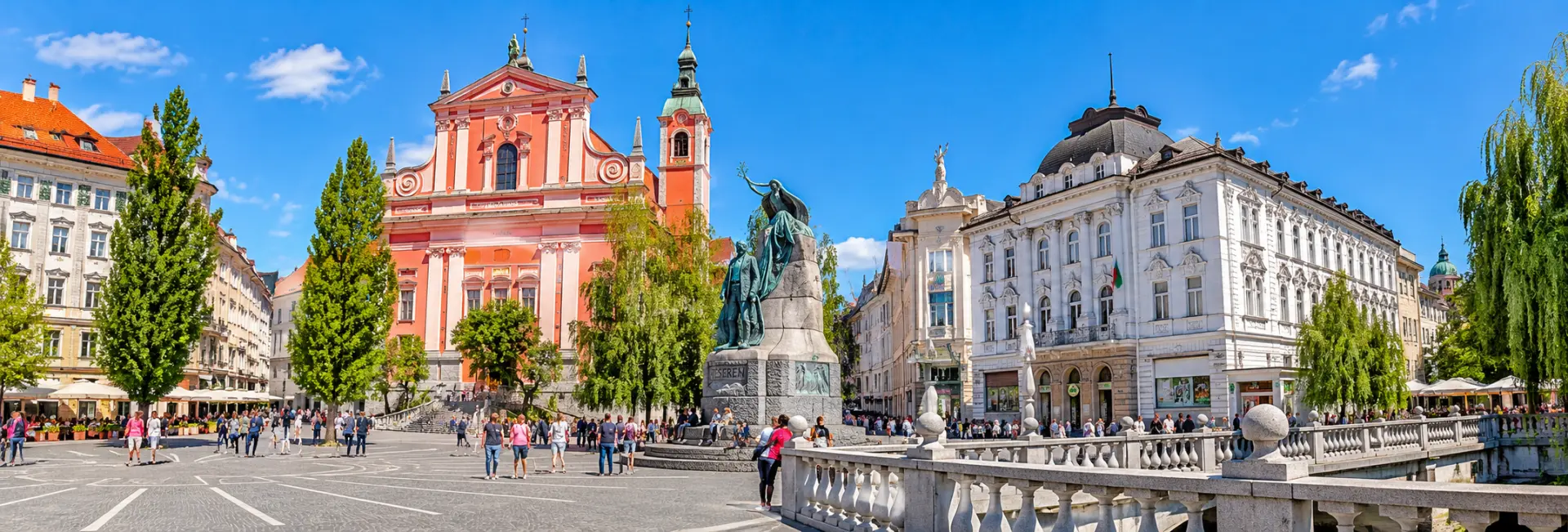
The square takes its name from France Prešeren, the nineteenth-century Romantic poet who is widely regarded as Slovenia's greatest. His monument stands at the centre, and the buildings around it show a rich mix of baroque, Art Nouveau and twentieth-century design. Together they give the square an elegant, well-balanced character, even though it has an irregular shape.
It is a place to linger rather than to tick off a sight. Locals say they will meet under the statue, street performers play at the edges, and in the evening the lights on the Triple Bridge and the pink church facade create a warm, relaxed mood.
History
A Crossroads at the City Gate
The square began as a crossroads near one of the old city gates, where roads from the surrounding region came together. In the seventeenth century the Franciscan Church of the Annunciation was built on its northern side, and for a time the open space in front of it was known as Saint Mary's Square.
From Gate to Public Square
The crossroads was only redesigned and paved as a proper public square in the middle of the nineteenth century, after the city walls were taken down. This was the point at which it began to work as an urban living room, rather than just a junction.
Rebuilding After 1895
The great earthquake of 1895 damaged much of Ljubljana, and the square was largely rebuilt in the years that followed. New townhouses, a pharmacy building and shops appeared around its edges. Early in the twentieth century the Art Nouveau Urbanc House and the refurbished Hauptmann House gave the square its distinctive Secession flavour, and a department store later completed the southern side between the world wars.
Plečnik and the Present Layout
The architect Jože Plečnik reshaped the area around the Triple Bridge in the early 1930s. His additions extended the square across the river and gave it the appearance it has today.
Architecture & Landmarks Around the Square
The Franciscan Church of the Annunciation
The salmon-pink church on the northern side is the most eye-catching building on the square. It dates from the seventeenth century and is a fine example of baroque architecture, with its colour giving the whole space a warm tone. Plečnik later altered the adjoining monastery and added a chapel beneath the church.
The Urbanc House
On the corner of Trubarjeva and Miklošičeva streets, the Urbanc House dates from 1903 and was the first department store in Ljubljana. It is also one of the most graceful Art Nouveau buildings in the city, and it still houses shops today.
The Hauptmann House
Standing diagonally across from the church, the Hauptmann House is another Secession gem from the early twentieth century. Its colourful facade rewards a look upwards, since many of the decorative details sit above the shop windows.
The Central Pharmacy
The Italianate building on the eastern side, known as the Central Pharmacy, was once a cafe frequented by intellectuals in the nineteenth century. It is a reminder that the square has long been a place for conversation and ideas.
Čop Street
A short pedestrian promenade called Čopova ulica leads away from the square towards Slovenska cesta. It is about 205 metres long and is named after Matija Čop, a friend of Prešeren and an important literary figure of his time.
The Prešeren Monument & the Story of Julija
The Monument
The monument was unveiled in 1905, designed by the architect Maks Fabiani with sculpture by Ivan Zajc. It shows the poet, while above him a muse holds a sprig of laurel over his head. The setting, with the statue at the centre of the square, was carefully chosen to make him the focal point of the city.
Who Was France Prešeren?
Prešeren lived from 1800 to 1849 and wrote some of the most celebrated poems in the Slovene language. One of his poems, Zdravljica, provided the verse that became the Slovenian national anthem. His birthplace is in the Upper Carniola region, but his work shaped the cultural identity of the whole country.
Julija Primic
Across the square, on the facade of a building, you will see a figure of Julija Primic, the woman Prešeren loved and who inspired much of his poetry. The statue looks across towards the poet, so that the two seem to gaze at each other for eternity. The romance was never fulfilled in life, which is part of why the story has endured.
A Place of Gathering
Slovenians have long chosen the statue as a place to gather during celebrations and moments of public feeling. If you see crowds here, it is probably more than a simple tourist stop.
The Triple Bridge & Plečnik's Touch
A Crossing Through Time
A bridge has stood at this spot since the Middle Ages, when it was a wooden structure. A stone bridge replaced it in 1842, and that central span, once called Hospital Bridge, still forms the widest part of the crossing.
Plečnik's Additions
In the early 1930s Plečnik added two pedestrian bridges, one on each side of the stone bridge, creating the Triple Bridge seen today. He also replaced the old railings with concrete balusters, giving the whole structure a lighter, more graceful look. The result is one of the most admired pieces of urban design in Slovenia.
Linking the Two Banks
The bridge connects the square to the Old Town and the market on the opposite bank. Plečnik also drew up plans for a colonnade along the southern side of the square, to echo the market on the opposite bank, although many of his proposals for the square were never carried out. Many visitors cross it several times just to enjoy the changing views of the river and the castle.
Events & Local Life
Prešeren Day
Slovenia marks its national day of culture on 8 February, the anniversary of the poet's death. It is a public holiday, and many museums and galleries open their doors with reduced or free admission. The square is a natural focus for ceremonies, guided walks and readings.
Concerts and Celebrations
In the warmer months the square is used for open-air concerts and other public events, and it has traditionally been one of the main venues for New Year's Eve celebrations in the capital. In winter, festive lights and decorations bring extra atmosphere.
Everyday Life
For most of the year, the square is simply a stage for daily life. Students wait for friends, couples meet, buskers play and tour guides gather groups beside the monument. This ordinary rhythm is a large part of its charm.
Ways to Experience It
- Meet someone under the Prešeren statue, as locals do, and watch the square fill and empty through the day
- Walk the Triple Bridge in both directions to see how the views change
- Look up at the Art Nouveau facades of the Urbanc and Hauptmann houses
- Step inside the Franciscan church for a quiet pause
- Join a guided walk, many of which begin near the tourist information centre by the Triple Bridge
- Stroll along Čop Street and the nearby riverside cafes
- Return in the evening to see the square lit up
Best Time to Visit
Time of Day
Early morning is calm and good for photographs, with soft light on the pink church. Midday and early afternoon are busy with visitors, while the early evening brings the liveliest atmosphere, as locals meet after work and the lights come on. After dark the square is quieter but still attractive.
Season
Spring and early autumn have pleasant weather for sitting outside. Summer is the main season for events, concerts and riverside cafes. Winter brings Christmas and New Year lights, and 8 February adds a cultural focus with Prešeren Day.
Weather
Because the square is open, it feels exposed in rain or strong sun. Nearby cafes and shops give shelter when needed.
Visitor Tips
- Treat the square as a starting point and allow about 30 minutes to look around, longer if you stop for a coffee
- The city centre is largely pedestrian, so reach the square on foot, by bicycle or by public transport
- The ground is level and paved, which makes the square easy for wheelchairs and strollers
- Keep an eye on bags and phones in busy periods, as in any popular city meeting place
- Check the local events calendar if you want to catch a concert, a festival or the Prešeren Day programme
- Visit churches with respect and dress modestly when going inside the Franciscan church
- Use the tourist information centre near the Triple Bridge for maps and guided walks
Events, opening hours of shops and church visits can change, so confirm current details locally.
Nearby Attractions
- Triple Bridge: the famous trio of bridges directly beside the square
- Ljubljana Central Market: Plečnik's riverside market on the opposite bank
- Dragon Bridge: an Art Nouveau bridge guarded by dragon sculptures, a short walk away
- Ljubljana Castle: the hilltop fortress reached by funicular from nearby Krek Square
- Ljubljana Cathedral: a baroque church in the Old Town
- Tivoli Park: the large city park on the western edge of the centre
FAQs about visiting Prešeren Square
What is Prešeren Square? +
It is the central square of Ljubljana, named after the poet France Prešeren. It stands beside the Triple Bridge at the edge of the Old Town and is the city's most popular meeting point.
Is there an entrance fee? +
No. The square is a public space and is open at all times. Entry to nearby museums, the castle and some other attractions is paid separately.
Who is the statue in the middle? +
It is France Prešeren, the nineteenth-century Romantic poet widely regarded as Slovenia's greatest. A muse above him holds a laurel sprig, and the monument was unveiled in 1905.
Who is the figure on the building across the square? +
It is Julija Primic, the woman Prešeren loved and who inspired much of his poetry. The figure looks towards the poet's statue.
Why is the church pink? +
The Franciscan Church of the Annunciation has a salmon-pink facade that has become a signature feature of the square. It dates from the seventeenth century and is a baroque building.
How long should I spend there? +
About 30 minutes is enough to look around the square and the Triple Bridge. Allow longer if you want to sit at a cafe, enter the church or join a guided walk.
Is the square suitable for wheelchairs and strollers? +
Yes. The surface is flat and paved, and the area is largely pedestrian.
What happens on Prešeren Day? +
It is Slovenia's national day of culture on 8 February. It is a public holiday, and many cultural venues open with free or reduced entry, with events held across the city.
