
Table of Contents
Overview
Ljubljana Old Town is a compact, car-free district of cobbled lanes, baroque houses and riverside terraces at the foot of Castle Hill. It spreads along both banks of the Ljubljanica River and forms the historic heart of the Slovenian capital. Everything worth seeing here lies within a short walk, which makes it one of the easiest old quarters in Europe to explore.
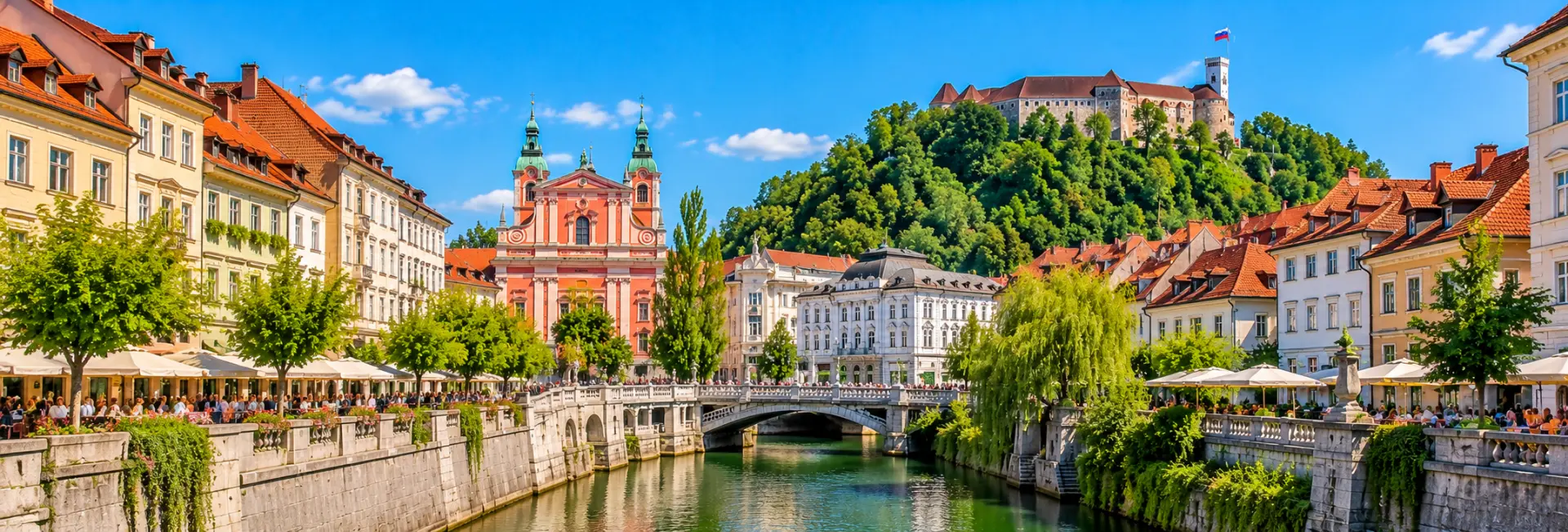
The atmosphere is relaxed rather than monumental. Pastel facades with steep tile roofs line the streets, cafes spill onto the embankments, and a series of elegant bridges links the two sides of the river. The sense of a small, well-kept city comes through at every turn, helped by the fact that the centre has been closed to general traffic since 2007.
The Old Town is also easy to read. It divides into a few distinct areas, each with its own square and character, so you can plan a loop that takes in the main sights in a few hours, or stretch it into a whole day of sitting, strolling and browsing.
History
Roman Emona
The first town in this area was the Roman settlement of Emona, founded in the first century BCE as a fortified camp. Traces of its walls and streets survive in and around the modern centre, and they remind visitors that the site has been inhabited for two thousand years. After the Roman period the settlement declined, and a medieval town grew up in a different spot, below the castle.
The Medieval Town
From the twelfth century the squares along the left bank of the river, notably Town Square, were important centres of medieval life. In 1335 the town became the capital of Carniola, the province that included much of present-day Slovenia, and its role as a regional centre grew steadily under the Habsburgs.
Earthquakes and Baroque Rebuilding
An earthquake in 1511 destroyed much of the medieval fabric on Town Square, and the buildings that replaced it were Renaissance and then baroque in style. Most of the historic buildings seen today date from the seventeenth and eighteenth centuries, including the Town Hall and the cathedral. A second severe earthquake in 1895 led to another wave of rebuilding, which brought Art Nouveau architecture to the city.
The Illyrian Provinces
For a short period from 1809 to 1813, Ljubljana was the capital of the Illyrian Provinces under Napoleonic rule. The city later returned to Habsburg control and became increasingly modern, with a railway link to Vienna and Trieste arriving in 1849.
Modern Times
In the twentieth century the architect Jože Plečnik reshaped much of the riverside, adding bridges, a market and public spaces. In 2007 the centre was closed to cars, and the Old Town gradually turned into the pedestrian-friendly district it is today.
Architecture & Streetscape
Baroque Houses and Tile Roofs
The dominant look is baroque. Houses with coloured facades, narrow frontages and steeply pitched tile roofs line the streets, many with decorative portals and small balconies. They sit close together and follow the curve of the river, which gives the lanes their winding, intimate quality.
Secession and Neoclassical Touches
Scattered among the baroque buildings are examples of Secession, neoclassical and modern design. The effect is a pleasing contrast, as white or pale facades appear between the older, more colourful ones. Many of these buildings were built after the earthquake of 1895.
Cobbles and Squares
The ground is paved in cobbles in several of the older streets, particularly towards the castle. The district is a sequence of linked squares, each opening naturally onto the next, so the walk feels like moving through a series of outdoor rooms.
Riverside Layout
The Ljubljanica River runs through the middle of the Old Town, and the embankments on both sides are lined with cafes and restaurants. The water is often described as a deep green, and it provides a calm backdrop that unifies the area.
Key Squares & Landmarks
Town Square (Mestni trg)
The first of the Old Town's three connected squares is dominated by the Town Hall, which dates from the late fifteenth century and was rebuilt in the early eighteenth. In front of it stands a copy of the Robba Fountain, also called the Fountain of the Three Carniolan Rivers. The sculptor Francesco Robba created it between 1743 and 1751, and its allegorical figures represent the Ljubljanica, the Sava and the Krka. The original is kept in the National Gallery. You can enter the Town Hall courtyard, which often holds free exhibitions.
Old Square (Stari trg) and Upper Square (Gornji trg)
The streets continue south into Old Square and then Upper Square, which run towards the foot of Castle Hill. They are quieter and more traditional, with small shops, craft workshops and antique dealers. From here a cobbled path climbs towards the castle for those who prefer to walk.
Ljubljana Cathedral
The Cathedral of Saint Nicholas stands just east of Town Square. Construction began in 1701, and the church is known for its green dome and twin towers. Its interior is decorated with frescoes by Giulio Quaglio showing scenes from the life of Saint Nicholas, patron saint of seafarers.
New Square (Novi trg) and Congress Square
On the right bank, New Square belonged to a separate part of the city that was enclosed by walls in the fourteenth century. It is home to the National and University Library, widely regarded as one of Plečnik's finest works. Nearby, Congress Square takes its name from the Congress of the Holy Alliance held in 1821, and it remains one of the main public spaces of the capital.
The River & Plečnik's Ljubljana
A City Shaped by One Architect
Few European capitals bear the stamp of a single architect as strongly as Ljubljana does. Plečnik reworked the Old Town's edges and riverbanks from the 1920s onwards, designing bridges, colonnades, stairways and public squares. His work is so extensive that parts of it were later recognised on the UNESCO World Heritage List.
The Bridges
- Triple Bridge: the fan-shaped trio of bridges that links Prešeren Square to the Old Town
- Dragon Bridge: an Art Nouveau crossing from 1901, guarded by four copper dragons
- Butchers' Bridge: a modern pedestrian crossing by the market that carries the name of an earlier bridge
- Cobblers' Bridge: another small Plečnik crossing upstream
The Central Market
The riverside colonnades and the open-air market along the left bank are part of the same Plečnik programme. They give the Old Town one of its liveliest daily scenes, with fresh produce, flowers and local products on sale in the morning.
Culture & Local Life
The Dragon of Ljubljana
The dragon is the symbol of the city and appears on the coat of arms, on bridges and in many shop windows. Legend says it was slain by Jason and the Argonauts in the marshes near the city, and the creature has remained a friendly local mascot ever since.
Cafes and Dining
The riverside is lined with cafes and restaurants, many with outdoor tables. In warm weather they fill with people from lunchtime until late evening, and the embankments become a long, informal promenade.
Events and Seasons
The Old Town hosts concerts, markets, festivals and seasonal celebrations through the year. In winter the streets are decorated with lights, and in summer the squares and riverbanks serve as open-air stages. Check the local events calendar if you want to time your visit around something specific.
A Lived-in Centre
Although it is popular with visitors, the Old Town remains an everyday meeting place for residents, students and office workers. This mix of local and visitor life is a large part of what keeps it feeling authentic.
Ways to Experience It
- Follow a self-guided loop: Prešeren Square, the Triple Bridge, Town Square, Old Square and back along the river
- Join a guided walking tour, many of which begin near the tourist information centre by the Triple Bridge
- Take a river cruise to see the bridges and embankments from the water
- Ride the funicular or walk up to the castle for the best view over the rooftops
- Browse the market and crafts stalls along the left bank
- Stop for a coffee or a meal on the riverside
- Walk the area again in the evening, when the lamps and reflections change the mood
Best Time to Visit
Season
Late spring and early autumn are especially pleasant, with mild weather and manageable crowds. Summer is the liveliest time, with outdoor terraces and events, but also the busiest. Winter brings festive lights and a quiet atmosphere, though days are short and the weather can be cold.
Time of Day
Mornings are calm and ideal for photography and for browsing the market. The afternoon brings the biggest crowds around the bridges and the main squares, and the evening has a relaxed, social feel, with cafes full and the lights reflected in the river.
Weather
Rain is possible at any time of year. Cobbles can be slippery when wet, but cafes and shops along the way offer plenty of places to take shelter.
Visitor Tips
- Plan to explore on foot, as the centre is pedestrianised and restricted to most vehicles
- Wear comfortable shoes, since some streets, especially near the castle, are cobbled and uneven
- Allow two to three hours for a relaxed loop, and more if you plan to visit the castle or the cathedral
- Use the tourist information centre near the Triple Bridge for maps, tours and event listings
- Walk the riverside rather than staying only on the main streets, as the best views and cafes are on the embankments
- The main squares are fairly level, but the streets leading up to the castle slope steadily
- Take care with belongings in busy areas, as in any popular city centre
- Respect the residents, since many people live above the shops and cafes
Opening times, events and rules for the pedestrian zone can change, so check local information before you go.
Nearby Attractions
- Ljubljana Castle: the hilltop fortress above the Old Town, reached by funicular from Krek Square
- Prešeren Square: the main square of the city, beside the Triple Bridge
- Central Market: the open-air market and colonnades along the river
- Congress Square and the National and University Library: a short walk across the river
- Tivoli Park: a large green space on the western edge of the centre
- Emona Roman remains: fragments of the ancient town, scattered around the modern centre
FAQs about visiting Ljubljana Old Town
What is Ljubljana Old Town known for? +
It is known for its baroque squares, riverside cafes, Plečnik bridges and its position below the castle. The whole district is pedestrianised, which makes it easy and pleasant to explore on foot.
Is Ljubljana Old Town free to enter? +
Yes. It is an open public district with no entry fee. Paid admission applies only to specific attractions, such as the castle and some museums.
How long do I need in the Old Town? +
Two to three hours is enough for the main squares, bridges and riverside. A full day lets you add the castle, the market and a leisurely lunch.
Can I drive into the Old Town? +
Access is restricted, since the city centre has been closed to general traffic since 2007. It is best to arrive on foot, by bicycle or by public transport.
What are the main squares? +
The main squares are Town Square, Old Square and Upper Square on the left bank, and New Square and Congress Square on the right bank. Prešeren Square lies at the edge, beside the Triple Bridge.
Where is the Robba Fountain? +
It stands in front of the Town Hall on Town Square. The fountain you see today is a copy, and the original is kept in the National Gallery.
Is Ljubljana Old Town suitable for wheelchairs and strollers? +
The main squares and riverside paths are mostly level, so many areas are manageable. Cobbled streets, particularly near the castle, can be uneven and steep.
What is the best way to see the castle from the Old Town? +
You can ride the funicular from Krek Square, which takes about a minute, or walk up a cobbled path from Upper Square. Both give good views over the rooftops.
