
Table of Contents
Overview
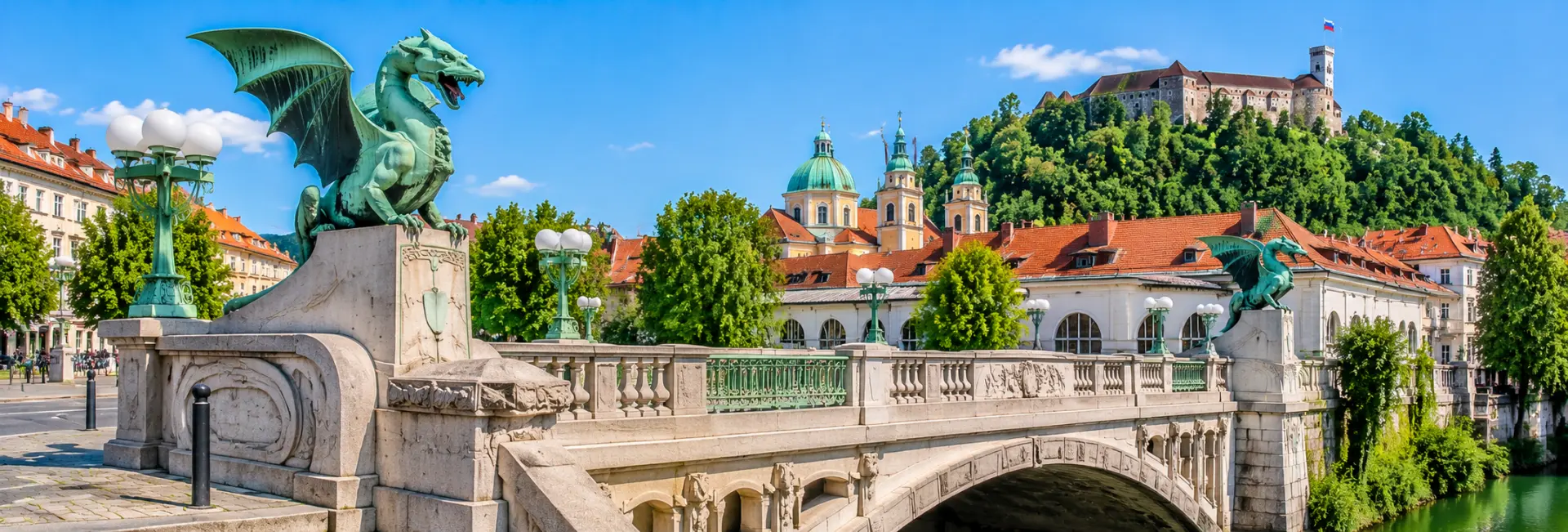
The Dragon Bridge, known in Slovene as Zmajski most, is one of the best-loved landmarks in Ljubljana. It crosses the Ljubljanica River just north of the central market, on the edge of the Old Town, and it is guarded by four fierce copper dragons that have become an emblem of the city.
The bridge opened in 1901 and was a modern engineering achievement for its time. It is built of reinforced concrete in the Vienna Secession style, which is the Austrian version of Art Nouveau, and it was among the earliest bridges of its kind in Europe. Its sweeping arch and decorative details make it as interesting for architecture fans as for anyone chasing a good photograph.
Most visitors pass over it while walking between the market and the neighbourhoods across the river. It takes only a few minutes to see properly, but the dragons, the stories and the setting give it more charm than its size suggests.
History
The Butchers' Bridge
The crossing here was originally an oak bridge called the Butchers' Bridge, or Mesarski most, built in 1819. Its name points to the butchers who traded in this part of the city, and it served as an everyday link across the river for many years.
The 1895 Earthquake
In 1895 a major earthquake struck Ljubljana, and it damaged the old wooden bridge beyond repair. The disaster became the starting point for a large programme of rebuilding and modernisation, in which the city replaced damaged structures with more up-to-date ones.
A New Bridge for the Emperor
The city's mayor, Ivan Hribar, commissioned a new bridge. It was originally named the Jubilee Bridge of Emperor Franz Joseph I, in honour of the long reign of the Austro-Hungarian monarch. The name did not stick. Locals soon began calling it the Dragon Bridge, and that is the name it has carried ever since.
A City Rebuilt
The earthquake affected roughly a tenth of the city, and the response went far beyond fixing damaged buildings. Streets, squares and bridges were redesigned in the fashionable styles of the day, and the Dragon Bridge was one of the first and boldest examples. It showed that the rebuilt Ljubljana intended to look forward, using the newest materials and techniques rather than simply copying what had stood before.
Opening and Later Care
Work took place between 1900 and 1901, and the bridge opened in 1901. It was renovated in 1983 and 1984, when parts of the structure were repaired using lightweight concrete. Today it carries road traffic as well as pedestrians, although the area around it is pleasant to walk in.
Architecture & Engineering
A Pioneer in Reinforced Concrete
The Dragon Bridge was the first reinforced concrete bridge in Ljubljana and one of the earliest in Europe. It was built using the Melan system, a method devised by the engineer Josef Melan in which iron arches are embedded within concrete. The technique allowed a graceful, wide arch with far less material than a traditional stone bridge would need.
Why the Method Mattered
Building in reinforced concrete was still a new idea at the start of the twentieth century. Engineers valued it because it could span wide gaps, resist heavy loads and last for a long time without the constant repairs that timber needed. For Ljubljana, which had just seen a wooden bridge fail in an earthquake, a solid arch of concrete and iron was an especially persuasive answer. When it was finished, the bridge's arch was counted among the larger ones in Europe.
Vienna Secession Style
The decorative design was the work of the architect Jurij Zaninović, who had studied under the famous Viennese architect Otto Wagner. His approach combined clean structural forms with ornamental details such as reliefs, lamps and sculpture. The result shows how a practical engineering project could also be a work of art.
The Setting
The bridge connects two busy parts of the centre. Between Kopitar Street and Ressel Street, it sits at the end of the open-air market, so the view along the river is lined with stalls, colonnades and cafe tables. From the middle of the bridge you can also look back towards the Triple Bridge and the castle on its hill.
The Dragons
Four Copper Guardians
The four dragons are the bridge's signature feature. They sit on pillars at both ends of the crossing, two on each side, with their wings spread and their mouths open. They were made of copper, and their green patina gives them an old, weathered look that suits the setting.
A Change of Plan
The dragons were not part of the first idea for the decoration. One account says that winged lions were originally planned, and the dragons were chosen instead because of their link to the city's identity. The decision worked, since the dragons soon became the main reason people came to look at the bridge.
More Dragons to Find
Look closely at the lamp posts and other details along the bridge, where smaller dragon figures decorate the ironwork. You can also spot the dragon on Ljubljana's coat of arms, above the castle, and flying on flags across the city.
Legends & Local Lore
Jason and the Argonauts
According to legend, the hero Jason and his companions, the Argonauts, passed through this region on their way home with the Golden Fleece. They came upon a dragon living in the marshes near Ljubljana, and Jason slew it. The story ties the city's founding to Greek mythology and explains why the dragon became its symbol.
The Longer Version
In fuller tellings of the tale, the dragon attacked the travellers' camp, and Jason found its lair with the help of Medea, who cast a sleeping spell over the beast. Jason then killed it, and the settlement that grew in the area was later said to have been founded by the Argonauts. Historians treat it as myth, but it gives the city a colourful origin story that residents are happy to share.
The Tail-Wagging Tale
A popular modern joke says the dragons wag their tails whenever a virtuous young woman crosses the bridge. Nobody claims to have seen it happen, but locals still tell the story, and many visitors watch the dragons with a smile as they walk past.
A Symbol of the City
Beyond the legends, the dragon stands for strength and protection. It appears throughout Ljubljana, from souvenir shops to civic buildings, and the Dragon Bridge is the place where the symbol is most easily seen in sculpture. Standing between the dragons is a very Ljubljana kind of photograph.
Ways to Experience It
- Walk across the bridge slowly and look at each of the four dragons from different angles
- Stand on the riverbank to see the arch and the reflection in the water
- Combine the visit with the central market, which lies right beside the bridge
- Take a river cruise, since boats pass beneath the arches and give a fresh view of the sculptures
- Follow the riverside path towards the Triple Bridge for a pleasant stroll
- Look out for the smaller dragon details on the lamps and railings
Photographing the Dragons
The dragons look best from a slight angle, so that you can see both the sculpture and the curve of the bridge behind it. Try stepping onto the riverbank for a low view of the arch, or standing at the far end of the bridge to frame a dragon against the market and the Old Town skyline. Overcast light often shows the green patina best, while strong midday sun can flatten the details.
Best Time to Visit
Time of Day
Early morning is the quietest time, with soft light on the copper and almost no crowds. Midday brings the busiest period, as market shoppers and tour groups overlap. In the evening the lamps come on and the bridge takes on a warmer atmosphere, although the dragons are harder to photograph in low light.
Season
The bridge can be enjoyed all year. Spring and summer have the liveliest atmosphere, with cafes and stalls busy along the river. Autumn gives gentle light and fewer visitors, and winter brings festive lights to the nearby streets and a quieter, crisper feel.
Market Days
The market beside the bridge adds colour to the surroundings when it is busy, particularly in the morning. If you prefer clear, uncluttered photographs, aim for a time when fewer stalls are open.
Visitor Tips
- There is no entrance fee, and the bridge is open to pedestrians at all times
- Allow about 10 minutes to see the bridge itself, and longer if you stop at the market
- Take care when crossing, as the bridge carries road traffic and the pavements can be busy
- Stand to the side when taking photos so other people can pass
- The crossing is level and generally easy for wheelchairs and strollers, although pavements can be narrow in places
- Keep an eye on your belongings in busy periods, as in any popular tourist area
- Pair the visit with a walk along the river to make the most of the setting
Market days and local events change, so check current information if you are planning around them.
Nearby Attractions
- Ljubljana Central Market: the riverside market and colonnades right next to the bridge
- Triple Bridge: the famous trio of bridges, a short walk upstream
- Prešeren Square: the main square of the city, with the poet's monument and the pink Franciscan church
- Ljubljana Cathedral: a baroque church close to the market
- Ljubljana Castle: the hilltop fortress reached by funicular from nearby Krek Square
- Butchers' Bridge: a modern pedestrian bridge that carries the old name of the earlier crossing
FAQs about visiting the Dragon Bridge
What is the Dragon Bridge? +
It is an Art Nouveau bridge over the Ljubljanica River in Ljubljana, opened in 1901. It is guarded by four copper dragons and is one of the city's best-known landmarks.
Why is it called the Dragon Bridge? +
It is named after the dragon sculptures at both ends of the bridge. The original name was the Jubilee Bridge of Emperor Franz Joseph I, but locals began calling it the Dragon Bridge and the name stuck.
Why is the dragon a symbol of Ljubljana? +
Legend says Jason and the Argonauts slew a dragon in the marshes near the city. The dragon later appeared on the city's coat of arms and became its emblem.
Who designed the Dragon Bridge? +
The structure was built using the Melan system, devised by the engineer Josef Melan. The architectural design was by Jurij Zaninović, a student of Otto Wagner.
Is there an entrance fee? +
No. It is a public bridge and can be crossed at any time of day.
How long should I spend there? +
About 10 minutes is enough for the bridge itself. If you also want to explore the market and the riverside, allow around half an hour.
Is it close to the Triple Bridge? +
Yes. The Dragon Bridge is a short walk downstream from the Triple Bridge, along the riverside by the central market.
Is the Dragon Bridge accessible for wheelchairs? +
The crossing is level and generally manageable for wheelchairs and strollers. The pavements can be narrow and busy at peak times.
