
Table of Contents
Overview
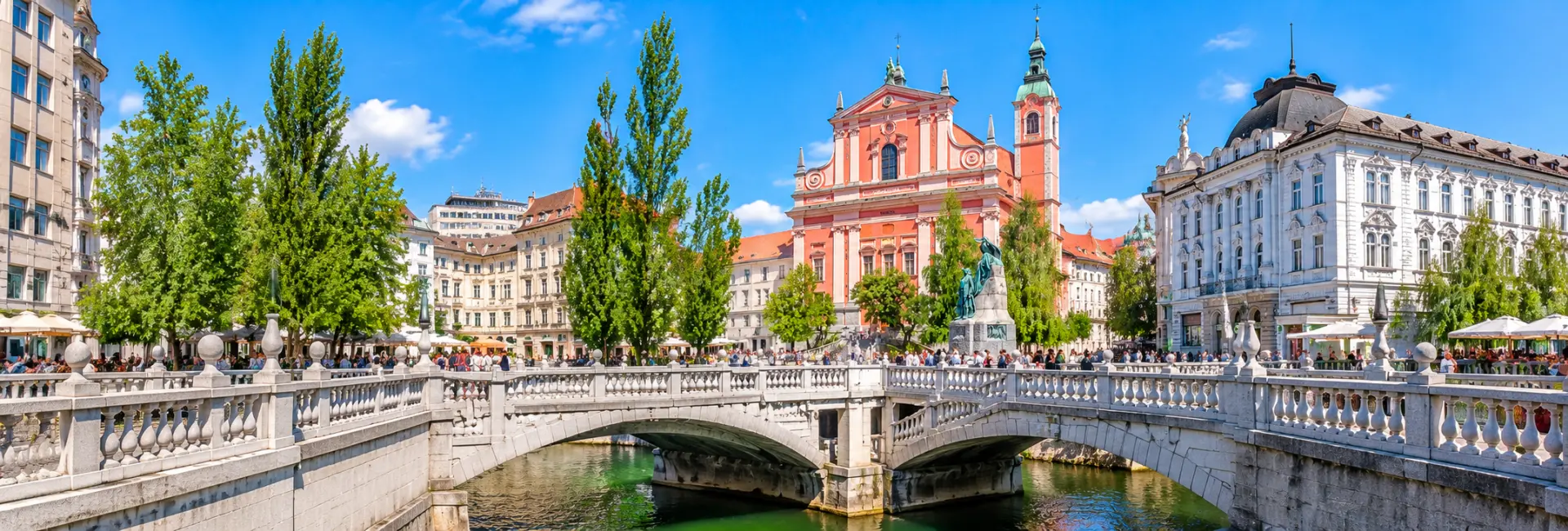
The Triple Bridge, called Tromostovje in Slovene, is a group of three bridges that cross the Ljubljanica River in the middle of Ljubljana. It links Prešeren Square on the northern bank with the medieval streets and the market on the southern side, and it is probably the single most recognisable piece of urban design in Slovenia.
What makes it unusual is its fan-like shape. A central stone bridge for general traffic is flanked by two slim pedestrian bridges that angle outwards, so that people arriving from the square are gently guided into the Old Town. The ensemble is closely linked with the architect Jože Plečnik, who reshaped the crossing in the early 1930s and gave Ljubljana much of its distinctive character.
The bridge is a public crossing rather than a ticketed sight. Most visitors cross it several times during a stay, and it makes a natural starting point for exploring the city on foot.
History
A Medieval Crossing
A bridge has stood at this spot for many centuries. The first written mention of a wooden bridge here dates from around 1280, when it was known as the Old Bridge. After a second crossing appeared further upstream, this one became the Lower Bridge. It stood on a strategic route that connected the lands of north-western Europe with the Balkans and south-eastern Europe.
The Hospital Bridge
The crossing was also called the Špital, or Hospital, Bridge after a poorhouse founded nearby in the early fourteenth century. The wooden bridge was destroyed by fire and rebuilt in 1657, but by the nineteenth century it was in poor repair.
The Stone Bridge of 1842
In 1842 the Italian architect Giovanni Picco designed a new masonry bridge with two arches to replace it. It opened on 25 September 1842 and was named Franz's Bridge after Archduke Franz Karl of Austria. This stone bridge forms the central span of the Triple Bridge today, and it survived the great earthquake of 1895 without damage.
A Bottleneck in the Making
By the late 1920s the bridge had become a bottleneck, as cars, carts and a tram line all competed for a narrow crossing. Plečnik was asked to solve the problem in 1929, and rather than widening the old bridge, he came up with a very different answer.
Plečnik's Solution
Construction began in 1931 and continued until spring 1932, when the bridge reopened to traffic. Plečnik added two footbridges, one on each side of the stone bridge, and gave all three a common design language. The ensemble was renovated in 1992, and since 2007 the area around it has been part of the city's pedestrian zone.
Architecture & Design
Why Not Simply Widen the Old Bridge?
Widening the 1842 bridge would have been the obvious answer, but it would have sacrificed a historic structure and produced a wide, heavy deck that dominated the river. Plečnik preferred to keep the old bridge as the centre of the composition and to add light pedestrian crossings beside it. The result separated people from vehicles, relieved the congestion caused by trams and cars, and kept the old stone arches visible.
The Fan Shape
The side bridges open outwards like a fan, which turns the crossing into a small public square above the water. This arrangement takes the pressure off the central roadway and lets pedestrians move freely and slowly. It also sets up a clear sense of arrival as you approach the Old Town from the north.
Materials
The central bridge is built partly of local limestone, while the added sections are made of reinforced concrete. Plečnik covered all three bridges with a continuous balustrade made of 642 artificial stone balusters, which gives them a unified, almost classical appearance. He removed the old metal railing from the 1842 bridge to bring it into line.
Proportions and Rhythm
Because the side bridges are slim and the balustrade is repeated without interruption, the three crossings read as one gentle curve rather than three separate structures. The even rhythm of the balusters adds a sense of calm, which suits a spot where large numbers of people pass through every day.
A Mediterranean Mood
Plečnik wanted to give Ljubljana a southern, Mediterranean feeling, and the stairways and balustrades show it clearly. The pairs of steps that drop from the side bridges to the river terraces resemble the bridges of Venice, and the lamps and balusters add a touch of old Italian elegance.
Part of a Larger Plan
The bridge is a key crossing point between two of Plečnik's urban axes in the city. One follows the river, while the other connects the Rožnik hill to the castle. The Triple Bridge sits right where the two lines meet, which helps explain why it feels so central.
Details Worth a Closer Look
The Balustrades and Lamps
Take a moment to run your eye along the stone balustrade, which repeats the same shape hundreds of times. Plečnik also placed lamp posts along the bridges, and they give the crossing a gentle glow in the evening.
The Riverside Stairways
From each side bridge, two staircases lead down to terraces just above the water. Poplar trees were planted along these terraces, and their tall crowns frame the bridge from below. It is worth walking down to see the arches and the river from this lower level.
The Kiosks and the Market Link
On the southern bank, a flower stall stands at the entrance to the market area, while on the opposite side there is a small kiosk. These small structures belong to Plečnik's plan, and they tie the bridge to the market colonnades that run along the riverside.
Views From the Bridge
- North: the pink Franciscan church and the open space of Prešeren Square
- South: the Old Town streets, the cathedral and the castle on its hill
- Up and down the river: terraces, cafes and the arches of nearby bridges
Recognition / Status
The Triple Bridge is part of a group of works by Plečnik in Ljubljana that UNESCO added to the World Heritage List in 2021, under the title The works of Jože Plečnik in Ljubljana - Human Centred Urban Design. The inscription recognises how his projects shaped the capital as a whole, including bridges, squares, markets, parks and public buildings.
Within that group, the Triple Bridge is probably the best-known element. It is often described as a symbol of the city, alongside the castle and the dragon.
Ways to Experience It
- Cross the bridge slowly in both directions, using the side bridges and the central one
- Walk down to the riverside terraces for a view of the arches from below
- Join a guided walking tour, as many start near the tourist information centre by the bridge
- Take a river cruise from the nearby embankment to see the bridge from the water
- Sit at a cafe along the river and watch people cross
- Photograph the bridge at sunrise or after dark, when the lamps are lit
- Follow Plečnik's wider work on foot by continuing to the market colonnades and nearby bridges
Best Time to Visit
Time of Day
Early morning is the quietest time, with soft light and very few people. During the day the bridge is busy, particularly around midday and in the afternoon, when tour groups and local commuters overlap. After sunset the lamps come on, the river reflects the lights and the bridge takes on a warmer, more intimate mood.
Season
Spring and summer are the liveliest seasons, with outdoor cafes along the river and long evenings. Autumn gives pleasant temperatures and fewer crowds, and winter adds festive lighting in the weeks around Christmas. The bridge is open to pedestrians at all times of year.
Weather
The surface can be slippery after rain, and the bridges feel exposed in wind or heat. Light rain, on the other hand, can make the stone and the river shine, which many photographers enjoy.
Visitor Tips
- There is no entrance fee, and the bridge can be crossed at any hour
- The crossing is flat and the area is pedestrian only, so it works well for strollers and most wheelchairs, but the stairs to the river terraces are not step-free
- Allow about 15 minutes for the bridge itself, and longer if you want to go down to the riverbank
- Expect crowds in the middle of the day, and be careful with bags and phones as in any busy city spot
- Keep to one side when stopping for photos so that others can pass
- Respect the pedestrian zone around the bridge and keep bicycles at a walking pace or push them
- Combine the visit with Prešeren Square and the market for an easy half-day of sightseeing
Pedestrian rules and local events can change, so check current information in the city centre.
Nearby Attractions
- Prešeren Square: the central square just north of the bridge, with the poet's monument and the Franciscan church
- Ljubljana Central Market: Plečnik's riverside market and colonnades on the southern bank
- Dragon Bridge: an Art Nouveau bridge with dragon sculptures, a short walk downstream
- Ljubljana Cathedral: a baroque church in the Old Town, close to the market
- Ljubljana Castle: the hilltop fortress, reached by funicular from nearby Krek Square
- Cobblers' Bridge: another Plečnik crossing, a little way upstream
FAQs about visiting the Triple Bridge
What is the Triple Bridge? +
It is a group of three bridges over the Ljubljanica River in the centre of Ljubljana. The central stone bridge dates from 1842, and the two pedestrian bridges were added by Jože Plečnik in the early 1930s.
Why is it called the Triple Bridge? +
Because it consists of three bridges side by side: the original central bridge and two footbridges on either side. Plečnik added the side bridges to relieve pressure on the old crossing.
Is the Triple Bridge a UNESCO site? +
Yes. It is part of the group of works by Jože Plečnik in Ljubljana that UNESCO listed as a World Heritage Site in 2021.
Is there an entrance fee? +
No. It is a public crossing and open at any time of day or night.
How long should I spend there? +
About 15 minutes is enough to cross it and take photographs. Allow longer if you want to walk down to the riverside terraces or have a coffee nearby.
Can I take a boat under the bridge? +
Yes, river cruises operate on the Ljubljanica and pass beneath the bridges. Check the current schedules and boarding points near the market and the centre.
Is the Triple Bridge accessible for wheelchairs? +
The crossing itself is level and pedestrianised, so it suits most wheelchairs and strollers. The staircases that lead down to the river terraces are not step-free.
When is the best time to photograph it? +
Early morning gives soft light and few people, while the evening brings lit lamps and reflections in the river. Both are better than the busy midday hours.
