
Table of Contents
Overview
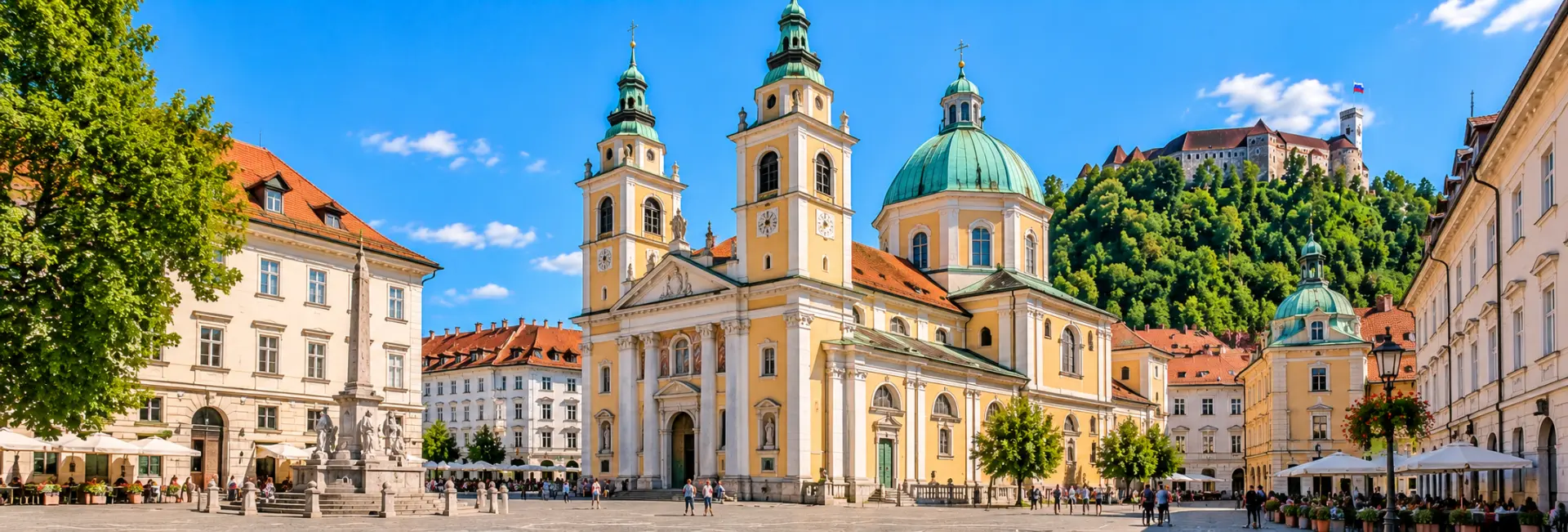
Ljubljana Cathedral, officially the Cathedral of Saint Nicholas, is the principal Catholic church of Slovenia's capital and one of the most recognisable buildings in the Old Town. Its green octagonal dome and twin bell towers rise above the rooftops and are easy to spot from the castle, the bridges and the riverside.
The church stands on Cyril and Methodius Square, beside the central market, the Town Hall and the Archbishop's Palace. It is a short walk from the Triple Bridge and fits naturally into any stroll through the centre. Locals sometimes call it by its older nickname, the Šenklavž church.
Outside, the cathedral looks solid and restrained. Inside, it is rich with frescoes, pink marble altars and gilded detail, and its modern bronze doors add a distinctive twenty-first-century note to a thoroughly baroque building. Most visitors spend 30 to 45 minutes inside, or about an hour if they also explore the surrounding square.
History
An Early Church for Boatmen
A church dedicated to Saint Nicholas has stood on this spot since the thirteenth century. The saint is the patron of sailors, and the church is associated with the boatmen and fishermen who worked on the Ljubljanica River. The first written mention of the three-nave Romanesque building dates from 1262.
Gothic Changes and the Diocese
After a fire in 1361 the church was re-vaulted in the Gothic style. When the Diocese of Ljubljana was established in 1461, the church became the bishop's seat and was altered and extended. In 1469 it was burned down, probably by the Ottoman Turks, and it was later restored.
A New Baroque Cathedral
By the early eighteenth century the old church no longer matched the ambitions of the city. It was pulled down in 1701, and a new baroque hall church was built between 1701 and 1706. The plans are attributed to the Jesuit architect Andrea Pozzo, and the work was supervised on site by local builders. The project was driven by the dean Janez Anton Dolničar, whose name is now given to the street beside the cathedral.
Consecration and Later Additions
The cathedral was consecrated in 1707. Its interior continued to be enriched for decades, with sculpture and painting added through the eighteenth and nineteenth centuries. A proper dome was finally built in 1841 and decorated a few years later. The most prominent modern additions are the bronze doors installed in 1996.
Architecture & Design
A Roman Model
The cathedral is a hall church with a Latin cross plan and side chapels. Its layout echoes the Jesuit church of Il Gesù in Rome, which was the model for many baroque churches across Europe. The result is a spacious central nave with good sightlines to the altar, designed to bring the congregation close to the service.
The Green Dome and Twin Towers
From outside, the cathedral is best known for its green dome and its two bell towers. The twin towers, which are reminiscent of Salzburg Cathedral, flank the western facade and give the church a strong, balanced silhouette. The dome sits above the crossing and is a defining feature of the city skyline.
The Facade
The main facade faces the Archbishop's Palace and is decorated with sandstone statues of bishops and saints set in niches. A Gothic pietà can be seen among them. To the right of the main entrance, a stone boss in the form of the head of Christ comes from the earlier cathedral, kept as a reminder of the church that stood here before.
A Dome Painted Before It Existed
Because the real dome was not built until 1841, the painter Giulio Quaglio created an illusionistic dome on the wooden ceiling above the crossing. The painted architecture gives the impression of greater height, and it shows how baroque artists used perspective to improve on what builders could achieve at the time.
Interior Highlights
Quaglio's Frescoes
The Italian painter Giulio Quaglio decorated the church in two periods, between 1703 and 1706 and again between 1721 and 1723. His frescoes show episodes from the life of Saint Nicholas, along with scenes of early Christian martyrdom. They are among the most important baroque paintings in Slovenia, and the colours and movement are striking when seen from the nave.
The Dome Fresco
The painter Matevž Langus decorated the dome in the middle of the nineteenth century. His work offers an interesting contrast to Quaglio's earlier style and shows how the interior continued to evolve after the original construction.
Altars, Marble and Gilding
Pink marble altars, white stucco and gilded details give the interior a warm, theatrical look. The high altar is surrounded by angels, and carved choir stalls and an organ add to the sense of richness.
Sculpture
- Statues of four early bishops of Emona by Angelo Putti, placed beneath the dome in the early eighteenth century
- Altar angels by the Groppelli brothers in the right part of the nave, from 1711
- Altar angels by Francesco Robba in the left part of the nave, from the middle of the eighteenth century
The Bronze Doors
The Main Door
The west door faces the Archbishop's Palace and was created by the sculptor Tone Demšar. It was installed in 1996 to mark 1,250 years of Christianity in the Slovenian lands, and it was blessed by Pope John Paul II during his visit that year. The reliefs depict key moments from the history of the Church in Slovenia, so the door works as a kind of illustrated chronicle.
The Ljubljana Door
The south door, facing Cyril and Methodius Square, is the work of the sculptor Mirsad Begić. It is known as the Ljubljana Door and shows portraits of six twentieth-century bishops of Ljubljana above the shrouded body of Christ. Many visitors find it as striking as the interior.
Why They Matter
The doors show how a historic church can add new art without losing its character. They are modern in style but speak the same language of faith and memory as the older decoration inside, and they give the cathedral a link to events within living memory.
Religious & Cultural Significance
The Seat of the Archdiocese
The cathedral is the seat of the Archbishop of Ljubljana and the principal Catholic church in Slovenia. Services take place here throughout the week, and major religious occasions are celebrated in the cathedral.
A Landmark for the City
The building is also a civic landmark. Its green dome is one of the signs by which the Old Town is recognised, and it appears on postcards and in photographs of the river. Locals use the square in front of it as a meeting point and a market place.
Music and Events
Choir recitals and chamber concerts are held in the cathedral during the year. Check the church calendar if you want to attend one.
Ways to Experience It
- Walk through the main doors and look up at the frescoes, taking time to follow the stories along the ceiling
- Study both bronze doors and try to identify the scenes and portraits on them
- Attend a Mass or a concert to hear the building in use
- Photograph the dome and towers from the Triple Bridge or the riverside
- Join a guided Old Town walk, many of which include a stop at the cathedral
- Combine the visit with the market and Town Hall on the same square
Best Time to Visit
Time of Day
Late morning and mid-afternoon are good times for sightseeing, since the church is generally open to visitors outside service hours. Early evening can be atmospheric, though the cathedral may close or be reserved for services. Check posted hours, since sightseeing is not possible during Mass.
Season
The cathedral can be visited all year. Spring and autumn are pleasant for walking in the surrounding streets, while summer is busiest. In winter, the church offers a quiet, sheltered break from cold weather.
Light
Natural light changes the mood of the interior through the day, so a clear day shows the colours of the frescoes best. Visits on overcast days can still be rewarding, as the lighting inside helps to bring out the gilding.
Visitor Tips
- This is a working church, so dress modestly and keep your voice low, especially during services
- Do not walk around during Mass, and check opening times, which usually include a break in the middle of the day
- Entry arrangements vary: ordinary visits have often been free, but some recent visitors report a small charge for sightseeing outside services, so be ready for either
- Photography rules can vary, so look for any signs and avoid flash
- Allow 30 to 45 minutes inside, and a little longer if you want to study the doors and the frescoes
- If you need step-free access, check ahead with the tourist information centre or ask on arrival
- Check for building or restoration work around the church, which has sometimes affected access
Opening hours, entry fees and service times can change, so confirm them with the tourist information centre or the cathedral before you go.
Nearby Attractions
- Ljubljana Central Market: the riverside market and colonnades just behind the cathedral
- Town Hall and Town Square: with the Robba Fountain, a short walk away
- Dragon Bridge: the Art Nouveau bridge with its four copper dragons, close by
- Triple Bridge and Prešeren Square: the heart of the city centre, within a few minutes
- Ljubljana Castle: reached by funicular from nearby Krek Square
- The Seminary Library and Archbishop's Palace: historic buildings beside the cathedral
FAQs about visiting Ljubljana Cathedral
What is Ljubljana Cathedral? +
It is the Baroque Cathedral of Saint Nicholas in the heart of Ljubljana's Old Town. It is the principal Catholic church in Slovenia and the seat of the Archbishop of Ljubljana.
When was it built? +
The current building was constructed between 1701 and 1706 and consecrated in 1707. It replaced an older church that had stood on the site since the thirteenth century.
Who designed it? +
The plans are attributed to the Jesuit architect Andrea Pozzo. The frescoes inside are largely the work of the Italian painter Giulio Quaglio.
What is special about the bronze doors? +
The doors were installed in 1996 for the visit of Pope John Paul II and to mark 1,250 years of Christianity in Slovenia. The main door by Tone Demšar shows the history of the Church, and the south door by Mirsad Begić shows twentieth-century bishops.
Is there an entrance fee? +
Entry for worship is free, and sightseeing has often been free as well. Some recent visitors report a small fee for sightseeing outside services, so it is best to check before you go.
How long should I spend inside? +
About 30 to 45 minutes is enough to see the frescoes, altars and doors. Allow longer if you wish to attend a service or a concert.
Can I visit during Mass? +
Sightseeing is generally not possible during services. Wait until the service has finished, or plan your visit outside the main service times.
Where is the cathedral? +
It stands on Cyril and Methodius Square, at Dolničarjeva ulica 1, next to the Central Market and the Town Hall.
