
Table of Contents
Overview
The National Gallery of Slovenia, known in Slovene as Narodna galerija, is the country's principal art museum and the best place in Ljubljana to understand how Slovenian painting developed. Its permanent collection stretches from the late Middle Ages to the early twentieth century, and it holds the largest body of historic fine art in the country.
The gallery occupies a handsome complex beside the eastern edge of Tivoli Park, a short walk from the old town. Inside, visitors move chronologically through sacred medieval art, Baroque altarpieces, polished portraits, realist scenes and the shimmering landscapes of the Slovenian Impressionists. A selection of European paintings adds context, showing the traditions that Slovenian artists absorbed and answered.
Unlike many national museums, it is compact enough to see in one relaxed visit. A glass-walled atrium, a Baroque fountain and a mix of old and new architecture make the building itself part of the experience, which is why the gallery suits both devoted art lovers and curious first-timers.
History of the Gallery
A Gallery for a New Era
The gallery was founded in 1918 as the National Gallery Society, at the moment when the Austro-Hungarian Empire dissolved and new states emerged in Central Europe. Its aim was to create a proper museum for Slovenian fine art at a time when national identity and culture were being asserted with fresh confidence.
Early Homes
The collection first lived in the Kresija Palace in central Ljubljana, where a first permanent exhibition opened to the public in 1920. During the 1920s the gallery moved into its present home, the building then known as Narodni dom, or National House, which had been created as a cultural centre for Slovene associations.
Growing the Collection
In 1927 the gallery ordered casts of classical sculptures from the Louvre, and in 1934 it added works that had belonged to the National Museum of Slovenia. After the Second World War it became a state institution in 1946, and twentieth-century works were later separated into the newly established museum of modern art, leaving the National Gallery to focus on older material.
Renewal in Recent Decades
The Friends of the National Gallery society was founded in 1995, and the building was completely renovated between 2013 and 2016, reopening with an enlarged and freshly arranged permanent collection. The gallery has also lent works for major exhibitions abroad, helping carry Slovenian art to wider audiences.
Architecture and Building
The Old Wing: A Neo-Renaissance Palace
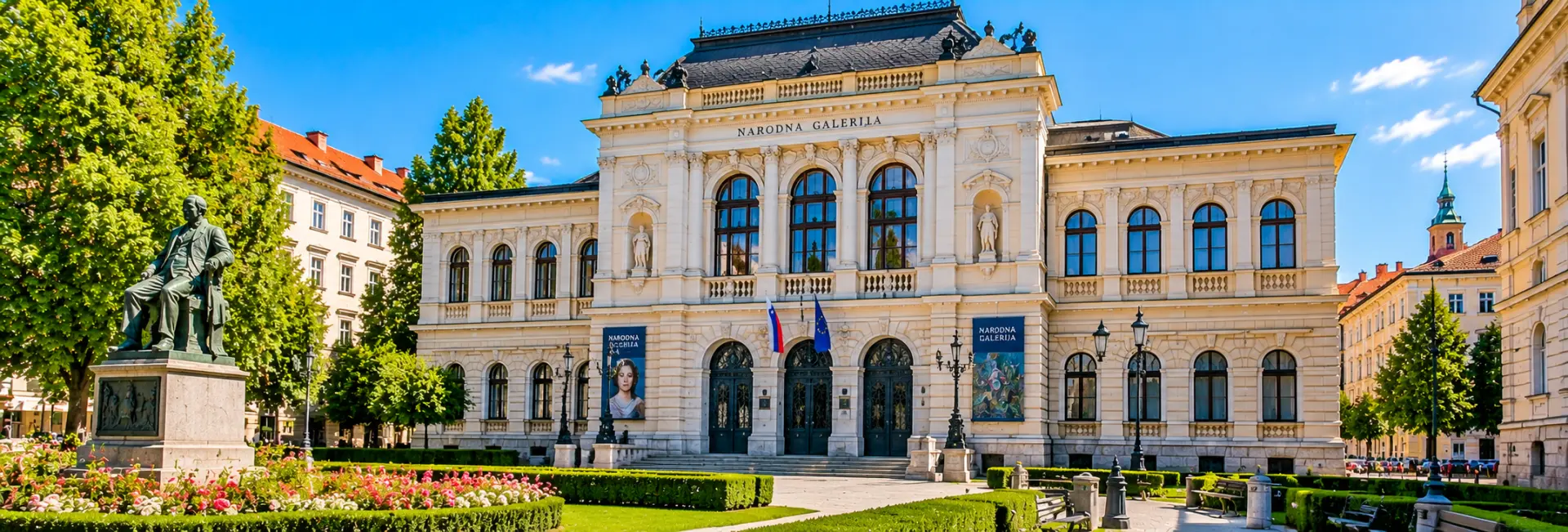
The original building dates from 1896 and was designed by the Czech architect František Škabrout. It was commissioned during the years when Mayor Ivan Hribar worked to turn Ljubljana into a capital that could represent all the Slovene lands. Its neo-Renaissance facade, with ornate detailing and a stately presence, reflects that ambition, and the interior includes a grand hall that still impresses.
The Modern Extension
In the early 1990s a new wing designed by the Slovenian architect Edvard Ravnikar was added to the main building. Its cleaner modernist lines provide extra exhibition space and a calm contrast to the ornamental older section. Together the two wings show how the gallery has grown with its collection.
The Glass Atrium
In 2001 a large glass gallery by the architecture studio Sadar + Vuga was built to link the older and newer wings. The bright, airy space faces Tivoli Park and works as an entrance hall, a meeting point and a venue for events. It is also where the original Robba Fountain now stands, set against the transparent walls.
- Neo-Renaissance main building from 1896 by František Škabrout.
- Modernist wing from the early 1990s by Edvard Ravnikar.
- Glass atrium from 2001 by Sadar + Vuga, joining the two sections.
- A full renovation of the complex between 2013 and 2016.
Collections and Exhibits
Medieval and Baroque Art
The permanent collection begins with sacred art from the Middle Ages, including altar paintings and sculpture created for churches across the Slovene lands. It continues into the Baroque, when artists such as Giulio Quaglio and Gregorio Lazzarini brought Italian drama and colour to commissions in the region. These rooms are a reminder that the territory sat at a crossroads of Alpine, Italian and Central European influences.
Portraits, Neoclassicism and Realism
Later galleries trace the nineteenth century. Jožef Tominc is known for refined Biedermeier portraits, Franc Kavčič for neoclassical compositions, and the brothers Janez and Jurij Šubic for realist scenes that moved painting toward everyday life and open air. The sequence shows Slovenian art becoming more confident and more varied.
Slovenian Impressionism
The heart of the modern collection is the group of painters who adapted Impressionist ideas to Slovenian landscapes and people. Ivan Grohar, Rihard Jakopič, Matija Jama and Matej Sternen are central names, and Ivana Kobilca, often described as the first Slovenian woman painter of European stature, receives special attention.
European Painting and Special Sections
- A selection of European paintings runs from Italian Renaissance-period work to early modern pieces, placing Slovenian art in a wider context.
- A dedicated section is devoted to the painter Zoran Mušič.
- Sculpture is shown alongside paintings, with more room given to it in the revised displays.
- Temporary exhibitions rotate through the year, and a library supports research and education.
Must-See Highlights
The Sower by Ivan Grohar
This iconic canvas shows a figure scattering seed across a rolling hillside, rendered in bold colour and confident brushwork. It is among the best-known images in Slovenian painting and a milestone of the national Impressionist movement.
Woman Drinking Coffee by Ivana Kobilca
Kobilca's portrait of a woman at a cafe table is celebrated for its quiet realism and subtle light. The gallery displays it alongside related works that reveal her working process, which makes the painting even more rewarding.
Black Woman by Anton Ažbe
Ažbe, a revered teacher as well as a painter, produced this striking portrait with powerful contrasts of light and shadow. It remains one of the most discussed works in the Slovenian canon.
The Robba Fountain
The Fountain of the Three Carniolan Rivers, created in the eighteenth century by the sculptor Francesco Robba, is one of the finest Baroque works in the city. After restoration, the original was moved indoors to protect it from the weather, and it now stands in the glass atrium. A replica stands outside in Ljubljana's Town Square.
Look for the Details
- Study the way Grohar and his circle handle light on summer fields.
- Compare Kobilca's genre scenes with her portraits to see how she experimented.
- Notice how Baroque painters stage drama with colour and gesture.
- Pause in the atrium to enjoy the fountain and the view toward the park.
Ways to Experience It
Follow the Chronological Route
The permanent collection is arranged more or less in order, so the easiest approach is to start at the beginning and walk forward through the centuries. This gives a clear narrative of how Slovenian art evolved, and the sequence helps first-time visitors connect the stories to the works.
Add a Temporary Exhibition
The gallery runs rotating exhibitions that explore particular artists, periods or themes. Check what is on before you go, because a special show can add a fresh angle and extra time to your visit.
Take a Break in the Atrium
The glass atrium is an inviting space to sit and rest. In the past the gallery has offered a cafe and a shop with books and postcards, which makes it easy to pause between rooms or pick up a souvenir.
Join a Tour or Workshop
The gallery offers educational programmes and activities for families and groups. Look at the current programme for guided tours, events and workshops, and consider booking ahead for anything that needs a reservation.
Pair It with a Walk
Because the building stands next to Tivoli Park, many visitors combine an hour or two of art with a stroll under the chestnut trees. The route from Prešeren Square to the gallery also passes several notable buildings, which turns the journey into part of the outing.
Best Time to Visit
Time of Day
Mornings and early afternoons are usually calmer, with fewer groups and more space to linger in front of major works. Later in the day, the atrium catches soft light, which is a lovely backdrop for a final look at the fountain.
Day of the Week
The gallery is generally closed on Mondays, so plan your visit for another day. Weekdays tend to be quieter than weekends, particularly outside the main holiday periods. Some museums in Slovenia offer free entry on certain days of the year or month, so check the current schedule if budget matters.
Season
- Spring and early autumn pair well with the park outside, making the visit part of a longer, relaxed day.
- Summer is lively, but the cool galleries offer relief from hot afternoons.
- Winter is a particularly good time for indoor sightseeing, when the collection offers a warm and quiet alternative to outdoor activities.
Visitor Tips
- Check current opening hours and ticket prices on the official website before you go, as they can change, and note that temporary exhibitions may be priced separately from the permanent collection.
- Allow about one and a half to two hours for the permanent collection, and more if you add a special exhibition.
- Start with the older wing and work forward in time, then finish in the modern wing for the Impressionist highlights.
- Take your time with the Slovenian Impressionists. Their work is less well known abroad than the European masters, but it rewards close attention.
- Use the atrium for a break, and check whether the cafe is open before you plan a coffee stop.
- If you plan to visit several museums, ask about combined tickets or city passes that may include entry.
- Photography rules vary between exhibitions, so check the signs or ask staff before taking pictures.
- The gallery lies about ten to fifteen minutes on foot from Prešeren Square, and several city bus lines stop nearby.
Nearby Attractions
- Tivoli Park lies right beside the gallery and offers chestnut-lined alleys, the Jakopič Promenade, a pond and a rose garden.
- Cekin Mansion, on the edge of the park, houses the Museum of Contemporary History of Slovenia.
- The National Museum of Slovenia and the Ljubljana Opera House stand along the route between the old town and the gallery.
- The Museum of Modern Art, whose early collection drew on works from the National Gallery, offers a natural follow-up focused on twentieth-century art.
- Prešeren Square and the Triple Bridge mark the start of the old town and are an easy walk away.
- The Orthodox Church of Saints Cyril and Methodius is another landmark on the walk from the centre to the park.
FAQs about visiting the National Gallery of Slovenia
What is the National Gallery of Slovenia known for? +
It is Slovenia's main art museum, holding the country's largest collection of fine art from the late Middle Ages to the early twentieth century. It is especially known for works by the Slovenian Impressionists and for housing the original Robba Fountain.
Where is the gallery and how do I get there? +
The gallery is at Prešernova cesta 24 in Ljubljana, beside the eastern edge of Tivoli Park. It is about ten to fifteen minutes on foot from Prešeren Square, and several city bus lines stop nearby.
Do I need a ticket? +
Yes, entry is normally ticketed, with separate pricing for temporary exhibitions in some cases. Check the official website for current prices, discounts and any free-entry days.
Which works should I not miss? +
Look for Ivan Grohar's The Sower, Ivana Kobilca's Woman Drinking Coffee and Anton Ažbe's Black Woman. The original Robba Fountain in the glass atrium is also a highlight.
How long should I spend there? +
Plan on about one and a half to two hours for the permanent collection. Add extra time if you want to see a temporary exhibition or rest in the atrium.
Why is the Robba Fountain inside the gallery? +
The original Baroque fountain was moved indoors after restoration to protect it from the elements. A replica now stands in Ljubljana's Town Square.
Is the gallery open on Mondays? +
It is generally closed on Mondays, but opening days can change, so confirm on the official website before you go.
What can I combine with a visit? +
Tivoli Park is next door, and the Museum of Contemporary History in Cekin Mansion, the Jakopič Promenade and the old town are all within walking distance.
