
Table of Contents
Overview
Metelkova Art Center, known locally as Metelkova mesto or simply Metelkova, is one of the most distinctive places in Ljubljana. A short walk from the main railway station, it fills a cluster of former military barracks with murals, sculptures, mosaics, music clubs, galleries and artist studios, all run by the people who use them rather than by a single owner or company.
Part open-air gallery, part nightlife district and part community hub, it feels different from the polished old town just a few minutes away. By day the courtyards are quiet and colourful, ideal for wandering with a camera. After dark the same spaces fill with people heading to concerts, club nights, film screenings and performances.
The official name is Avtonomni kulturni center Metelkova mesto, or AKC Metelkova mesto, which translates as Metelkova City Autonomous Cultural Centre. The word autonomous matters, because the site has long operated on its own terms, shaped by volunteers, artists and activists who turned an abandoned military complex into a lasting cultural landmark.
History
From Barracks to Brownfield
The complex began life as military property. The Austro-Hungarian army commissioned the barracks in 1882, and work was completed in 1911. Later the buildings served the Yugoslav People's Army, and they remained in military hands until Slovenia declared independence in 1991. When the army left, the site was left empty and uncertain, a large brownfield close to the city centre.
A Plan for Peace and Creativity
Around 1990 and 1991 more than 200 organizations came together as the Network for Metelkova, an alliance of artists, youth groups and cultural workers. They argued that the vacant barracks should be turned toward peaceful and creative uses, with studios, venues and workshops that Ljubljana lacked at the time. The city gave them permission to use the site, but the promises that followed were not fully kept.
The Occupation of 1993
The turning point came in September 1993, when a group of about two hundred artists, activists and volunteers occupied the northern part of the complex. They acted after buildings within the barracks were demolished without proper authority, and they wanted to stop further destruction and redevelopment. The occupation turned the site into a squat almost overnight.
An Autonomous Zone
By 1995 Metelkova had been redefined as a self-organized autonomous cultural zone. Over the following years it gained connections to the city's water and power systems, welcomed new groups, including LGBTQ+ organizations and other associations, and settled into its role as a permanent part of Ljubljana's cultural scene. Its relationship with the authorities has stayed complicated, but the site has endured for more than three decades.
Recognition / Status
Metelkova's status is unusual. It is not a conventional museum or a licensed attraction, yet it is widely recognized as a cultural landmark, both locally and abroad.
- The area was declared a national cultural heritage site in 2005, which helped protect it from redevelopment pressures.
- Its self-managed, volunteer-run character has made it a frequent subject of study by urban researchers interested in squats, alternative culture and city regeneration.
- Tourism organizations list it among Ljubljana's best-known landmarks, and it is a regular stop on city tours.
- Although it began as an illegal occupation, it now operates in a tolerated, partly formalized arrangement, and the land remains in municipal ownership.
This mix of recognition and ambiguity is part of what gives the place its character. It is celebrated as a symbol of creativity and independence, while still existing outside the usual rules that govern city attractions.
Street Art and Architecture
Military Buildings, Artistic Skins
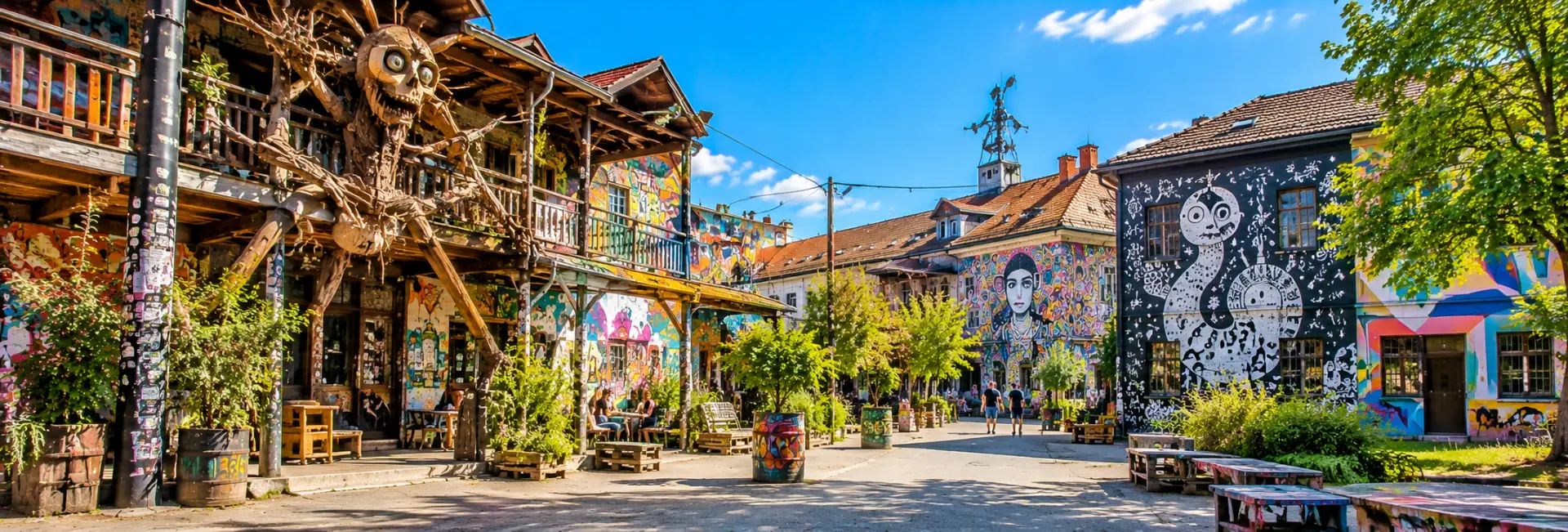
The architecture is the bones of the story. Metelkova consists of seven barracks buildings spread over roughly 12,500 square metres, and their plain military shapes have been transformed by decades of intervention. Walls, doors, windows and rooflines carry layers of paint, mosaic and found objects.
Art Everywhere You Look
Art is not confined to a gallery here. Murals cover whole facades, sculptures stand in the courtyards, and creative touches extend to benches, lamp posts and patio walls. Both well-known and lesser-known Slovenian artists have contributed, along with visitors from abroad, so the site reads like a constantly changing open-air museum.
A Space in Constant Transformation
Nothing is ever finished at Metelkova. Pieces fade, get painted over or are replaced by new work, and the look of a courtyard can change from one season to the next. That unpredictability is part of the appeal, and it means a repeat visit rarely feels like a repeat.
Look for the contrast between the severe structure of the old barracks and the playful, sometimes provocative imagery that now covers them. It is a vivid illustration of how a place designed for discipline became a place for self-expression.
Key Venues and Areas
Music and Nightlife
Metelkova hosts a cluster of independent clubs, each with its own personality and programme. Programmes change frequently, so it is worth checking the calendar before you plan an evening.
- Gala Hala is the main concert space, known for strong sound and a wide range of live acts.
- Channel Zero is famous for its bass-heavy sound system, with electronic, dub and rock-leaning nights.
- Klub Gromka leans toward punk, hardcore and other loud genres, and also stages performing arts, film and talks.
- Menza pri koritu offers a mixed calendar, from poetry readings to gigs, in a room with a famous column in the middle of the stage.
Queer Spaces
Klub Tiffany and Klub Monokel are among the oldest LGBTQ+ venues in the city. Tiffany opened in 1993 and also hosts cultural events, while Monokel has long been the main lesbian club. Both are central to the site's identity as a tolerant, welcoming space.
Studios, Offices and Galleries
Beyond the clubs, many buildings house artist studios and the offices of cultural organizations, research groups and civil society initiatives. Exhibitions, workshops and community events take place in various corners of the complex, so there is often something to see in the daytime too.
Hostel Celica
On the edge of the complex stands Hostel Celica, a former military prison converted into accommodation in 2003. Twenty of its original cells were redesigned by artists, and the hostel keeps iron bars on doors and windows. It also runs a free gallery and a small museum in two former solitary confinement cells.
Culture, Festivals and Community
A Home for Festivals
Metelkova is a regular venue for some of Ljubljana's best-known cultural festivals. Events such as the City of Women festival, the Druga Godba festival, MENT Ljubljana, the Ljubljana Jazz Festival and Ana Desetnica have all used its spaces. Each September the centre also marks its own anniversary with a festival celebrating its perseverance.
A Community, Not a Product
The site is run by a self-organized community of artists, activists and volunteers rather than by a single manager. Different associations look after different buildings and programmes. That structure explains both the variety of the offer and the sense of ownership that regulars feel.
Radio, Ideas and Debate
Alongside music and art, Metelkova has a long tradition of discussion, lectures and political and social events. Student radio has been one of its closest allies, and many of the groups based here work on civil society, research and social issues, giving the centre an intellectual side that is easy to overlook if you only come for the clubs.
Ways to Experience It
Wander the Courtyards
The simplest way to see Metelkova is to walk in and look around. There is no ticket and no fixed route. Take your time with the murals and sculptures, peek into the passages between buildings and notice how each corner has its own mood.
Catch a Gig or Club Night
For many visitors the highlight is the music. Pick a venue that suits your taste, whether that is punk, electronic, dub or an eclectic mix, and check what is on that night. Many events start late, so plan for a long evening.
Stay in a Former Cell
Spending a night at Hostel Celica is one of the most memorable ways to experience the area. If you are not staying, you can still visit the gallery and learn about the building's past as a prison.
Take a Guided Walk
Local guides regularly include Metelkova on alternative culture and street art tours. A guide can explain the history behind particular buildings and artworks, and can share stories that are hard to pick up on your own.
Combine Art and Museums
Two museums sit right beside the complex, so it is easy to pair a gallery visit with a stroll through the autonomous zone. See the nearby attractions section for details.
Best Time to Visit
Daytime for Art
Visit in the afternoon if your main interest is the murals and sculptures. The courtyards are calm, the light is good for photography and you can look closely without crowds. Hostel Celica's gallery and the neighbouring museums also work best in the daytime.
Late Evening for Nightlife
The atmosphere changes completely after dark. Clubs usually come alive late in the evening, and weekends are the busiest. If you want to see the art in quiet before the crowds arrive, go early in the evening and then stay on for a gig.
Season
- Late spring through early autumn is the liveliest period, with courtyards full of people and outdoor socializing spilling out of the clubs.
- Winter is quieter, though indoor concerts and club nights continue, and the street art is just as striking in cold light.
- September is a good month for a visit because of the annual celebration marking the centre's anniversary.
Visitor Tips
- Check the event calendar before you go. Programmes change constantly, and each venue has its own style, so a quick look helps you pick the right night.
- Bring some cash. Smaller venues and bars often do not accept cards, so having notes and coins on hand avoids frustration.
- Treat the art with respect. Do not touch, climb on or add to existing pieces unless you are taking part in an organized project.
- Ask before photographing people, especially at night or inside venues. The community values privacy and consent.
- Keep your belongings close, as in any busy nightlife area, and look after your friends as you move between venues.
- Accessibility is limited in places, so wheelchair users may want to check ahead.
- Remember that this is a community space. Be friendly, respect different identities and lifestyles, and follow any house rules posted at individual venues.
- Walking through the courtyards is free, but individual concerts and events may charge an entry fee.
- Allow one to two hours for a daytime wander, or an entire evening if you plan to see a show.
Nearby Attractions
- The Museum of Contemporary Art Metelkova sits right at the entrance to the complex and presents modern and contemporary art in a well-curated setting.
- The Slovene Ethnographic Museum stands a short walk away and explores everyday life, culture and traditions.
- Ljubljana's main railway station is only a few minutes' walk from Metelkova, which makes the area easy to reach on arrival or departure.
- Prešeren Square and the Triple Bridge lie within a short walk to the south-west and mark the start of the old town.
- Ljubljana Castle looks over the city from its hill and is a natural follow-up for visitors who want a view over the rooftops.
- Plečnik's Central Market and the riverside cafes along the Ljubljanica make a pleasant contrast to Metelkova's raw energy.
FAQs about visiting Metelkova Art Center
What is Metelkova Art Center? +
It is an autonomous cultural centre in a former military barracks in central Ljubljana. The complex is known for its street art, independent music venues, studios and community events.
Is it free to enter? +
Yes, you can walk through the courtyards and see the art without paying. Individual concerts, club nights and some events may charge an entry fee.
Is Metelkova a squat? +
It began as one in 1993, when artists and activists occupied the barracks. It is now a tolerated autonomous zone with national cultural heritage status, though it still operates outside the rules of a conventional attraction.
When is the best time to go? +
Afternoons suit visitors who want to explore the art in peace, while late evenings are the best time for music and nightlife. Weekends are the busiest, and the centre is livelier from late spring to early autumn.
Can I stay overnight at Metelkova? +
Yes. Hostel Celica, a former military prison on the edge of the complex, offers rooms in cells redesigned by artists, as well as regular rooms.
Do the venues accept cards? +
Many of the smaller venues and bars prefer cash, so it is wise to carry some with you. Policies vary from place to place.
How do I get there from the old town? +
Metelkova is a short walk from the main railway station and the old town. Most visitors walk, and the area is easy to find along Metelkova ulica.
How long should I spend there? +
About one to two hours is enough for a daytime visit focused on the street art. Plan for an evening if you want to catch a concert or club night.
