
Table of Contents
Overview
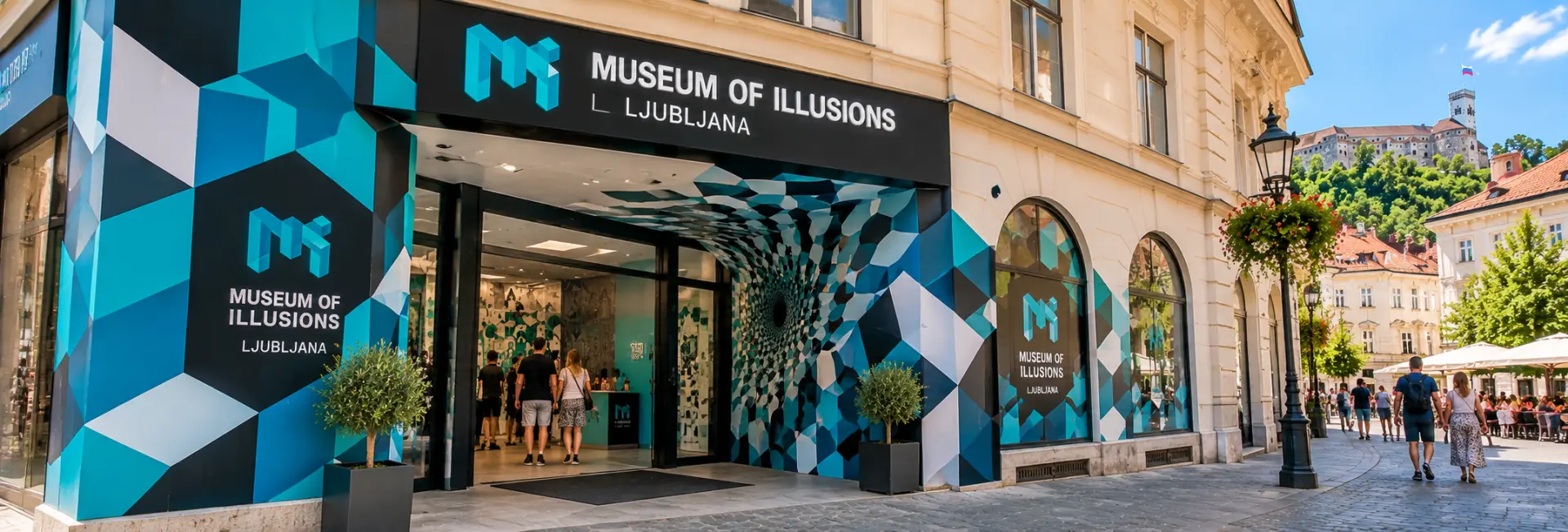
Tucked onto Kongresni trg, one of the central squares of Ljubljana, the Museum of Illusions is a hands-on attraction built around one simple idea: your senses are less reliable than you think. Locally it is known as Hiša iluzij, and on signage and ticketing it often appears as the House of Illusions, so visitors will find the same place under both names.
Instead of asking you to stand back and read labels, the museum puts you inside the tricks. You can walk through a rotating tunnel that scrambles your balance, shrink and grow in a distorted room, and pose for photos that appear to defy gravity. Around 70 exhibits are spread through the building, and short information cards explain what your eyes and brain just got wrong.
It suits almost every kind of visitor. Families get a lively stop that works especially well on a rainy day, groups of friends come away with plenty of photos, and curious adults get a surprisingly neat introduction to how perception works. A typical visit is short enough to fit between other sights, yet playful enough that many people end up staying longer than they planned.
History of the Museum
Opening in 2016
The museum opened in 2016, the year Ljubljana held the title of European Green Capital. Its creator, Dejan Grbič, wanted to give the city something fresh and different for that busy tourism year, and the result was the first museum of its kind in the Slovenian capital.
The original collection was smaller than today's, with almost 40 optical illusions and holograms. Even then, the line-up included a mirrored Infinity Disco Room with music and a disco ball, a Vortex Tunnel for the brave, and a set of classic illusions of the type found in psychology textbooks. The holograms leaned toward the theatrical, with a werewolf and a rising Count Dracula among the spooky surprises.
A Museum Meant to Be Touched
From the start, the idea was to avoid the usual museum experience of looking at objects from a distance. Visitors were encouraged to step into the exhibits, touch them and take photos. Captions were provided in Slovenian, English, German and Italian, which helped the museum work for the international crowds that pass through central Ljubljana.
Growth Since Opening
Over the years the museum has expanded well beyond its first collection, and the current exhibit count is around 70. It also includes a games area stocked with brain-teasers and puzzles, many of which can be bought in the shop on the way out. That mix of illusion, play and souvenir shopping has kept it a firm fixture on the city's list of family-friendly attractions.
The Setting on Kongresni Trg
The museum sits at number 13 on Kongresni trg, which is also called Congress Square. The address puts it in the middle of the historic centre, a short walk from the river and the main pedestrian streets, so it is easy to add to a day of sightseeing without any real detour.
A Square Named for a Congress
The square takes its name from the Congress of the Holy Alliance, a gathering of European powers held in Ljubljana in 1821. In preparation for that event, the older town walls were pulled down and the area was redesigned as a proper public space. The ground itself has deeper layers, since the square was laid out over what was once the moat beside the walls of Roman Emona and, later, medieval Ljubljana.
What Surrounds It
Green space fills the middle of the square in the form of Zvezda Park, whose name means Star Park. Around it stand some of the city's more distinguished buildings, including the main building of the University of Ljubljana on the south side and the Slovenian Philharmonic nearby. Across the road on Slovenska cesta stands the Ursuline Church of the Holy Trinity, a baroque landmark from 1726.
Exhibits & Rooms
The collection is best understood as a set of interactive zones rather than a gallery of objects. Some exhibits are rooms you walk through, some are mirrors and set-ups made for photos, and some are classic illusions that simply need a second look. Each one comes with an information card that explains the effect.
Walk-Through Rooms
The biggest crowd-pleasers are the rooms that change how your body feels or looks. The Vortex Tunnel, the Ames room, the reversed room and the Infinity Disco Room all belong here. They are physical experiences first and photo opportunities second, and they tend to produce the loudest reactions of the visit.
Mirrors, Faces and Photo Set-Ups
Another group of exhibits plays with how you see yourself and each other. The face swap, the kaleidoscope, the honest mirror and the head-on-a-platter set-up all turn ordinary reflections and poses into something strange. These are the exhibits that work best with a friend holding the camera.
Classic Illusions and Holograms
Interspersed among the bigger installations are traditional optical illusions of the kind that appear in textbooks, along with holograms and the hollow face of Ivan Cankar, a nod to one of Slovenia's best-known writers. These smaller pieces reward slowing down and reading the explanation.
The Games Area
Near the end, a playroom invites you to test your patience on mechanical puzzles and brain-teasers. It is a pleasant change of pace after the more physical exhibits, and a handy place for children to settle while adults catch their breath.
Must-See Highlights
With so many exhibits, it helps to know which ones people talk about afterwards. These six are a good place to start:
- The Vortex Tunnel: a rotating tube that you cross on a stable walkway. Your eyes insist you are moving, your balance disagrees, and almost everyone wobbles.
- The Ames room: a specially shaped room in which people appear to grow or shrink as they walk from one corner to the other. It is one of the most photographed experiences in the building.
- The Infinity Disco Room: mirrors, music and a disco ball combine to create the impression of a dance floor that never ends.
- The hollow face of Ivan Cankar: a face that is actually dished inward, yet seems to bulge out and follow you as you move around it.
- Head on a platter: a classic set-up that makes it look as though your head is resting on a serving tray, which is guaranteed to get a laugh.
- The kaleidoscope: step in front of it and watch your reflection fragment into repeating patterns that stretch toward infinity.
The Science Behind the Fun
Why the Brain Gets Fooled
Illusions work because the brain does not record the world like a camera. It constantly makes educated guesses based on experience, filling gaps and assuming that things behave in familiar ways. Illusions exploit those assumptions, which is why a hollow face looks solid and a sloping room looks perfectly square.
The Ames room is a good example. Its shape is deliberately distorted, but the viewing angle makes it look like an ordinary rectangular room. Because your brain trusts the room, it adjusts its judgement of the people inside, so one person seems enormous and another tiny.
Balance and the Vortex
The Vortex Tunnel shows how vision and balance work together. When the surrounding walls spin, your eyes report strong motion, while the inner ear says you are standing still. The mismatch is what makes steady walking suddenly tricky.
Different Brains, Different Results
The museum makes a point of noting that perception differs from person to person, so not everyone reacts to an exhibit in the same way. That makes the visit a small experiment in itself. Comparing what you each saw is part of the fun, and it is also what makes the place genuinely educational, particularly for children and students.
Ways to Experience It
At Your Own Pace
The museum is designed for self-guided exploration. There is no fixed route and no need to join a group, so you can linger at the exhibits that grab you and move quickly past the rest. Information cards at each exhibit provide the explanations, and captions are available in several languages.
With Family and Friends
This is a museum that works best in company. Many of the illusions need a second person to appreciate, whether that means watching a friend shrink in the Ames room or taking a photo for someone upside down. Children, parents, couples and grandparents can all take part, and the exhibits are interactive enough to hold the attention of younger visitors.
Groups and Celebrations
The museum has been promoted for school groups, birthday celebrations and small corporate events. If you are planning something beyond a standard visit, it is worth contacting the team ahead of time to confirm what can be arranged.
Booking Your Ticket
Tickets can be bought on arrival or through the museum's online shop, and they are also sold through several ticketing platforms. Ticket types usually include adult, child and family options. Prices change from time to time, so check the official source on the day you book.
Best Time to Visit
Opening Hours
The museum is listed as open every day, generally from 9:00 in the morning until 21:00 in the evening. That wide window gives you plenty of flexibility, but hours can shift on holidays or for special events, so a quick check of the official website before you go is wise.
Time of Day
Early in the day and later in the evening tend to be calmer than the middle of the afternoon, when tour groups and families often arrive together. Arriving soon after opening gives you the best chance of taking photos in the popular rooms without waiting your turn.
Season and Weather
Because the experience is entirely indoors, it is a dependable choice in any season. It makes an especially good rain-day or cold-day plan, and a welcome break from the summer heat. School holidays and the busy weeks around festive events in Ljubljana are likely to bring larger crowds.
Visitor Tips
A little preparation makes the visit smoother and the photos better. Keep these points in mind:
- Allow about an hour: most people spend somewhere between 45 minutes and an hour and a half, depending on how long they spend in the games area and on photos.
- Go easy on the Vortex Tunnel: it can cause dizziness, so it is wise to skip it, or take it slowly, right after a big meal or a few drinks, and if you are prone to motion sickness.
- Bring a charged phone: many exhibits are designed to be photographed, and you will want enough battery and storage to capture them.
- Read the cards: the short explanations are what turn a silly photo into a real moment of understanding.
- Take turns: in a group, swap roles between model and photographer so that everyone gets the best shots.
- Check accessibility in advance: several exhibits involve uneven or moving surfaces, so visitors with mobility needs should contact the museum beforehand. Registered service animals are welcome in the public areas.
- Parking: an underground car park lies beneath Kongresni trg, which is convenient if you are arriving by car.
- Confirm current details: ticket prices, opening hours and exhibit availability can change, so use the official website for the latest information.
Nearby Attractions
The museum's position makes it easy to build a short walking route around it. A few places worth pairing with your visit:
- Zvezda Park: the green heart of Kongresni trg is right outside, and it holds a copy of the Roman-era Citizen of Emona statue and fragments of the ancient city walls.
- Slovenian School Museum: a small museum nearby that shows how children in Slovenia were taught in past centuries, with reconstructed classrooms.
- Ursuline Church of the Holy Trinity: a baroque church from 1726 that faces the square from across Slovenska cesta and is often described as the city's finest example of the style.
- Prešernov trg and the Triple Bridge: the lively main square and the famous trio of bridges over the Ljubljanica river are within easy walking distance.
- Ljubljana Castle: the hilltop fortress above the old town makes a natural next stop once you have had your fill of illusions, with views across the city.
FAQs about visiting the Museum of Illusions in Ljubljana
What is the Museum of Illusions in Ljubljana? +
It is an interactive museum of optical illusions on Kongresni trg, also known as Hiša iluzij or the House of Illusions. It has about 70 exhibits, including the Vortex Tunnel, the Ames room and a mirrored disco room.
How long does a visit take? +
Most visitors spend between 45 minutes and an hour and a half. If you have children or enjoy the puzzle area, it is easy to stay a little longer.
What are the opening hours? +
The museum is generally open every day from 9:00 to 21:00. Hours can change around holidays or events, so confirm on the official website before you go.
How much do tickets cost, and where can I buy them? +
Adult, child and family tickets are available, and prices change over time, so check the official online ticket shop for current rates. You can buy on site or in advance through the museum's web shop and other ticket platforms.
Is it suitable for children? +
Yes, it is designed for all ages, and children usually love the hands-on rooms and photo set-ups. The Vortex Tunnel can cause dizziness, so it is best for adults to decide whether younger children should try it.
Is the Vortex Tunnel safe for everyone? +
It is a walkway through a rotating tube, and most people manage it fine, but it can make you feel unsteady or queasy. Anyone prone to motion sickness, or who has just eaten, may prefer to skip it.
How do I get to the museum? +
It is in the centre of Ljubljana at Kongresni trg 13, within easy walking distance of Prešernov trg and the Triple Bridge. If you are driving, there is an underground car park beneath the square.
Is the museum accessible for visitors with mobility needs? +
Some exhibits involve moving or uneven surfaces, so it is best to contact the museum before your visit to discuss your needs. Registered service animals are allowed in public areas.
What else can I combine with a visit? +
Zvezda Park, the Slovenian School Museum and the Ursuline Church are all steps away, and the Triple Bridge and Ljubljana Castle make easy additions to a walking route.
