
Table of Contents
Overview
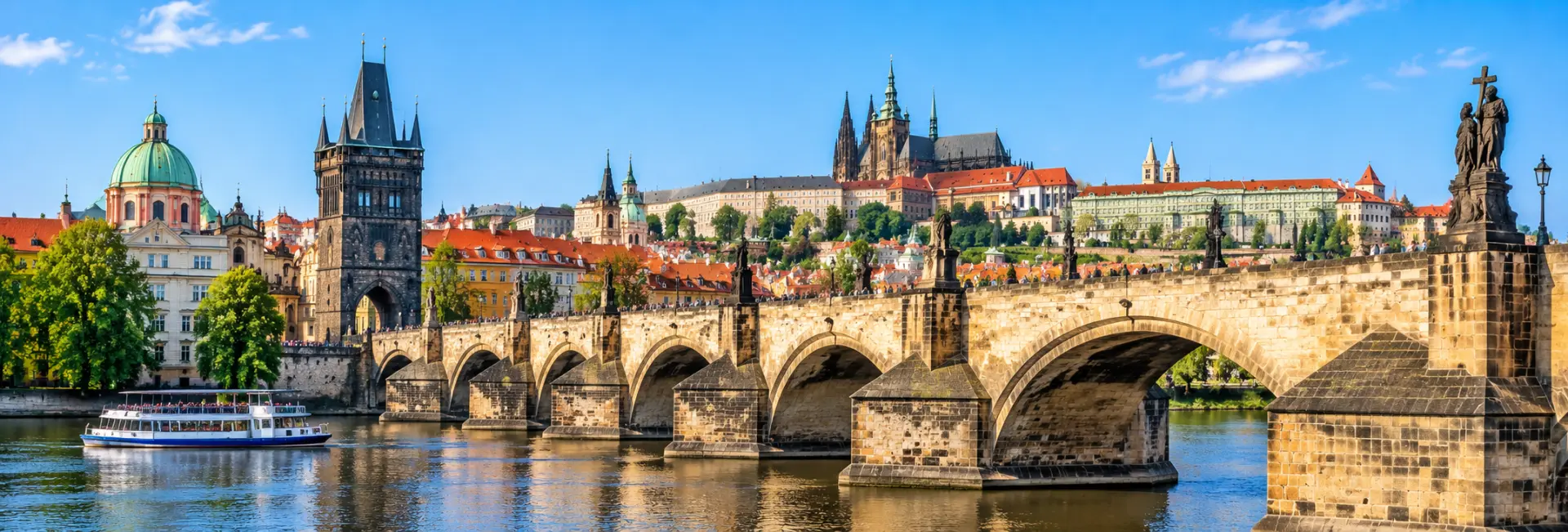
Charles Bridge is Prague's oldest surviving bridge and, for most visitors, the single image that sums up the city: a long stone crossing over the Vltava River, lined on both sides with dark Baroque statues and busy with musicians, artists and crowds at almost any hour. Stretching about 516 meters between the Old Town and the Lesser Town below Prague Castle, it has connected the two halves of the city since the late 14th century.
Unlike a modern landmark built for photographs, Charles Bridge has spent over six centuries as a working part of the city, carrying royal processions, everyday foot traffic and, these days, a steady stream of tourists rather than cars. It's free to walk across at any time, which makes it one of the easiest and most rewarding stops in Prague, whether you cross it once on the way somewhere else or come back at different times of day to see how the light and crowds change.
It's also worth remembering that Charles Bridge isn't a museum piece kept behind glass; it's a living part of Prague's daily rhythm, used by commuters, students and residents alongside the tourists who come specifically to see it. That mix of everyday use and historic weight is a big part of what makes walking across it feel different from visiting a more purely ceremonial landmark.
History
Replacing a Flooded Predecessor
Before Charles Bridge existed, Prague crossed the Vltava on the Judith Bridge, a stone structure built around 1170 under King Vladislav II and named for his wife. That bridge stood for over 170 years before a major flood in 1342 destroyed most of it, leaving the city without a reliable stone crossing.
A New Bridge for a New Capital
King Charles IV commissioned its replacement in 1357, reportedly laying the foundation stone at a precise date and time chosen by his astrologers for good fortune. Construction was overseen by the architect Peter Parler, who was still in his twenties at the time and would go on to design St. Vitus Cathedral, and the project took roughly 45 years to complete, finishing around 1402.
From Crossing to Open-Air Gallery
For nearly 500 years it was the only way to cross the river in Prague, carrying everything from royal coronation processions to daily market traffic. Its character changed dramatically starting in the late 17th century, when the city began adding the statues of saints that still line the bridge today, a process that continued in phases into the early 20th century and turned a purely functional crossing into something closer to an open-air gallery.
Surviving into the Modern City
The bridge kept carrying wheeled traffic well into the 19th century, sharing space with carts, carriages and eventually early trams, until other bridges were finally built across the Vltava starting in 1841 and took some of the pressure off. Vehicle traffic was banned entirely in 1965 as part of a broader restoration effort, permanently turning Charles Bridge into the pedestrian landmark it is today.
Architecture & Design
Charles Bridge is a Gothic stone arch bridge built from Bohemian sandstone, supported by 16 arches and originally designed to be both sturdy and monumental. According to local legend, the mortar binding the stones was mixed with raw egg whites to strengthen it, and modern chemical analysis has in fact found traces of egg proteins in the material, though historians are divided on how much difference this actually made structurally.
Fortified towers guard each end of the bridge: the Old Town Bridge Tower, considered one of the finest Gothic gate towers in Europe, and the two Lesser Town Bridge Towers on the opposite bank, one Gothic and one Renaissance in style. The bridge has survived numerous floods over the centuries, including serious ones in 1784 and 1890, and underwent a significant restoration between 2008 and 2010 that replaced damaged stonework, though the project drew criticism from some heritage experts for its handling of the bridge's historic material.
The bridge's proportions were also unusually generous for their time, at close to 10 meters wide, wide enough that it functioned as a genuine public space rather than just a narrow crossing. That width is part of why it still works so well today as a place where street performers, artists and slow-moving crowds can all share the same stretch of stone without the bridge feeling like a bottleneck.
The Statues & Towers
What most visitors remember about Charles Bridge is its procession of statues: 30 mostly Baroque sculptures of saints and religious figures, added in stages between 1683 and 1928 and standing along both parapets like an outdoor gallery. Most of the originals have since been moved indoors to the National Museum for preservation, with weather-resistant replicas standing in their place on the bridge itself.
Taken as a group, the statues form a kind of theological procession, mixing figures central to Bohemian religious history with saints venerated more broadly across Catholic Europe. Several were funded by wealthy noble families or religious orders of the time, which is part of why the styles and quality vary noticeably from one statue to the next, even though most date from the same general Baroque period.
- Statue of St. John of Nepomuk: the bridge's most famous figure, commemorating a priest thrown from the bridge in 1393, with a bronze plaque at its base that visitors traditionally touch for good luck
- Statue of St. Adalbert of Prague: one of several statues depicting early Bohemian religious figures central to the country's Christian history
- Old Town Bridge Tower: climbable for a small fee, offering views back along the bridge toward the castle
- Lesser Town Bridge Towers: a matched pair of towers on the opposite bank, also open for those willing to climb the stairs for the view
Ways to Experience It
The simplest way to experience the bridge is also the most popular: just walk it, in either direction, taking in the statues, the street musicians and the views over the river toward Prague Castle on one side and the spires of the Old Town on the other. Vendors and artists set up along the bridge through the day, selling everything from paintings to jewelry, which adds to the atmosphere but also to the congestion during busy hours.
- Walking the bridge: free and open 24 hours a day, with no ticket needed to simply cross
- Climbing the towers: both the Old Town Bridge Tower and the Lesser Town towers charge a small entry fee for access to their viewing platforms
- Guided walking tours: several operators run themed tours covering the bridge's statues, legends and history in more depth than a self-guided walk allows
- River views: boat tours on the Vltava pass directly beneath the bridge, offering a different angle on its arches and towers
For a slightly different perspective, some visitors head to Kampa Island or the embankments on either bank, where you can see the full length of the bridge from the water level rather than walking along its length, a view that shows off the arches and reflections in the river far better than being on the bridge itself ever can.
Best Time to Visit
Charles Bridge is at its busiest from mid-morning through late afternoon, when tour groups and day-trippers fill both lanes of foot traffic almost shoulder to shoulder. Arriving at sunrise, or visiting after around 10pm, gives a much quieter experience, with fewer crowds, softer light on the statues and a better chance to actually stop and look rather than simply being carried along by the flow of people.
The bridge is worth visiting in every season, since the views of the castle and the river change with the light and weather, but early morning in spring or autumn tends to offer the most comfortable combination of mild temperatures and thin crowds. Evening visits have their own appeal, when the gas lamps along the bridge come on and the statues take on a more atmospheric, almost eerie quality that's very different from the daytime experience.
Visitor Tips
- The bridge is free and always open, so there's no need to plan around opening hours the way you would for an indoor attraction
- Pickpockets are a known issue in the densest crowds, so keep bags and valuables secured, especially around midday
- The bridge surface is uneven cobblestone, so comfortable, flat shoes are a good idea
- The statue of St. John of Nepomuk and its bronze plaque are roughly in the middle of the bridge, so allow time to find it if that's a priority
- Both bridge towers involve climbing narrow spiral staircases, which may not suit visitors with mobility concerns
Nearby Attractions
Because it connects two of Prague's most visited districts, Charles Bridge naturally fits into a day of walking between several other major sights on either bank of the river.
- Old Town Square, a short walk east through the Old Town from the bridge's eastern end
- Prague Castle and Hradčany, reached by walking up through the Lesser Town from the bridge's western end
- Kampa Island, a small, quiet riverside park just south of the bridge on the Lesser Town side
- Lesser Town Square and St. Nicholas Church, a few minutes' walk from the bridge's western tower
FAQs about visiting Charles Bridge
How old is Charles Bridge? +
Construction began in 1357 and finished around 1402, making the bridge roughly 620 years old, and it remains Prague's oldest surviving bridge over the Vltava.
Is Charles Bridge free to visit? +
Yes, walking across the bridge is free and it's open 24 hours a day, though climbing the towers at either end requires a small paid ticket.
What are the statues on Charles Bridge? +
They're 30 mostly Baroque sculptures of saints and religious figures, added between 1683 and 1928, with the most famous being the statue of St. John of Nepomuk near the bridge's midpoint.
Why do people touch the statue of St. John of Nepomuk? +
Local tradition says touching the bronze plaque at the base of his statue brings good luck and guarantees a return visit to Prague, and the metal is visibly polished from centuries of hands doing exactly that.
When is the best time to visit to avoid crowds? +
Early morning around sunrise or after about 10pm are the quietest windows, since the bridge fills with tour groups and day-trippers through the middle of the day.
Can I drive or cycle across Charles Bridge? +
No, the bridge has been pedestrian only since 1965, when vehicle traffic was banned as part of its restoration and preservation.
Are the original statues still on the bridge? +
Most of the originals have been moved to the National Museum for preservation, with weather-resistant replicas now standing in their place along the bridge.
What else is nearby worth combining with a visit? +
Old Town Square, Prague Castle, Kampa Island and Lesser Town Square are all within easy walking distance of one end of the bridge or the other.
