
Table of Contents
Overview
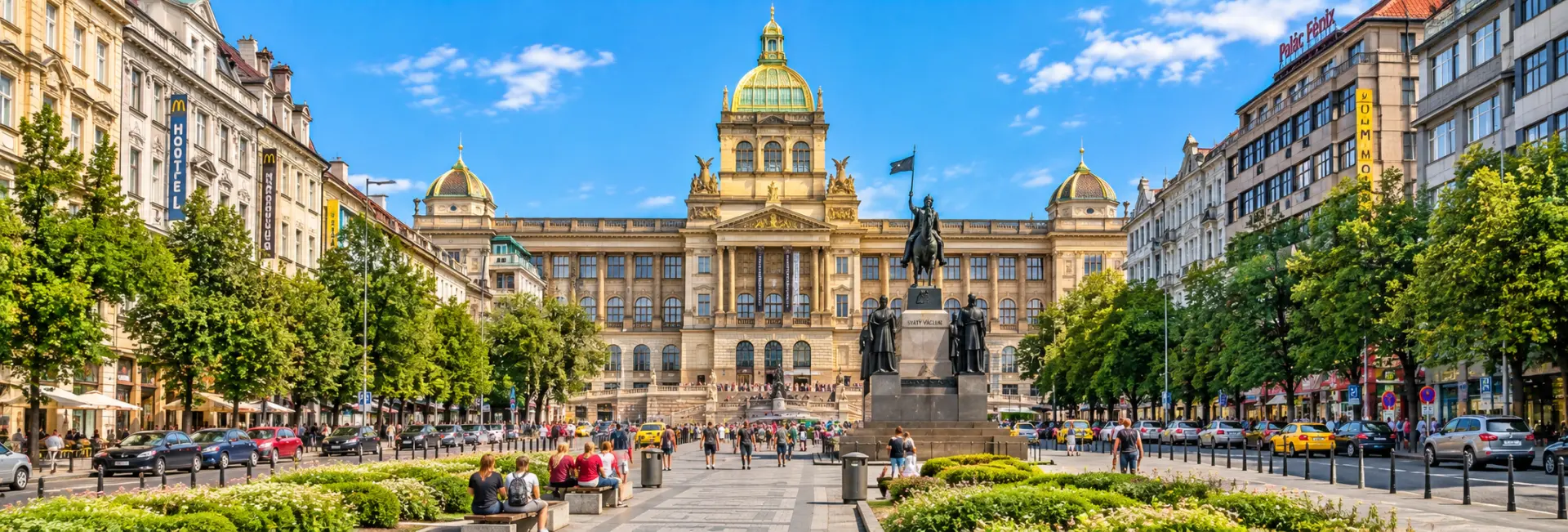
Wenceslas Square is less a traditional square than a long, gently sloping boulevard, running about 750 metres from the edge of Prague's Old Town up to the grand facade of the National Museum. Lined with historic facades, department stores, hotels, and passages, it functions as both the commercial heart of the New Town and the place Czechs instinctively picture when they think about their country's modern history.
Almost every major turning point of the last century has played out here, from the declaration of an independent Czechoslovakia in 1918 to the 1989 demonstrations that ended communist rule. Visitors today find a lively, sometimes chaotic mix of shopping, dining, and street life layered directly on top of that history, with the mounted statue of Saint Wenceslas keeping watch over it all from the square's upper end.
History
From Horse Market to National Symbol
The square was laid out in 1348 as part of the New Town founded by King Charles IV, and for centuries it served a purely practical purpose as the Koňský trh, or Horse Market, where traders sold livestock and goods on the edge of the medieval city. It kept that working-class character well into the 19th century, when the Czech national revival began reshaping how Praguers saw their own history and identity.
A New Name and a New Identity
In 1848, on a proposal by the journalist Karel Havlíček Borovský, the square was renamed for Saint Wenceslas, the 10th-century Bohemian duke regarded as the country's patron saint. Between roughly 1890 and 1930 the square took on much of the appearance it has today, as burgher palaces, department stores, and hotels replaced older buildings along its length, turning it into the commercial and social centre of the New Town.
A Stage for Modern History
The square's role as a gathering place for pivotal national moments took shape in the 20th century. Czechoslovak independence was proclaimed in front of the Saint Wenceslas statue on 28 October 1918, and the date was later set into the paving stones there. In January 1969, student Jan Palach set himself on fire near the National Museum in protest against the Soviet-led invasion that had crushed the Prague Spring reforms, an act that helped inspire the mass demonstrations of "Palach Week" twenty years later. Those 1989 protests, part of the broader Velvet Revolution, filled the square with crowds night after night and led directly to the collapse of Czechoslovakia's communist government by the end of that year.
Recognition & Status
Wenceslas Square lies within the Historic Centre of Prague, inscribed by UNESCO as a World Heritage Site in 1992 for the exceptional concentration of historic architecture across the city's core. While individual buildings along the square, including the National Museum and the Wenceslas statue, carry their own protected status as cultural monuments, the square's broader significance rests as much on its political and social history as on its architecture.
It remains the country's default venue for large public gatherings, from New Year's Eve crowds to political demonstrations, a role it has held continuously since at least the early 20th century.
Architecture & Streetscape
Rather than a single architectural style, the square reads as a layered timeline of Central European design. Neo-Renaissance and neo-Baroque facades from the late 19th century sit alongside early 20th-century Art Nouveau buildings and later Functionalist and Cubist-influenced structures, reflecting the decades in which the square was most actively rebuilt.
The National Museum
Anchoring the upper, southeastern end of the square is the National Museum's main building, a monumental neo-Renaissance structure designed by architect Josef Schulz and built between 1885 and 1891. Its domed silhouette closes the view down the entire length of the boulevard and has become one of the most recognizable backdrops in Prague.
Passages and Arcades
Many of the buildings along the square conceal interior passages and arcades lined with shops, cinemas, and cafés, a distinctive feature of Prague's early 20th-century commercial architecture. These covered walkways let pedestrians cut between Wenceslas Square and the surrounding streets without stepping back onto the main boulevard.
Key Areas & Landmarks
The Statue of Saint Wenceslas
At the square's upper end stands the bronze equestrian statue of Saint Wenceslas, created by sculptor Josef Václav Myslbek and unveiled in 1913, though not fully completed until 1924. The mounted duke is flanked by four smaller statues of other Czech patron saints at the base, and the monument has served as the traditional meeting point and backdrop for the demonstrations and celebrations described above.
Lucerna Passage
A short walk from the statue, the Lucerna Palace complex houses one of the square's best-known passages, home to an Art Nouveau theatre and cinema and, more recently, to artist David Černý's inverted sculpture of Saint Wenceslas riding an upside-down, dead horse, a wry counterpoint to Myslbek's original.
The Lower Square
The northwestern, lower end of the square opens toward Old Town, where it meets the pedestrianized shopping street Na Příkopě. This stretch tends to be the busiest with foot traffic, lined with international retail chains, fast food, and street performers.
- Statue of Saint Wenceslas and the National Museum, upper end
- Lucerna Palace and its passages, mid-square
- Jan Palach memorial cross, near the National Museum
- Pedestrian link to Na Příkopě and Old Town, lower end
Ways to Experience It
Wenceslas Square costs nothing to visit and works well both as a standalone stop and as a link between other parts of central Prague. Walking its full length from the National Museum down to Old Town takes only about fifteen minutes at an easy pace, though the shops, passages, and side streets can easily stretch that into a couple of hours.
- Walk the square end to end, starting at the National Museum steps for a view down the whole boulevard
- Duck into Lucerna Passage to see the upside-down Wenceslas sculpture and browse its shops
- Join a guided history walk focused on 1918, 1968-69, and 1989
- Use the square as a shopping stop, with department stores and international brands along its length
- Return in the evening to see the National Museum and statue lit up against the sky
Best Time to Visit
Wenceslas Square is busy at almost any hour, since it doubles as a transport corridor and shopping street rather than a purely touristic stop. Morning tends to offer the clearest views and calmest pace, before shoppers, commuters, and tour groups fill the boulevard.
Late December brings crowds for a Christmas market near the National Museum end and for New Year's Eve celebrations, when the square becomes one of the city's main gathering points. Anniversaries tied to the square's history, particularly November, can also bring commemorative events and larger-than-usual crowds.
Visitor Tips
Because the square is a working commercial street as much as a sight, a visit benefits from a bit of street sense alongside the sightseeing.
- Keep valuables secure in the lower, busier end of the square, where pickpocketing is more common
- Compare menus before sitting down at restaurants directly on the square, since prices there run higher than on nearby side streets
- Use the Muzeum metro station (lines A and C) for the upper end near the National Museum, or Můstek station (lines A and B) for the lower end
- Check listings for the National Museum before visiting, since its main building alternates between regular hours and special exhibitions
- Visit the Lucerna Passage during opening hours to see the David Černý sculpture, as it sits inside a covered arcade rather than out on the street
Nearby Attractions
Wenceslas Square sits close enough to Prague's other major sights that it works naturally as a starting or ending point for a day of walking.
- Old Town Square and the Astronomical Clock, a short walk down Na Příkopě or through the side streets
- Na Příkopě, a pedestrianized shopping street connecting the square to Old Town
- The National Museum's main building, at the square's upper end
- Franciscan Garden, a quiet green space just off the square's lower half
- Municipal House, a short walk northeast toward the Powder Tower
FAQs about visiting Wenceslas Square
Is Wenceslas Square an actual square? +
Not in the traditional sense; it is a long, rectangular boulevard about 750 metres long and 60 metres wide, more like a wide avenue than an enclosed plaza.
Why is Wenceslas Square historically important? +
It has been the setting for many of Czechoslovakia's and the Czech Republic's defining modern moments, including the 1918 declaration of independence, the 1969 protests following the Soviet invasion, and the mass demonstrations of the 1989 Velvet Revolution.
Is it free to visit Wenceslas Square? +
Yes, the square is an open public street with no admission charge; only specific attractions along it, such as the National Museum, charge for entry.
How long does it take to walk the whole square? +
Walking end to end takes about fifteen minutes at a relaxed pace, though browsing the shops and passages along the way easily extends a visit.
What is the upside-down horse statue? +
It is a sculpture by artist David Černý inside the Lucerna Passage, showing Saint Wenceslas riding a dead, inverted horse, created as a satirical counterpoint to the traditional statue at the top of the square.
Is Wenceslas Square safe at night? +
The square is generally safe and well lit, though like many busy tourist areas it sees pickpocketing, particularly in the crowded lower end, so keeping an eye on belongings is worthwhile.
What is the nearest metro station? +
Muzeum station, on lines A and C, sits at the upper end near the National Museum, while Můstek station, on lines A and B, serves the lower end near Old Town.
What's a good way to combine a visit with other sights? +
Walking down Na Příkopě toward Old Town Square links Wenceslas Square directly to the Astronomical Clock and the rest of Prague's historic core in about ten minutes.
