
Table of Contents
Overview
Tucked into a small square in Malá Strana, just a few minutes' walk from Charles Bridge, the Lennon Wall is a stretch of plaster that has been continuously painted, whitewashed, and repainted since 1980. What began as a single portrait and a few song lyrics scrawled in tribute to John Lennon grew, over the following decade, into an unofficial gathering point for young Czechs pushing back against communist rule, and it has continued evolving ever since.
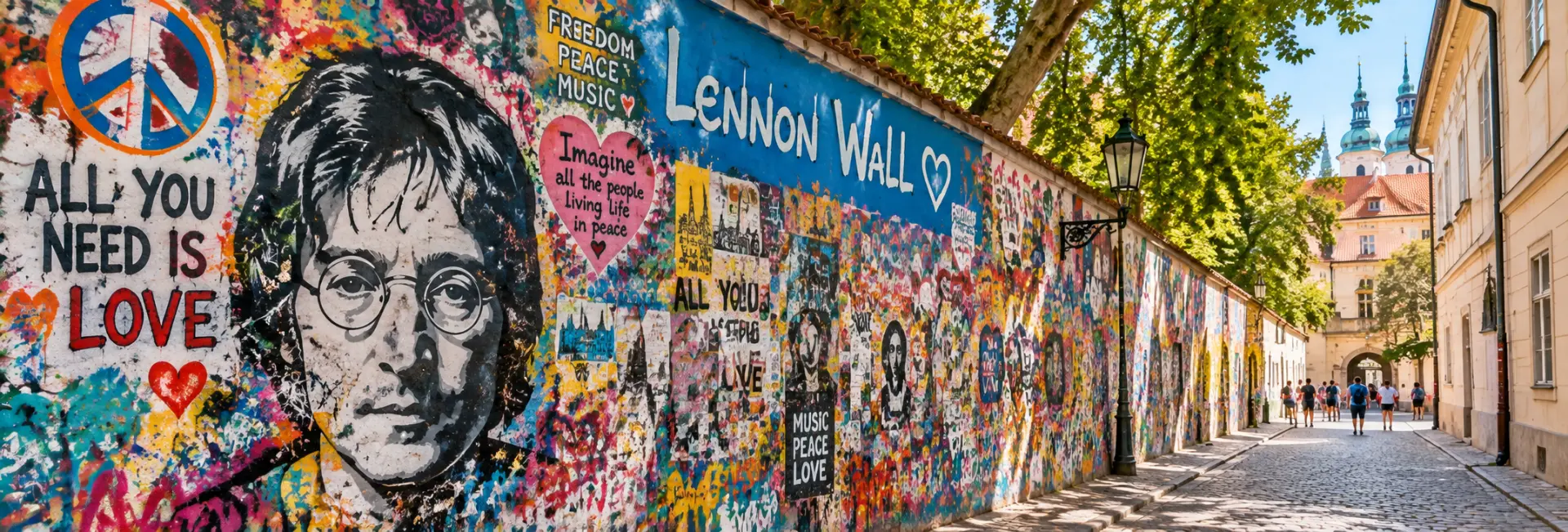
Unlike most historic sights, the Lennon Wall has no fixed appearance. Its current layer of paint might be gone within days, replaced by new portraits, quotes, and messages from whoever picks up a brush next. That constant change is the point: the wall functions less as a monument to a single moment than as an ongoing record of whoever has something to say.
History
Early Inscriptions and a Lennon Portrait
The wall, which encloses a garden belonging to the Knights of Malta, had already been used for love poems and quiet grievances against the regime since at least the 1960s, earning it a local nickname along the lines of a "wailing wall." Its association with John Lennon began within days of his murder in New York in December 1980, when an unknown artist painted his portrait on the plaster along with a few lines from his songs.
A Focal Point of 1980s Dissent
Through the 1980s, the wall became a place where young Czechs recorded grievances the state-controlled press would never print, from calls for the withdrawal of Soviet troops to petitions for the release of political prisoners. Secret police repeatedly painted over the messages, only for new ones to appear within a day or two. Annual gatherings on the anniversary of Lennon's death grew into open demonstrations, and by 1988 tensions around the wall and its associated "Lennonist" movement had escalated into a clash between hundreds of students and security police on nearby Charles Bridge, one of several episodes that fed into the momentum leading to the Velvet Revolution the following year.
After 1989
Once communist rule ended, the wall lost its underground political charge but kept its role as a space for open expression, gradually shifting toward broader themes of peace, love, and global solidarity alongside ongoing tributes to Lennon and the Beatles. In 2014, to mark the 25th anniversary of the Velvet Revolution, a group of art students controversially painted the entire wall white, leaving only a single portrait of Lennon and a quote from Václav Havel, a gesture some saw as a reset and others as an erasure of decades of layered history. The wall filled back in with new graffiti within days and has continued to change ever since, including a 2019 redesign involving artists from several countries and later additions responding to international causes.
Cultural Significance
The Lennon Wall's significance lies less in any single image on it than in what it represents: a space that communist authorities never fully controlled, sitting on private church-owned land rather than state property, where dissent could be expressed even when public political speech was dangerous elsewhere in the city. That history has given it lasting symbolic weight as a monument to free expression, even though the wall itself carries no official plaques or fixed artwork.
Its meaning has broadened over time from a specifically Czechoslovak protest site into a more general symbol of peace and solidarity, with visitors adding messages related to causes well beyond its original context, from environmental activism to international human rights movements.
Recognition & Status
The wall sits within the Historic Centre of Prague, part of the UNESCO World Heritage Site inscribed in 1992, though the wall itself is not separately protected as a monument and has no formal heritage listing of its own. It remains privately owned by the Sovereign Military Order of Malta, whose Grand Priory complex the wall borders, and the order has generally tolerated and at times actively supported the tradition of public painting.
Its recognition today comes almost entirely through popular and cultural status rather than official designation: it is consistently included among Prague's most visited sights and is widely referenced in guidebooks and media as a symbol of the city's 20th-century history.
What to See There
What is visible on the wall at any given moment depends entirely on when it is visited, since the layer of paint changes frequently and sometimes dramatically. Recurring elements tend to include a portrait of Lennon in his round glasses, lines from Beatles songs such as "Imagine" or "Give Peace a Chance," peace symbols, and handwritten messages and dedications left by visitors in dozens of languages.
- A current portrait or image of John Lennon, repainted periodically
- Beatles lyrics and peace-themed slogans
- Layered visitor graffiti, quotes, and personal messages
- The Grand Priory complex and gardens the wall encloses
- The adjacent square, Velkopřevorské náměstí, with views toward the French Embassy building
Ways to Experience It
Seeing the Lennon Wall requires no ticket or scheduling, since it sits on an open public square that can be visited at any hour. Most people take it in as a short stop on a longer walk through Malá Strana, though the wall rewards a slower look given how much text and imagery is layered onto it at any one time.
- Walk from Charles Bridge through Lázeňská street to reach the wall in about five minutes
- Bring a marker or paint if you want to add your own message, as informal contributions are generally accepted
- Pair a visit with a walk around the nearby Kampa Island and its riverside park
- Join a guided walking tour of Malá Strana that covers the wall's Cold War history in more depth
- Return on a later trip to see how the wall has changed, since its appearance shifts over time
Best Time to Visit
Early morning is the quietest time to see the wall, before tour groups and day-trippers passing through Malá Strana on the way to or from Charles Bridge fill the small square. Given how narrow the space is, even moderate crowds can make it hard to get a clear, unobstructed view or photograph.
Because the wall's appearance changes unpredictably, there is no single "best" season tied to what is painted on it; timing a visit is more about avoiding crowds than catching any particular design.
Visitor Tips
The wall is simple to visit but easy to rush past on the way to or from Charles Bridge, so a few small adjustments help make the most of a stop.
- Visit early or later in the day to avoid the densest foot traffic through the square
- Be respectful when adding to the wall, since it remains private property tolerated for public use rather than an official canvas
- Watch for pickpockets in the surrounding narrow streets, which get crowded during peak season
- Combine the visit with Kampa Island, just a short walk away, for a quieter riverside stop afterward
- Don't expect a fixed "famous" image; treat whatever is currently painted as a snapshot of an ongoing, changing work
Nearby Attractions
The Lennon Wall sits in the heart of Malá Strana, close to several other well-known sights on the west bank of the Vltava.
- Charles Bridge, about a five-minute walk away
- Kampa Island and its riverside park, just south of the wall
- Malostranské náměstí and the Church of St. Nicholas, a short walk north
- Petřín Hill and its lookout tower, reachable on foot or by funicular
- Prague Castle and St. Vitus Cathedral, further uphill to the north
FAQs about visiting the Lennon Wall
What is the Lennon Wall? +
It is a continuously repainted graffiti wall in Prague's Malá Strana district that began as a memorial to John Lennon in 1980 and grew into a symbol of dissent and free expression during the communist era.
Did John Lennon ever visit Prague? +
No, Lennon never visited the city; the wall became associated with him only after his death in 1980, when his music and message of peace resonated with young Czechs living under communist rule.
Who owns the Lennon Wall? +
It belongs to the Sovereign Military Order of Malta, whose Grand Priory complex the wall borders, which is why it stood outside direct state control during the communist period.
Is it free to visit? +
Yes, the wall sits on an open public square with no admission charge and is accessible at any hour.
Can visitors add their own graffiti to the wall? +
Informal contributions are generally accepted and are part of the wall's tradition, though visitors should be respectful given that it remains private property.
Why does the wall look different in every photo? +
Because it is repainted so frequently, sometimes within days, its appearance is never fixed; what one visitor sees may be completely different from what another sees weeks later.
What happened at the wall in 1988? +
Rising tensions around the wall's messages of dissent led to a clash between hundreds of students and security police on nearby Charles Bridge, one of several events that helped build momentum toward the 1989 Velvet Revolution.
How long does a visit take? +
Most people spend fifteen to twenty minutes at the wall, though it can easily be combined with a longer walk through Malá Strana and nearby Kampa Island.
