
Table of Contents
Overview
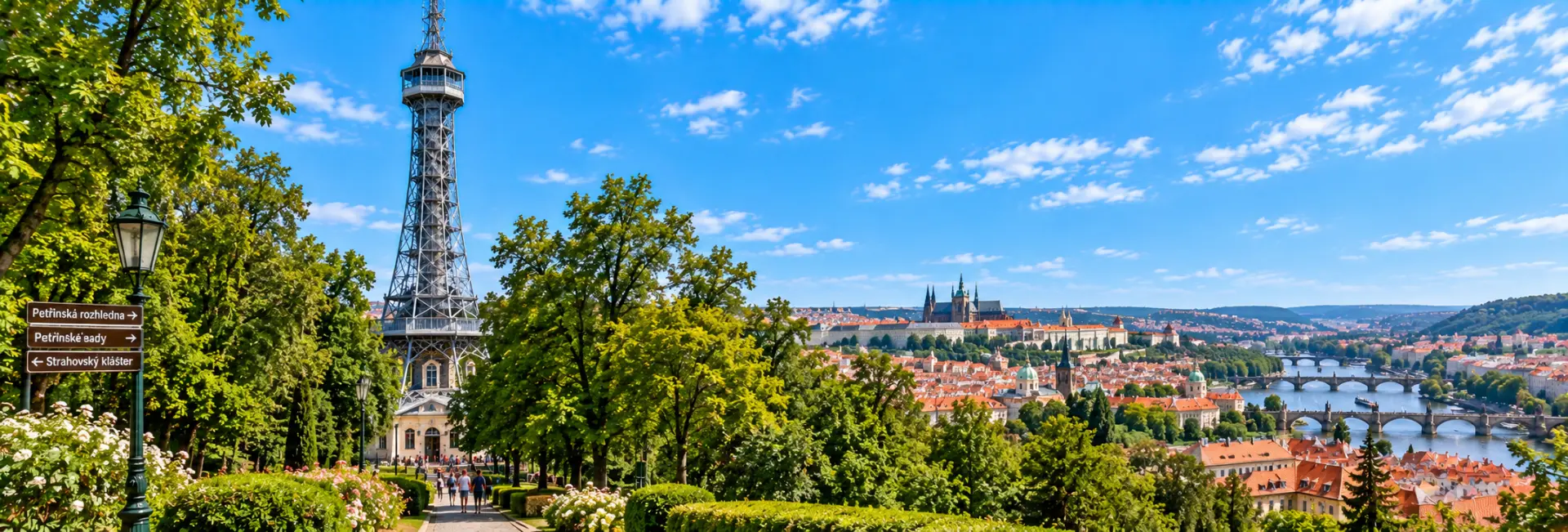
Rising above Malá Strana to a height of 327 metres, Petřín Hill is one of the largest green spaces in central Prague, a wooded park of orchards, gardens, and winding paths topped by a miniature version of the Eiffel Tower. Together, the hill and its lookout tower form one of the city's most rewarding combinations of nature and history, offering panoramic views over the rooftops of Prague alongside centuries-old fortifications and a scattering of quirky attractions.
Beyond the tower itself, Petřín holds a medieval defensive wall, a mirror maze, rose gardens, an astronomical observatory, and a sobering memorial to the victims of Czechoslovakia's communist era, all within walking distance of Charles Bridge and Prague Castle. A funicular railway has carried visitors up the hillside since 1891, though the climb on foot through the orchards is itself one of the park's pleasures.
History
A Rocky Hill and a Medieval Wall
Petřín's name is thought to derive from the Czech word for stone, a reference to the quarried rock that has been dug from the hillside since ancient times to build the city below. Its most prominent early structure, the Hunger Wall, was built on the orders of King Charles IV between 1360 and 1362 as part of Prague's medieval fortifications, using marlstone quarried directly from the hill. Local legend holds that the wall's construction coincided with a famine and gave paid work to hungry residents, which is how it earned its enduring nickname, though later historians generally treat the story as folklore layered onto a genuine defensive project.
From Orchards to Public Park
Over the following centuries the hill's slopes were used for vineyards and orchards, remnants of which survive in the fruit trees still planted across parts of the park today. Petřín gradually transformed into a public recreational space through the 19th century, as Prague's growing population sought green space close to the city center.
The 1891 Jubilee Exhibition
The hill's modern landmarks arrived together in 1891, when the Petřín Lookout Tower, the funicular railway, and the Mirror Maze were all built for Prague's Jubilee Exhibition, a large industrial fair intended to showcase Czech achievement within the Austro-Hungarian Empire. The tower and funicular have each been closed and rebuilt more than once since then, including a landslide that shut the funicular for two decades and a lengthy 1979-1992 reconstruction of the tower itself, but the trio has remained the hill's defining group of attractions for well over a century.
Petřín Tower: Architecture & Design
The Petřín Lookout Tower is a steel-framework structure standing 63.5 metres tall, built as a loose, one-fifth-scale homage to the Eiffel Tower rather than a strict replica, most visibly in its octagonal rather than square base. Because it sits atop a hill already well above the level of the Vltava River, the tower's viewing platform reaches roughly the same altitude above sea level as the top of its much taller Parisian namesake.
Built in just four months in 1891 by the Czech Tourist Club, the tower originally carried a small lift alongside its 299-step staircase. That lift was removed in 1953 when a television transmitter was installed inside the tower, which went on to serve as Prague's main broadcast antenna until the Žižkov Television Tower took over the role in the early 1990s; the tower itself was closed to visitors for reconstruction for much of that period, between 1979 and 1992.
Key Areas & Landmarks
The Hunger Wall
Running across the hillside, the Hunger Wall stands up to 4.5 metres tall in places and remains one of the most visible traces of Charles IV's 14th-century building projects in Prague, restored several times over the centuries, most recently in the 1970s.
Petřín Mirror Maze
Built for the same 1891 exhibition as the tower, the small neo-Gothic Mirror Maze combines a hall of distorting mirrors with a diorama depicting a battle scene from Prague's history, making it a popular stop for visitors with children.
Rose Garden and Orchards
The hill's Rose Garden blooms through the late spring and summer months, while surviving fruit orchards on the lower slopes recall Petřín's earlier life as agricultural land before it became a public park.
St. Lawrence Church and Štefánik's Observatory
Near the tower stands the Church of St. Lawrence, a building with Romanesque origins later rebuilt in Baroque style, and Štefánik's Observatory, a public astronomical observatory that offers daytime and evening viewings through its telescopes.
Memorial to the Victims of Communism
At the foot of the hill, near the Hunger Wall, a row of gradually disintegrating bronze figures descending a staircase forms the Memorial to the Victims of Communism, created by sculptor Olbram Zoubek and unveiled in 2002. Inscriptions at its base record estimated numbers of those convicted, executed, or forced into exile under Czechoslovakia's communist government between 1948 and 1989.
- Petřín Lookout Tower, the hill's Eiffel-inspired centerpiece
- The medieval Hunger Wall
- Mirror Maze, with its distorting mirrors and historical diorama
- Rose Garden and surviving fruit orchards
- St. Lawrence Church and Štefánik's Observatory
- Memorial to the Victims of Communism, at the hill's base
Recognition & Status
Petřín Hill lies within the Historic Centre of Prague, part of the UNESCO World Heritage Site inscribed in 1992, and the Hunger Wall is separately protected as a Czech cultural monument given its medieval origins. The lookout tower and funicular, though only around 130 years old, are treated as protected technical and historic monuments in their own right, reflecting their status as some of the country's earliest surviving pieces of 19th-century tourist infrastructure.
As the largest continuous green space in central Prague, the hill also carries informal recognition as one of the city's most valued public parks, playing a role in local life well beyond its tourist attractions.
Ways to Experience It
Petřín can be reached on foot from several directions, including a walking path from Prague Castle and Strahov Monastery, or via the historic funicular railway from Újezd in Malá Strana, though the funicular has periodically closed for maintenance and its current operating status is worth checking before a visit. Once at the top, climbing the tower's 299 steps, or taking its lift for part of the way, is the main draw, though the surrounding gardens and monuments are easily worth a couple of hours on their own.
- Ride the funicular railway from Újezd to the summit, service permitting
- Climb or hike up through the orchards and gardens on foot from Malá Strana or Strahov
- Climb the tower's 299 steps, or use the lift, for panoramic views over Prague
- Visit the Mirror Maze for a quick, family-friendly stop near the tower
- Walk the length of the Hunger Wall for a quieter, less-visited route across the hill
Best Time to Visit
Petřín is at its most photogenic in spring, when the orchards blossom, and in autumn, when the wooded slopes turn shades of red and gold, though the hill is worth visiting in any season for its views alone. Weekday mornings tend to be the quietest time to climb the tower, since weekends and summer afternoons draw the largest crowds, particularly around the Mirror Maze and rose garden.
Because much of the appeal is outdoors, a clear day makes a meaningful difference to the views from the tower's platform, so checking the forecast before making the climb is worthwhile.
Visitor Tips
A visit to Petřín rewards a bit of planning, given the hill's size and the physical effort involved in reaching the top.
- Check the current status of the funicular before relying on it, since it has closed for extended maintenance periods in the past
- Wear comfortable shoes, since both the walking paths and the tower's 299-step climb require some stamina
- Bring a bit of cash or a card for tower and maze admission, as these sites charge separate entry fees
- Visit the tower first thing in the morning or later in the afternoon to avoid the busiest window for the climb
- Pack a light layer, since it is noticeably windier and cooler at the top of the tower than at ground level
Nearby Attractions
Petřín Hill sits close to several of Prague's other major sights, making it easy to combine with a longer walking route through Malá Strana and the Castle district.
- Strahov Monastery and its historic library, a short walk from the hill's upper paths
- Prague Castle and St. Vitus Cathedral, reachable on foot from the summit
- Charles Bridge and the Lennon Wall, downhill toward the river
- Kampa Island, along the riverbank below the hill
- Malostranské náměstí and the Church of St. Nicholas, in the valley below
FAQs about visiting Petřín Hill & Tower
How tall is the Petřín Lookout Tower? +
The tower itself is 63.5 metres tall, but because it stands on a hill well above the Vltava River, its viewing platform sits at roughly the same altitude above sea level as the top of the Eiffel Tower in Paris.
Is the Petřín Tower a replica of the Eiffel Tower? +
It was built as a loose, one-fifth-scale homage rather than an exact copy, most noticeably in its octagonal base compared with the Eiffel Tower's square footprint.
How do you get to the top of Petřín Hill? +
Visitors can walk up through the park's gardens and orchards from Malá Strana or Strahov, or take the historic funicular railway from Újezd, when it is in service.
Is there an entry fee for Petřín Hill? +
The park itself is free and open to the public; separate tickets are required for the tower, the Mirror Maze, and the funicular railway.
What is the Hunger Wall? +
It is a medieval defensive wall built on the orders of Charles IV in the early 1360s, nicknamed for a local legend that its construction provided paid work during a famine.
What is the Memorial to the Victims of Communism? +
It is a row of bronze figures at the base of the hill, created by sculptor Olbram Zoubek and unveiled in 2002, symbolizing the physical and psychological toll of Czechoslovakia's communist era between 1948 and 1989.
How many steps are in the Petřín Tower? +
There are 299 steps to the top, though a lift is generally available for part or all of the climb for visitors who prefer not to walk up.
Is Petřín Hill good for families? +
Yes, the combination of the Mirror Maze, gardens, orchards, and gentle walking paths makes it a popular spot for families, alongside the tower climb for older children and adults.
