
Table of Contents
Overview
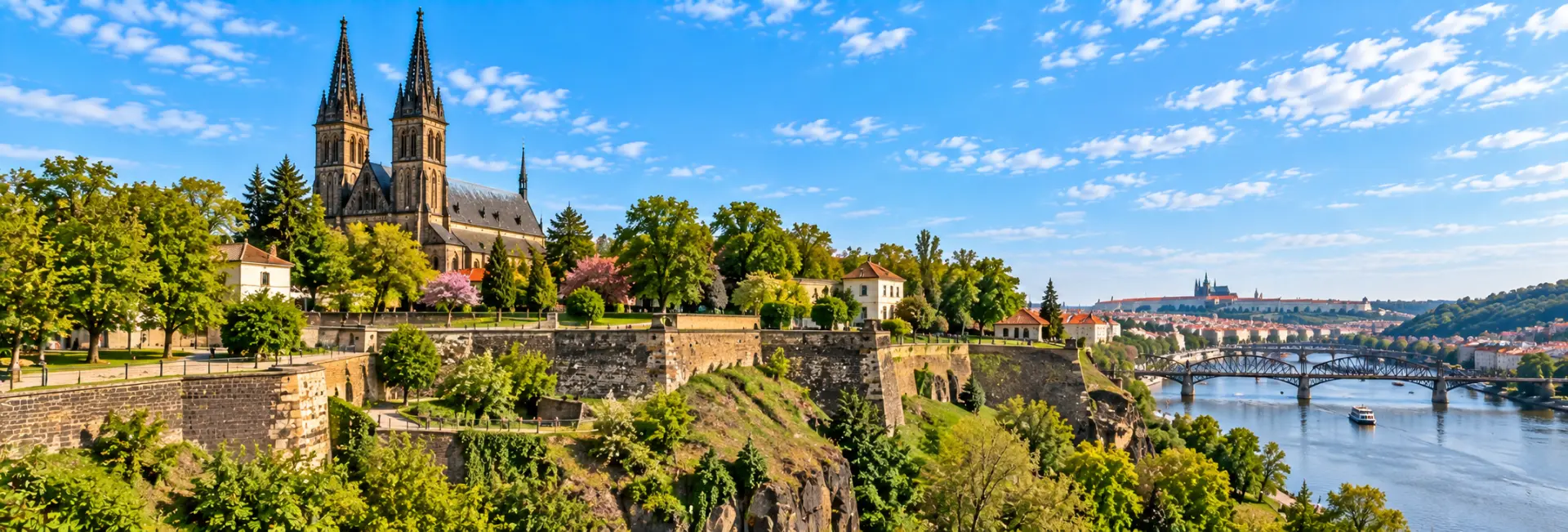
Perched on a rocky bluff above the Vltava River south of Prague's center, Vyšehrad is a fortified hilltop that Czech legend names as the original seat of the country's earliest rulers, older in myth than Prague Castle itself. Today it is a quiet park of Baroque ramparts, a Romanesque rotunda, and a neo-Gothic basilica, offering some of the best uninterrupted views over the river with a fraction of the crowds found elsewhere in the city.
Vyšehrad's grounds also hold the Vyšehrad Cemetery, the final resting place of many of the country's most celebrated composers, writers, and artists, making it as much a site of cultural pilgrimage as of medieval history. Between its legends, its architecture, and its graves, Vyšehrad rewards visitors willing to walk a bit further south of the main tourist route.
History
Legendary Origins
Czech folklore holds that Vyšehrad was the seat of the prophetic Princess Libuše, who is said to have stood on its cliffs and foreseen the future glory of Prague before marrying a ploughman named Přemysl and founding the Přemyslid dynasty. Archaeological evidence points to a more grounded origin, with the fortified settlement dating to around the 10th century, somewhat later than the founding of Prague Castle itself, though the legend has remained central to how Vyšehrad is remembered.
Royal Seat and Decline
Vyšehrad reached its greatest importance in the 11th century under King Vratislaus II, who founded the Basilica of St. Peter and St. Paul and made the fortress his primary residence, alongside the still-surviving Rotunda of St. Martin, built during the same period. Bohemian rulers largely abandoned Vyšehrad as a residence by the mid-12th century in favor of Prague Castle, and the site went through cycles of neglect and destruction over the following centuries, including sacking in the 15th century during the Hussite Wars.
Charles IV's Revival and Baroque Rebuilding
In the 14th century, Emperor Charles IV renewed Vyšehrad as part of his broader building program for Prague, incorporating it into the city's fortifications and its coronation traditions. The fortress was damaged again by Swedish forces in the 17th century and subsequently rebuilt in the Baroque style visible in much of its surviving ramparts and gates today, later serving as a military garrison before its final transformation into a public park in the 19th and 20th centuries.
Architecture & Notable Buildings
The Basilica of St. Peter and St. Paul
Founded by Vratislaus II in the 1070s as a Romanesque church, Vyšehrad's basilica burned in 1249 and was rebuilt over the following centuries, taking its current neo-Gothic form, with its twin spires, in a major reconstruction completed in 1903. Its interior preserves Art Nouveau murals and decoration from that late 19th-century rebuilding.
The Rotunda of St. Martin
Built during the same 11th-century period as the basilica, the Rotunda of St. Martin is the oldest surviving building in Prague, a small Romanesque round church that has survived war, fire, and centuries of changing use largely intact.
Baroque Fortifications and Gates
Much of what visitors walk through today, the sweeping brick ramparts, bastions, and gates including the Tábor Gate and Leopold Gate, dates from the 17th-century Baroque rebuilding of Vyšehrad into a modern artillery fortress, after Swedish troops damaged earlier structures during the Thirty Years' War.
Casemates and the Gorlice Hall
Beneath the fortifications, a network of underground passages known as the casemates houses the Gorlice hall, which displays several original Baroque statues removed from Charles Bridge for preservation, offering a rare underground counterpoint to the open park above.
Grounds & Legends
Vyšehrad's park grounds are dotted with monuments connecting the site's real history to its mythology. Four monumental statues by sculptor Josef Václav Myslbek, depicting legendary pairs from Czech folklore including Libuše and Přemysl, once stood on Palacký Bridge before wartime damage led to their relocation to Vyšehrad in the years after 1945.
The Devil's Column
In one corner of the park stand three large stone cylinders known as the Devil's Column, moved here from the basilica in 1888. Their original purpose remains uncertain, with theories ranging from an ancient milestone to a medieval pillory, and local legend has attached its own supernatural tales to the stones over the years.
Libuše's Bath
A rocky outcrop above the river known as Libuše's Bath is popularly associated with the legendary princess, adding another physical touchstone to Vyšehrad's founding myth, even though its actual origin is more architectural than mythical.
Vyšehrad Cemetery & Slavín
Established in its current form in the 1870s on the site of an older burial ground, the Vyšehrad Cemetery adjoins the basilica and has become the resting place of more than 600 notable figures from Czech cultural life, including composers, writers, and artists. At its eastern end stands Slavín, a monumental communal tomb built between 1889 and 1893 to designs by architect Antonín Wiehl, reserved for the country's most distinguished public figures.
Composers Antonín Dvořák and Bedřich Smetana, writer Karel Čapek, and artist Alfons Mucha are among those buried at Vyšehrad, making the cemetery a place of quiet pilgrimage for visitors interested in Czech music, literature, and art as much as in medieval history.
Ways to Experience It
Vyšehrad rewards unhurried walking more than any single ticketed attraction, since much of its appeal lies in strolling the ramparts, park paths, and cemetery at a relaxed pace. A handful of sites, including the basilica interior, the casemates, and the Gorlice hall, charge separate admission, while the grounds themselves are free to enter.
- Walk the Baroque ramparts for uninterrupted views over the Vltava and southern Prague
- Visit the Basilica of St. Peter and St. Paul to see its neo-Gothic interior and Art Nouveau murals
- Tour the underground casemates and the Gorlice hall to see relocated Charles Bridge statues
- Walk through Vyšehrad Cemetery and Slavín to pay respects to notable Czech figures
- Join a guided tour focused on Vyšehrad's legends and its lesser-visited corners
Best Time to Visit
Vyšehrad tends to be noticeably quieter than Prague Castle or Old Town, making almost any time of day a reasonable one to visit, though early morning and late afternoon light suit the ramparts and river views particularly well. Spring and autumn offer comfortable walking weather across the park's largely open, exposed grounds.
The cemetery and basilica keep more limited hours than the outdoor fortress area, so visitors hoping to see both should plan around posted opening times rather than arriving late in the day.
Visitor Tips
Vyšehrad's spread-out grounds and mix of free and ticketed sites make a little planning worthwhile.
- Take the metro to Vyšehrad station on Line C, which sits close to the fortress entrance
- Wear comfortable shoes, since the park covers considerable ground with some uneven, cobbled surfaces
- Check current opening hours for the basilica and cemetery separately from the park grounds, which are open longer
- Bring a camera for the ramparts, which offer some of the least obstructed skyline views in Prague
- Combine a visit with a walk along the riverside promenade below the fortress for a longer outing
Nearby Attractions
Vyšehrad sits a little apart from Prague's main historic core, making it a good anchor for exploring the city's southern districts along the river.
- The Dancing House, a short walk or tram ride north along the embankment
- Náplavka riverside promenade, known for its waterfront cafés and weekend farmers' market
- New Town and Charles Square, further north toward the city center
- Podolí swimming complex, along the river to the south
- Emmaus Monastery, a short walk toward the New Town
FAQs about visiting Vyšehrad
What is Vyšehrad? +
Vyšehrad is a historic fortified hilltop above the Vltava River in Prague, tied to the legendary founding of the city and home to a Romanesque rotunda, a neo-Gothic basilica, and the Vyšehrad Cemetery.
Is Vyšehrad older than Prague Castle? +
According to legend, yes, but archaeological evidence suggests Prague Castle's fortified settlement actually predates Vyšehrad, which was established around the 10th century.
Is it free to visit Vyšehrad? +
The park and ramparts are free to enter; separate admission is charged for the basilica interior, the underground casemates, and the Gorlice hall.
Who is buried at Vyšehrad Cemetery? +
More than 600 notable Czech figures are buried there, including composers Antonín Dvořák and Bedřich Smetana, writer Karel Čapek, and artist Alfons Mucha, many within the Slavín pantheon.
What is the oldest building at Vyšehrad? +
The Rotunda of St. Martin, built in the 11th century, is the oldest surviving building not just at Vyšehrad but in all of Prague.
What is the Devil's Column? +
It is a set of three large stone cylinders of uncertain original purpose, moved to Vyšehrad's park from the basilica in 1888 and surrounded by various local legends.
How do you get to Vyšehrad? +
The easiest route is by metro to Vyšehrad station on Line C, which is close to the fortress entrance, or by tram to nearby stops along the river.
How long does a visit take? +
A relaxed visit covering the ramparts, basilica, and cemetery typically takes two to three hours, though the park can be enjoyed in less time if only the views and grounds are of interest.
