
Table of Contents
Overview
Josefov is Prague's smallest historic district, a tight cluster of streets tucked between Old Town Square and the Vltava River that was once the city's walled Jewish ghetto. Despite its size, it holds one of the best-preserved complexes of Jewish heritage sites anywhere in Europe: six historic synagogues, a Renaissance-era town hall, and the Old Jewish Cemetery, where generations of burials were stacked so tightly that graves rise in layers beneath the uneven ground.
The quarter's story runs from medieval segregation through 19th-century slum clearance to the devastation of the Holocaust, and almost none of that history has been softened for visitors. Walking Josefov today means moving between elegant Art Nouveau facades built over the old ghetto's footprint and solemn memorial spaces that record, in painstaking detail, what was lost.
History
A Medieval Ghetto
Jewish settlement in Prague is believed to date back as far as the 10th century, but the community's confinement to a specific quarter hardened after a pogrom in 1096 and a series of church-driven segregation orders in the following centuries. A charter issued by King Přemysl Otakar II in 1262 gave the community a degree of legal self-administration even as it remained physically walled off from the rest of the city.
A Golden Age Under Maisel and Rudolf II
The ghetto reached its cultural and economic peak in the late 16th century. Mordecai Maisel, the community's mayor and a financier to the Habsburg court, used his considerable wealth to fund synagogues, paving, and public buildings, while the rabbi and scholar Judah Loew ben Bezalel, later linked to the legend of the Golem of Prague, taught at the Old-New Synagogue during the same period under the relatively tolerant reign of Emperor Rudolf II.
Emancipation and the Ghetto's Renaming
Legal restrictions on Prague's Jewish community eased over the 18th century, and Emperor Joseph II's reforms of the 1780s extended greater civic rights to Jewish residents. In gratitude, the quarter was officially renamed Josefov in his honor in 1850, and full legal equality followed with Austro-Hungarian reforms later in the 19th century, allowing wealthier Jewish families to move elsewhere in the city.
Slum Clearance and Rebuilding
By the late 19th century, the old ghetto's cramped, unsanitary tenements were widely viewed as a public health problem, and city authorities launched a large-scale slum clearance project, known as the asanace, between 1893 and roughly 1913. Most of the original medieval and early modern housing was demolished and replaced with the Art Nouveau apartment buildings and the grand Pařížská Street boulevard that define much of Josefov's streetscape today, while the synagogues, cemetery, and town hall were deliberately preserved.
The Holocaust
Nazi Germany's occupation of Czechoslovakia brought catastrophe to Prague's Jewish community, the vast majority of whom were deported to the Theresienstadt ghetto and from there to death camps, with only a small fraction surviving. In a grim irony, the occupying authorities preserved much of Josefov's synagogue collection and religious artifacts, reportedly intending to create a museum documenting a people they expected to eliminate entirely; that same collection today forms the core of the Jewish Museum in Prague's holdings.
Recognition & Status
Josefov lies within the Historic Centre of Prague, inscribed as a UNESCO World Heritage Site in 1992, and its surviving synagogues, the Jewish Town Hall, and the Old Jewish Cemetery are individually protected as Czech national cultural monuments. The Jewish Museum in Prague, one of the oldest Jewish museums in Europe, was founded in 1906 and today administers most of the quarter's historic synagogues and the cemetery as a single ticketed circuit, while the Old-New Synagogue remains an active house of worship run separately by the Prague Jewish Community.
The Pinkas Synagogue functions as a formal Holocaust memorial, with the names of roughly 80,000 Czech and Moravian Jewish victims hand-painted across its interior walls, making Josefov one of the most significant sites of Holocaust remembrance in Central Europe.
Architecture & Streetscape
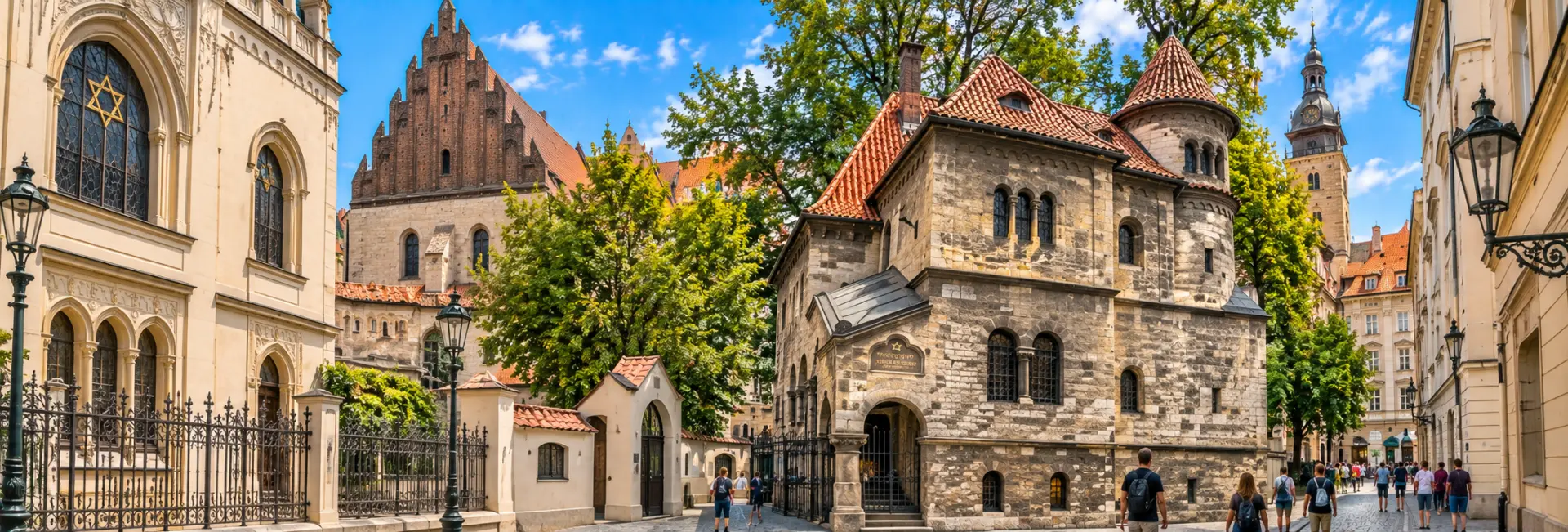
Josefov's architecture reflects two very different eras layered on top of each other: a handful of surviving medieval and Renaissance religious buildings surrounded almost entirely by early 20th-century Art Nouveau apartment blocks built during the asanace clearance. The result is a streetscape that looks, at first glance, like an elegant turn-of-the-century Parisian quarter, with the older Jewish monuments appearing almost incidentally between the grand facades.
Pařížská Street
Cut straight through the former ghetto during the slum clearance, Pařížská Street is a wide, tree-lined boulevard of Art Nouveau and neoclassical buildings that now houses some of Prague's most expensive fashion boutiques, forming an odd but deliberate contrast with the modest religious buildings just off its path.
Surviving Gothic and Renaissance Structures
Scattered among the newer buildings, the Old-New Synagogue's steep Gothic gables, the Jewish Town Hall's Rococo facade, and the Renaissance-era Maisel Synagogue give a sense of what the ghetto's built environment looked like before redevelopment, even though almost all of the surrounding housing from that period is gone.
Key Areas & Landmarks
The Old-New Synagogue
Completed around 1270, the Old-New Synagogue is widely considered the oldest active synagogue in Europe and has served as the main house of prayer for Prague's Jewish community for more than seven centuries, with the sole interruption of the Nazi occupation years. Its steep Gothic vaulting and Renaissance iron grille around the bimah remain largely original, and Rabbi Loew's seat by the Torah ark has been left empty since his death in 1609 as a mark of respect.
The Old Jewish Cemetery
In use from the 15th century until 1787, the Old Jewish Cemetery holds an estimated tens of thousands of burials on a plot too small to expand outward, resulting in graves layered on top of one another and a dense, tilting field of roughly 12,000 visible tombstones. It is one of the most complete surviving Jewish cemeteries of its kind in Europe and one of Josefov's most visited sites.
The Pinkas, Maisel, Klausen, and Spanish Synagogues
The Pinkas Synagogue, dating to 1535, now serves as a Holocaust memorial inscribed with victims' names. The Maisel Synagogue, funded by Mordecai Maisel in the 1590s, and the Klausen Synagogue both house exhibitions on Jewish history and religious life, while the ornate, Moorish Revival Spanish Synagogue, the newest of the group, showcases the community's history into the modern era.
The Jewish Town Hall
Built in 1577 next to the Old-New Synagogue and later given a Rococo facade, the Jewish Town Hall served as the ghetto's administrative center and is recognizable today for its clock tower, which carries a second clock face with Hebrew numerals that runs counterclockwise.
- Old-New Synagogue, Europe's oldest active synagogue
- Old Jewish Cemetery, in use from the 15th to 18th centuries
- Pinkas Synagogue, now a Holocaust memorial
- Maisel, Klausen, and Spanish Synagogues, housing historical exhibitions
- Jewish Town Hall, with its Hebrew-numeral clock
Ways to Experience It
Most of Josefov's historic sites are grouped into a single circuit managed by the Jewish Museum in Prague, which sells a combined ticket covering several synagogues and the Old Jewish Cemetery. The Old-New Synagogue is ticketed separately, since it remains an active place of worship rather than a museum site.
- Buy the Jewish Museum's combined ticket to visit the Pinkas, Maisel, Klausen, and Spanish Synagogues along with the Old Jewish Cemetery
- Purchase a separate ticket for the Old-New Synagogue to see its original Gothic interior
- Join a guided walking tour focused on the ghetto's history, the Golem legend, and the Holocaust memorial
- Walk Pařížská Street to see the contrast between the quarter's older monuments and its Art Nouveau redevelopment
- Visit independently at a slower pace, since the quarter is small enough to cover on foot in a few hours
Best Time to Visit
Josefov's sites keep relatively short hours compared with outdoor attractions elsewhere in Prague, so visiting earlier in the day gives the most flexibility to see everything on the combined ticket before closing. The quarter is busiest during midday in peak summer months, when tour groups move through the cemetery and main synagogues in quick succession.
All sites are closed on Saturdays in observance of the Jewish Sabbath and on major Jewish holidays, so it is worth checking the current calendar before planning a visit, particularly around the Jewish High Holidays in autumn.
Visitor Tips
Because several of Josefov's sites are places of worship, memorial, or mourning rather than purely historical exhibits, a visit calls for a somewhat different approach than typical sightseeing.
- Dress modestly and expect head coverings to be required or offered at the Old-New Synagogue and other active religious spaces
- Keep noise low inside the Pinkas Synagogue and the Old Jewish Cemetery, both of which function as memorial sites
- Photography is often restricted or banned inside synagogue interiors and the cemetery; check posted rules before taking pictures
- Buy tickets online in advance during peak season to avoid long queues at the Jewish Museum's ticket offices
- Plan around the Saturday closures, since arriving on a Sabbath will mean the main sites are inaccessible
Nearby Attractions
Josefov's compact size and central location make it easy to combine with the rest of Prague's historic core in a single day.
- Old Town Square and the Astronomical Clock, a short walk to the southeast
- Charles Bridge, reachable on foot along the riverside
- Rudolfinum concert hall, on the edge of Josefov by the Vltava
- Franz Kafka's birthplace and the nearby Kafka statue, just outside the quarter's boundary
- Wenceslas Square, a walkable route through the New Town
FAQs about visiting Josefov
What is Josefov? +
Josefov is Prague's former Jewish ghetto, now a small historic district holding several of Europe's best-preserved synagogues, a centuries-old Jewish cemetery, and the Jewish Museum in Prague.
Why is it called Josefov? +
The quarter was renamed in 1850 after Holy Roman Emperor Joseph II, whose 18th-century reforms extended greater legal rights to Prague's Jewish residents.
Do you need a ticket to visit Josefov? +
The neighborhood itself is open and free to walk through, but entry to the main synagogues and the Old Jewish Cemetery requires a ticket, typically sold as a combined pass by the Jewish Museum in Prague.
Is the Old-New Synagogue still used for worship? +
Yes, it remains an active synagogue for the Prague Jewish Community and is considered the oldest continuously used synagogue in Europe, so it is ticketed separately from the museum circuit.
Is Josefov open on Saturdays? +
No, the main sites close on Saturdays for the Jewish Sabbath as well as on major Jewish holidays, so it is best to plan a visit for another day of the week.
What happened to Josefov's original buildings? +
Most of the ghetto's original housing was demolished during a slum clearance project between 1893 and 1913 and replaced with Art Nouveau buildings; the synagogues, cemetery, and town hall were deliberately kept standing.
Why does the Old Jewish Cemetery look so crowded? +
Jewish burial law required continuous use of the same consecrated ground, so as space ran out, new layers of soil and graves were added on top of older ones over centuries, leaving a dense, uneven field of tombstones.
How long does it take to see Josefov? +
Most visitors spend two to four hours covering the main synagogues and the cemetery, though the quarter itself can be walked in well under an hour if time is limited.
