
Table of Contents
Overview
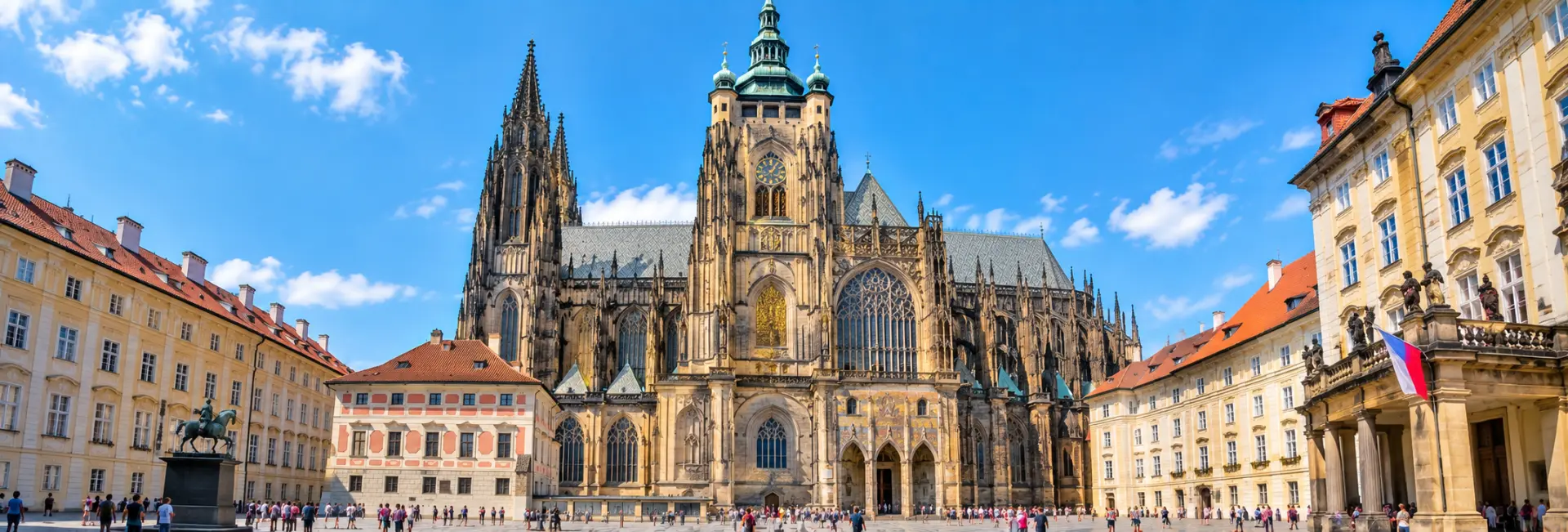
St. Vitus Cathedral is the soaring Gothic church at the center of Prague Castle, its twin spires and flying buttresses visible from almost anywhere in the city. Formally known as the Metropolitan Cathedral of Saints Vitus, Wenceslas and Adalbert, it's the largest and most important church in the Czech Republic, serving as both a working cathedral and the traditional site of Bohemian royal coronations and burials.
Construction began in 1344 and wasn't finished until 1929, meaning the building visitors see today is the result of nearly six centuries of work by different architects across several very different eras. Step inside and that layered history is immediately visible: medieval stone carving, Renaissance additions, Baroque tombs and 20th century stained glass all sit within the same soaring nave, making the cathedral as much a walk through Czech history as a religious site.
It's also worth remembering the cathedral isn't a standalone building you can simply walk up to from the street. It sits inside the walls of Prague Castle itself, tucked into the Third Courtyard, so a visit here almost always comes as part of a broader trip through the wider castle complex rather than as an isolated stop.
History
From Rotunda to Cathedral
The site has hosted a church dedicated to St. Vitus since around 925, when Prince Wenceslas founded a small Romanesque rotunda here. That rotunda was later replaced by a larger basilica, and when Prague was elevated to an archbishopric in 1344, Charles IV decided the city needed a cathedral worthy of its new status, commissioning a much grander Gothic building on the same spot.
Two Master Builders
Charles IV first hired the French architect Matthias of Arras, who laid out the choir and the surrounding chapels in a style inspired by southern French cathedrals before his death in 1352. He was succeeded by Peter Parler, just twenty-three years old at the time, who reworked and extended the design with bolder, more experimental engineering, including early net vaulting that influenced Gothic architecture across Central Europe. Parler worked on the cathedral until his own death in 1399, leaving the eastern end largely complete along with the lower stages of the bell tower.
Six Centuries to Completion
Work slowed and eventually stalled during the Hussite Wars of the 15th century, and for the next several hundred years the cathedral stood only partly built, sealed off from the rest of the structure by a temporary wall. Serious efforts to finish it didn't begin until 1873, when architects Josef Mocker and later Kamil Hilbert took over construction of the western nave and facade in a sympathetic neo-Gothic style, closely following what could be reconstructed of Parler's original plans. The cathedral was finally consecrated as complete on 12 May 1929, timed to coincide with the 1,000th anniversary of St. Wenceslas's death.
A Building That Outlasted Its Builders
Along the way, the project survived fires, changes in ruling dynasties and long stretches where funding or political will simply ran out. What makes the final result unusual is how closely the 20th century architects stuck to Parler's surviving medieval plans rather than imposing a completely different vision, so despite the gap of nearly 500 years between the east end and the west facade, the building reads as a coherent whole rather than two mismatched halves stitched together.
Architecture & Design
Because it was built across so many centuries, St. Vitus Cathedral isn't a single architectural statement but a layered one, moving from Matthias of Arras's restrained French Gothic choir through Peter Parler's more inventive medieval vaulting to a careful 19th and 20th century neo-Gothic completion designed to match what came before. The building stretches about 124 meters in length and 60 meters in width, with a nave tall enough to make the cathedral feel genuinely vast rather than simply long.
Its most recognizable feature from outside the castle walls is the Great South Tower, rising close to 100 meters and topped with a Baroque dome and clock rather than a Gothic spire, a reminder that even the tower's construction spanned multiple stylistic periods. Inside, flying buttresses and ribbed vaulting carry the eye upward throughout the nave, while dozens of side chapels branch off the main space, each added at a different point in the building's long history.
Look closely at the choir and you can actually trace the handover between architects: Matthias of Arras's section is comparatively sober and geometric, while Peter Parler's later work grows noticeably more ambitious, with diagonal ribs and decorative tracery that pushed Gothic engineering further than most of his contemporaries were attempting anywhere else in Europe.
Notable Features
- St. Wenceslas Chapel: the cathedral's oldest and most sacred space, its lower walls set with over a thousand semi-precious stones and its upper walls painted with 14th century frescoes of St. Wenceslas's life
- Crown Chamber: a room above St. Wenceslas Chapel holding the Bohemian Crown Jewels, sealed behind a door with seven locks held by seven different state and church officials
- Golden Gate: the cathedral's ceremonial southern entrance, decorated with a 14th century glass mosaic of the Last Judgment
- Mucha Window: a stained glass window in the north transept designed by Art Nouveau artist Alphonse Mucha in 1931, depicting Saints Cyril and Methodius
- Royal Crypt: an underground chamber beneath the nave holding the tombs of several Bohemian kings and queens, including Charles IV and Rudolf II
- Great South Tower: climbable for a fee, home to the massive Zikmund bell and an observation gallery with sweeping views over Prague
Cultural & Religious Significance
St. Vitus Cathedral has been central to Czech religious and national identity for over a thousand years, standing on ground first consecrated in the 10th century and continuing as an active place of worship today. It was the traditional site of Bohemian royal coronations for centuries and remains the resting place of numerous kings, queens, archbishops and other major figures from Czech history, tying the building directly to the country's story of statehood.
The cathedral is also the spiritual home of St. Wenceslas, patron saint of Bohemia, whose relics rest in the chapel built specifically to honor him. The Bohemian Crown Jewels kept above that chapel, including the St. Wenceslas Crown, are shown to the public only on rare ceremonial occasions, which only adds to their symbolic weight as artifacts of Czech sovereignty rather than simply museum pieces.
Beyond its royal and religious history, the cathedral has also become closely tied to Czech national memory in a broader sense, hosting state funerals, official commemorations and the occasional major public event, alongside its everyday role as a working parish and archdiocesan seat. That combination of active worship, national symbolism and centuries of accumulated history is part of what makes it feel different from a purely historical monument.
Visiting Etiquette & Tips
- As an active place of worship, visitors should dress modestly, keep noise to a minimum and remain respectful during any ongoing services
- The cathedral's exterior and the Third Courtyard around it are free to view, but seeing most of the interior requires a Prague Castle circuit ticket
- Photography is generally allowed inside, though tripods aren't permitted and flash photography is specifically prohibited in St. Wenceslas Chapel
- Climbing the Great South Tower involves 287 steps on a narrow spiral staircase, so it's not a good fit for visitors with mobility concerns
- St. Wenceslas Chapel is usually viewed from its entrance rather than entered freely, since access to the interior is restricted to protect the frescoes and stonework
Best Time to Visit
Weekday mornings right at opening tend to be the quietest time to see the cathedral, before the crowds visiting the wider castle complex build through the late morning and early afternoon. Between roughly 10am and 2pm the south-facing stained glass windows catch the best natural light, which is worth timing a visit around if seeing the windows clearly matters to you.
Autumn, particularly September and October, tends to offer a good combination of mild weather and thinner crowds compared to the peak of summer. Overcast days are actually a bonus for photography inside the cathedral, since the stained glass glows more evenly without the harsh contrast that direct sunlight can create.
Because the cathedral sits inside the castle complex, its own opening hours are tied to those of Prague Castle more broadly, so it's worth checking the castle's current schedule rather than assuming the cathedral keeps separate hours of its own.
Nearby Attractions
Since it sits at the heart of Prague Castle, St. Vitus Cathedral is naturally paired with the rest of the castle complex and the historic Hradčany district surrounding it.
- The Old Royal Palace and Golden Lane, both within the same castle complex just steps from the cathedral
- St. George's Basilica, one of the oldest churches in the country, a short walk across the adjoining square
- Charles Bridge and Malá Strana, reached by walking down through the Lesser Town below the castle
- Strahov Monastery, about a fifteen minute walk west of the castle grounds
FAQs about visiting St. Vitus Cathedral
How long did St. Vitus Cathedral take to build? +
Construction began in 1344 and wasn't finished until 1929, meaning the cathedral took nearly 600 years to complete across several very different architectural periods.
Is St. Vitus Cathedral free to visit? +
The exterior and the surrounding Third Courtyard are free to see, but entering most of the interior requires a Prague Castle circuit ticket.
Can I see the Bohemian Crown Jewels? +
Not usually. They're kept in a sealed chamber above St. Wenceslas Chapel and are shown to the public only on rare ceremonial occasions, with the last public display in 2018.
What is the Mucha Window? +
It's a stained glass window in the cathedral's north transept, designed by Art Nouveau artist Alphonse Mucha in 1931 and depicting Saints Cyril and Methodius.
Is it possible to climb the tower? +
Yes, the Great South Tower can be climbed for a separate fee, involving 287 steps up a narrow spiral staircase to an observation gallery with views over Prague.
Who is buried inside the cathedral? +
The Royal Crypt beneath the nave holds the tombs of several Bohemian kings and queens, including Charles IV and Rudolf II, alongside the relics of St. Wenceslas in his dedicated chapel.
How long should I plan for a visit? +
Around 45 minutes covers the main highlights, while visitors who also want to explore every chapel and climb the tower should budget closer to 90 minutes to two hours.
What else is nearby worth visiting? +
The Old Royal Palace, Golden Lane and St. George's Basilica are all within the same castle complex, with Charles Bridge and Malá Strana a short walk downhill.
