
Table of Contents
Overview
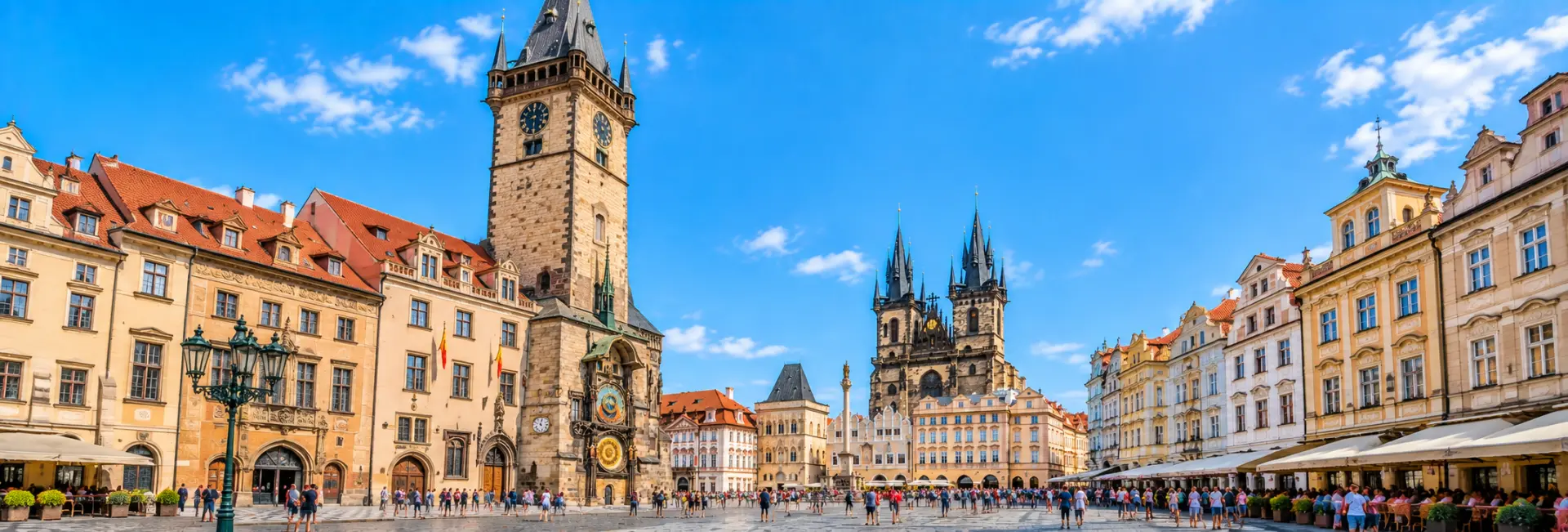
Mounted on the southern face of the Old Town Hall tower, the Prague Astronomical Clock, known locally as the Orloj, is the oldest astronomical clock in the world that still runs on its original mechanism. Since 1410 it has tracked far more than the hour: the position of the sun and moon against the zodiac, the changing seasons, and a calendar of saints' days, all displayed on two large ornamented dials.
What draws most visitors, though, happens on the hour, when a small door opens above the clock face and a procession of wooden apostles rotates past two tiny windows while a skeletal figure of Death tips an hourglass below. The combination of medieval engineering, folk legend, and free street theater has made the clock one of the most photographed spots in Central Europe and a fixture of any visit to Prague's Old Town Square.
History
Origins on the Old Town Hall
The Old Town Hall itself dates to 1338, when Prague's Old Town councillors converted a merchant's house on the square into their seat of government, gradually adding a tower and connecting buildings over the following decades. The clock came later: it was installed on the tower's south wall in 1410, built by the clockmaker Mikuláš of Kadaň working alongside Jan Šindel, an astronomer at Charles University who is credited with designing the clock's astronomical calculations.
Later Additions and the Hanuš Legend
Around the end of the 15th century, a master craftsman named Jan Hanuš (also written Hanuš of Růže) reworked the mechanism and is often, if imprecisely, remembered as the clock's original inventor. A well-known Prague legend claims town councillors had Hanuš blinded afterward so he could never build a rival clock elsewhere, and that a heartbroken Hanuš sabotaged the mechanism before he died, silencing it for decades. Historians treat the story as folklore layered onto the real craftsman rather than a documented event, but it remains one of the city's most retold tales. The lower calendar dial, meanwhile, is a much newer addition: its painted roundel was created in 1865 by the Czech artist Josef Mánes.
Damage and Restoration
The clock has been rebuilt and repaired many times over six centuries. Its most serious damage came on 8 May 1945, during the Prague Uprising near the end of the Second World War, when German artillery set fire to the Old Town Hall's eastern wing and destroyed the clock's wooden apostle figures along with much of the town hall archive. Craftsmen carved replacement figures and restored the mechanism within a few years, and the clock has undergone several further conservation projects since, including a multi-month overhaul completed in 2018 that cleaned and restabilized the gears and astronomical dial.
Architecture & Design
The Astronomical Dial
The upper and larger of the clock's two faces is the astronomical dial, a working model of the sky as understood by medieval astronomers. Concentric rings and a rotating star field show the sun's and moon's positions against the zodiac, the current position of the sun above or below the horizon, and readings in three different time systems used in medieval Bohemia, alongside the modern hour. Gilded Gothic script and hand-forged ironwork frame the dial, giving it a dense, almost jewel-like appearance despite its scientific purpose.
The Calendar Dial
Below the astronomical dial sits the calendar dial, a painted disc that rotates once a year and marks each day with its corresponding saint. Mánes's 19th-century roundels around its edge depict the twelve months through scenes of rural Bohemian life, from spring plowing to winter woodcutting; the originals now hang in the Prague City Museum, with faithful copies in place on the tower. Carved and painted figures of the twelve zodiac signs ring the outer edge of the same dial.
Recognition & Status
The Old Town Hall and its clock sit within the Historic Centre of Prague, which UNESCO inscribed as a World Heritage Site in 1992 in recognition of the exceptional density and preservation of Gothic, Renaissance, and Baroque architecture across the district. The clock is also protected as a Czech national cultural monument, a status that governs how any restoration or repair work on the mechanism and its casing must be carried out.
Beyond its formal status, the Orloj functions as an unofficial symbol of Prague itself, appearing on postcards, guidebooks, and civic branding far more often than any single building in the city, in part because it is both genuinely historic and instantly recognizable even to visitors seeing it for the first time.
What to See on the Clock
The Walk of the Apostles
Every hour between roughly 9:00 and 21:00 (check current posted times, as they shift seasonally), a bell rings and two small shuttered windows above the clock face open. A rotating carousel inside carries wooden figures of the twelve apostles past the windows in a slow procession, each visible for only a couple of seconds before the doors swing shut and a gilded rooster crows to mark the end of the show. The full performance lasts less than a minute, so most visitors watch for the buildup rather than the show itself.
The Four Moving Figures
Flanking the astronomical dial are four carved figures representing vices and fears that were prominent in medieval thought: a skeleton symbolizing Death rings a bell and tips an hourglass at the top of each hour, while figures representing Vanity, Greed, and, in older readings, foreign conquest or unchecked desire nod or shake their heads in response. Death's gesture triggering the whole sequence is the visual cue most visitors watch for before the apostles appear above.
- Astronomical dial: sun, moon, and zodiac positions
- Calendar dial: saints' days and Mánes's monthly roundels
- Four allegorical figures flanking the dial
- Twelve rotating apostle figures in the upper windows
- Gilded rooster that crows at the end of the hourly show
Ways to Experience It
Most visitors experience the clock for free, simply by standing in Old Town Square before the hour and watching the show from ground level. For a closer look at the mechanism itself, paid tickets grant access to the Old Town Hall's interior, including a viewing gallery near the clock's inner workings and a walk up (or lift ride up part of) the tower for a panoramic view over the square and the city's rooftops.
- Watch the free hourly apostle show from the square
- Buy a combined ticket for the Old Town Hall tower and clock mechanism viewing
- Join a guided walking tour that covers the clock's history and legends alongside the rest of Old Town
- Return after dark to see the clock and tower illuminated against the square
Best Time to Visit
The clock performs on the hour throughout the day, so timing is less about the show itself and more about avoiding crowds. Early morning, shortly after the square opens for the day, and late evening tend to be the quietest windows for a clear view, while midday and early afternoon draw the thickest crowds, especially in summer. Visiting on the hour during peak tourist season can mean standing several rows back from the clock face.
Seasonally, late spring and early autumn offer a reasonable balance of mild weather and smaller crowds compared with the height of summer. A winter visit, particularly around the Christmas market season when Old Town Square is strung with lights and stalls, gives the clock a different, festive backdrop, though the square itself becomes busier for that reason.
Visitor Tips
A little planning goes a long way with a sight this popular, since the appeal of watching the show is easily undercut by a poor vantage point or a rushed viewing.
- Arrive 10-15 minutes before the hour to secure a clear sightline, since good spots fill quickly
- Stand slightly off to the side rather than directly in front for a less obstructed view of the apostle windows
- Keep an eye on belongings in the crowd, as dense tourist gatherings are a common target for pickpockets
- Book tower and interior tickets online in advance during peak season to skip the ticket-office queue
- The tower has a lift for part of the ascent, but check current accessibility details before visiting if mobility is a concern
- Remember the astronomical dial does not show the time the way a normal clock does; look to the smaller clock hands or the top of the tower for a quick read of the hour
Nearby Attractions
The clock sits at the center of Old Town Square, so most of Prague's historic core is within easy walking distance, making it a natural anchor point for a half-day or full-day sightseeing loop.
- Church of Our Lady before Týn, the twin-spired Gothic church across the square
- St. Nicholas Church, a Baroque landmark on the square's northern side
- Charles Bridge, roughly a 10-minute walk toward the Vltava River
- Josefov, Prague's historic Jewish Quarter, just north of the square
- Wenceslas Square, a short walk through the Old Town's shopping streets
FAQs about visiting the Prague Astronomical Clock
What is the Prague Astronomical Clock? +
It is a medieval astronomical clock mounted on the Old Town Hall in Prague's Old Town Square, first installed in 1410, that tracks the sun, moon, and zodiac alongside the time of day and puts on a short mechanical show of the Twelve Apostles every hour.
Is the Prague Astronomical Clock the oldest in the world? +
It is widely recognized as the oldest astronomical clock still in operation, since its original medieval mechanism, though repaired and adjusted many times, has never been fully replaced.
Is it free to watch the clock? +
Yes, watching the hourly show from Old Town Square costs nothing; tickets are only needed if you want to enter the Old Town Hall, view the mechanism up close, or climb the tower.
How long does the hourly show last? +
The full sequence, from the ringing bell to the rooster's crow, takes under a minute, so it is worth arriving early rather than expecting an extended performance.
What is the best time to visit to avoid crowds? +
Early morning or later in the evening tend to be quieter than midday, and visiting outside the peak summer season generally means more breathing room around the clock face.
Can you climb the Old Town Hall tower next to the clock? +
Yes, a paid ticket includes access to the tower, which has a partial lift and a viewing gallery near the top with panoramic views over Old Town Square and the wider city.
Is the story about the clockmaker being blinded true? +
It is a popular Prague legend rather than a documented historical event; the craftsman most associated with the tale, Jan Hanuš, did work on the clock in the late 15th century, but the blinding and sabotage story is folklore that grew up around him over time.
What else is nearby worth visiting? +
The Church of Our Lady before Týn, St. Nicholas Church, and Charles Bridge are all within a short walk, making the clock a convenient starting point for exploring the rest of historic Prague.
