
Table of Contents
Overview
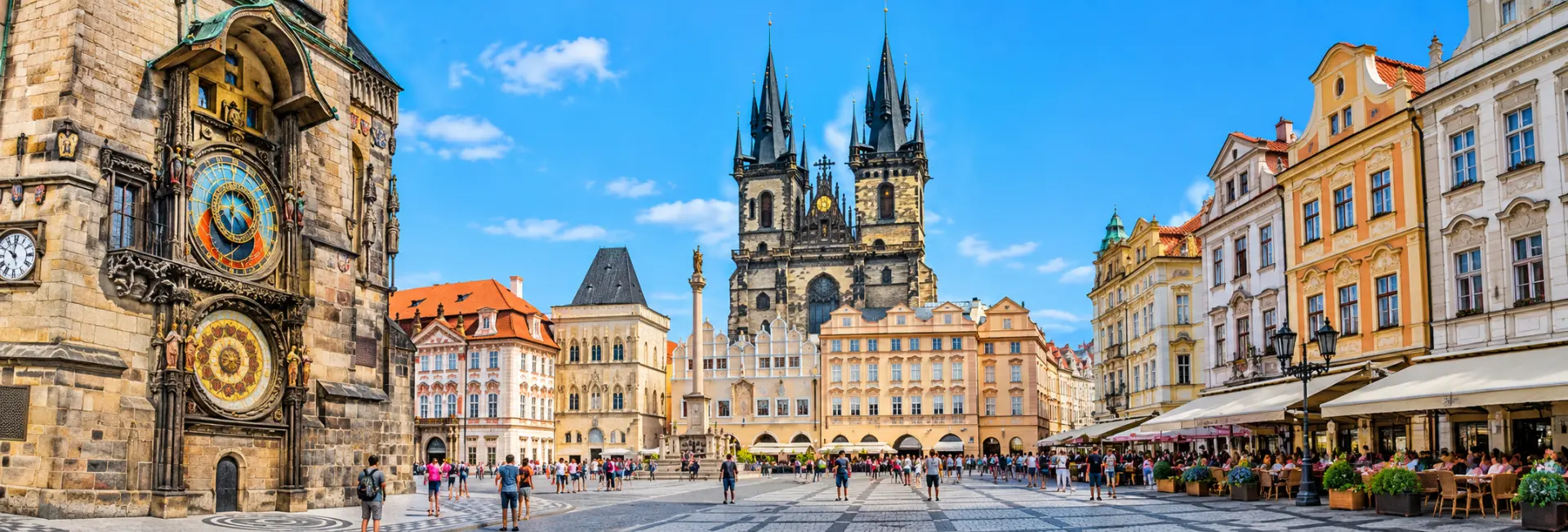
Old Town Square, known locally as Staroměstské náměstí, is the historic heart of Prague and usually the first image people picture when they think of the city. Pastel-colored merchant houses, Gothic church towers and a famous medieval clock all crowd around a cobbled square that has served as Prague's main public gathering space for nearly a thousand years.
Unlike a single monument, the square works more like an open-air museum of Prague's architectural history, with Romanesque, Gothic, Baroque and Rococo buildings standing side by side around its edges. It sits right between two of the city's other major landmarks, Wenceslas Square and Charles Bridge, which makes it an almost unavoidable stop on any walk through central Prague, whether you come specifically to see it or simply pass through on the way somewhere else.
The square also functions as a genuine crossroads of daily life in Prague, not just a set piece for visitors. Locals cut through it on their way to work, street performers and market stalls come and go with the seasons, and the surrounding cafes and shops give the space a lived-in feel that's easy to miss if you only glance at it from a tour bus window.
History
A Medieval Marketplace
The square's origins trace back to the 10th and 11th centuries, when it functioned as a market at the meeting point of several important European trade routes rather than as a formally planned civic space. By the 12th century it had taken on a more defined shape, and it has remained the center of what's now called Prague's Old Town ever since.
Seat of Power and Religion
The Old Town Hall was established here in 1338 as the seat of the district's local administration, and its Gothic tower, completed in 1364, was for a time the tallest structure in the city. Over the following centuries the square filled in with churches, guild houses and grand residences, reflecting Prague's growing importance after Charles IV became Holy Roman Emperor in 1355 and turned the city into an imperial capital.
A Stage for Czech History
The square has repeatedly served as a backdrop for major turning points in Czech history. In June 1621, following the Battle of White Mountain, 27 Czech Protestant noblemen and leaders were publicly executed here, an event still marked today by 27 crosses set into the pavement near the Old Town Hall. Centuries later, during the final days of the Prague Uprising in May 1945, the town hall itself was shelled and set on fire, destroying its eastern wing, which was never rebuilt.
A Living Landmark
Beyond these dramatic moments, the square has also hosted centuries of more ordinary civic life, from public proclamations and markets to, more recently, concerts, festivals and political gatherings. That layering of tragedy, celebration and everyday commerce is a big part of why Czechs still treat the square as a genuine symbol of the nation rather than simply a tourist backdrop.
Key Landmarks
- Old Town Hall: founded in 1338, home to the Astronomical Clock and a climbable tower with panoramic views over the rooftops
- Church of Our Lady before Týn: a Gothic church with twin spires that dominate the square's skyline, its towers famously not quite identical due to the long, interrupted construction
- St. Nicholas Church: a Baroque church on the square's western side, known for its elaborate interior and occasional concerts
- Kinský Palace: a Rococo building that now houses part of the National Gallery's collections
- House at the Stone Bell: a Gothic townhouse, rediscovered behind a later facade in the 20th century and now used for exhibitions
- Jan Hus Memorial: a large monument at the center of the square, unveiled in 1915 on the 500th anniversary of the reformer's execution
Together these buildings span roughly five centuries of architectural styles, which is part of why the square rewards slow, careful looking rather than a quick glance from the middle of the crowd.
The Astronomical Clock
Mounted on the southern wall of the Old Town Hall, the Prague Astronomical Clock, known locally as the Orloj, was first installed in 1410, making it the oldest astronomical clock still in operation anywhere in the world. Its main dial tracks the position of the sun and moon and displays several different time systems at once, while a calendar dial below shows the months and saints' days associated with each date.
Every hour between roughly 9am and 11pm, a short mechanical show plays out above the clock face: a figure representing Death tips an hourglass and pulls a bell rope, windows open to reveal a procession of the Twelve Apostles, and a small golden rooster crows to mark the top of the hour. The show itself lasts under a minute, but crowds routinely gather ten or fifteen minutes early to secure a good view, and the tower attached to the clock can also be climbed for one of the best rooftop panoramas in the city.
The clock's history has its own share of legend. One long-standing story claims its medieval maker, Mikuláš of Kadaň, was blinded by the town council after finishing the clock so he could never build another one to rival it, and that he took his revenge by sabotaging the mechanism before he died. Historians generally treat this as folklore rather than fact, but it's one of the stories guides on the square still tell most often.
Ways to Experience It
Most visitors start by simply standing in the square and taking in the mix of architecture before working their way toward specific landmarks like the clock tower or Týn Church. Because everything of interest sits within a short walk of the center, it's easy to spend anywhere from twenty minutes to a couple of hours here depending on how many of the surrounding buildings you want to go inside.
- Watching the Astronomical Clock: free to view from the square on the hour, with the option to pay for tower access afterward
- Climbing the Old Town Hall Tower: offers panoramic views back over the square and across Prague's rooftops toward the castle
- Visiting Týn Church: open to visitors during set hours, though these can shift, so it's worth checking posted times at the entrance
- Free walking tours: several companies run tours starting from the square that cover its history and legends in more depth
- Seasonal markets: Christmas and Easter markets fill much of the square with stalls, food and mulled wine during their respective seasons
Beyond the square itself, the streets just behind Týn Church lead into Ungelt, a former merchant courtyard now lined with quieter cafes, which makes a good spot to sit down away from the busiest part of the crowd without walking far.
Best Time to Visit
The square is busiest from around 10am to 6pm, especially in summer and during the Christmas and Easter market seasons, when both the crowds and the noise level climb noticeably. Arriving before 9am gives a much calmer view of the buildings and a decent chance at photographing the clock tower without a wall of people in front of it, while an evening visit after around 9pm offers a quieter, more atmospheric version of the same view once the tour groups have thinned out.
Winter brings the Christmas markets, which give the square a completely different character, full of lights, stalls and mulled wine, though also considerably more crowded than the rest of the year. Spring and autumn tend to offer the most comfortable balance of mild weather and manageable crowds for visitors who want to linger rather than just pass through.
Photographers in particular tend to favor the very first hour after sunrise, when the low light catches the Týn Church spires and the square is still empty enough to get a clean shot of the Old Town Hall without a crowd gathered in front of the clock.
Visitor Tips
- The square itself is free and open at all times, with no ticket needed simply to walk through and see the buildings from outside
- Entry fees apply for climbing the Old Town Hall Tower and for some of the individual buildings, such as Kinský Palace's gallery spaces
- Watch for pickpockets in the densest crowds, particularly right before the Astronomical Clock's hourly show
- The cobblestones can be uneven underfoot, so comfortable shoes are worth it if you plan to be on your feet for a while
- Restaurants directly on the square tend to charge tourist prices, so it's often better value to eat a block or two away
Nearby Attractions
Old Town Square sits at the center of a dense cluster of historic sights, making it a natural hub for exploring the rest of Prague's old center on foot.
- Charles Bridge, a short walk southwest through the Old Town's narrow streets
- Wenceslas Square, a short walk south, marking the start of Prague's New Town
- Josefov, the historic Jewish Quarter, just north of the square with its synagogues and old cemetery
- Municipal House and the Powder Tower, a short walk east along the old city walls
FAQs about visiting Old Town Square
Is Old Town Square free to visit? +
Yes, the square itself is free and open at all times, though a few individual sights around its edges, like the Old Town Hall Tower, charge their own separate entry fee.
How old is the Astronomical Clock? +
It was first installed in 1410, which makes it the oldest astronomical clock still working anywhere in the world.
When does the Astronomical Clock's show happen? +
The mechanical show runs every hour, roughly between 9am and 11pm, though it lasts under a minute, so it's worth arriving a few minutes early to get a clear view.
What are the 27 crosses in the pavement? +
They mark the site where 27 Czech Protestant noblemen and leaders were publicly executed in June 1621, following the Battle of White Mountain.
How much time should I plan for a visit? +
Twenty minutes to an hour covers the square itself, though visitors who also climb the tower or go inside nearby churches and museums often spend closer to two or three hours in the area.
When is the best time to visit for fewer crowds? +
Early morning before 9am or evening after about 9pm are both quieter than the middle of the day, when tour groups and day-trippers fill the square.
Is Old Town Square good to visit in winter? +
Yes, it hosts one of Prague's best-known Christmas markets, though it also gets considerably more crowded during that period than at other times of year.
What else is nearby worth combining with a visit? +
Charles Bridge, Wenceslas Square, the Josefov Jewish Quarter and the Municipal House are all within a short walk of Old Town Square.
