
Table of Contents
Overview
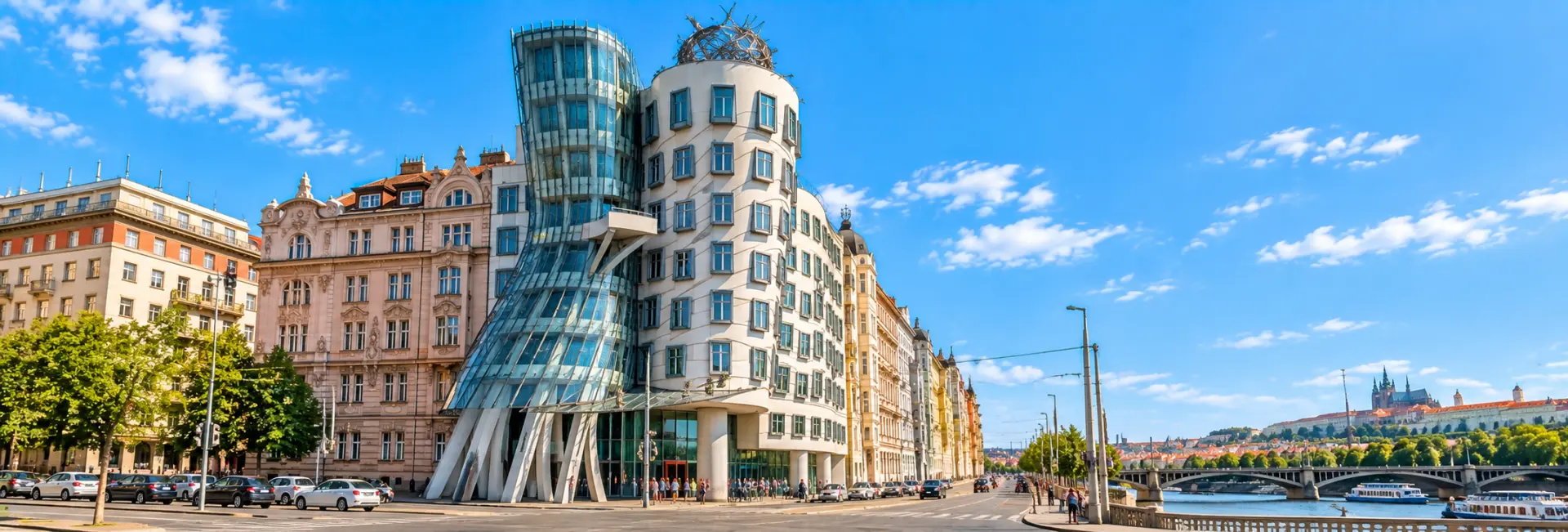
Standing on the Rašín Embankment beside the Vltava River, the Dancing House is one of the few buildings in central Prague built after 1989 to become as recognizable as the city's medieval landmarks. Its two intertwined towers, one a solid curved form and the other a glass structure that appears to sway, gave rise to its nickname, inspired by the dancers Fred Astaire and Ginger Rogers, whom the design is said to evoke.
Completed in 1996 to designs by Frank Gehry and Vlado Milunić, the building sits on a site that had been an empty lot since a wartime bombing decades earlier, and its unapologetically modern silhouette against a backdrop of Art Nouveau and Baroque facades made it one of the most debated buildings in the country when it opened. Today it houses offices, a hotel, a gallery, and a rooftop restaurant, and functions as a working symbol of Prague's architectural leap into the post-communist era.
History
A Site Shaped by War
The building occupies a corner plot where an apartment house once stood before it was destroyed during an American bombing raid on Prague on 14 February 1945, one of the final months of the Second World War. The ruined building was gradually cleared over the following years, and the site sat vacant for decades afterward, situated next to the home of future Czechoslovak and Czech president Václav Havel, who grew up nearby and long hoped to see a cultural center built there.
Design and Construction
The project moved forward in 1992, when the Dutch insurance company Nationale-Nederlanden purchased the land and selected Croatian-Czech architect Vlado Milunić to lead the design. At the company's request, Milunić brought in a second architect; after French architect Jean Nouvel declined due to the site's small footprint, Milunić invited Canadian-American architect Frank Gehry, who accepted. The two met for the first time in Geneva in 1992 and developed the design together, laying the foundation stone in March 1994 and completing construction in 1996.
Reception and Recognition
The building's radically modern form, set among the neoclassical and Art Nouveau buildings that line the embankment, provoked strong criticism when it opened, with detractors arguing it clashed with the character of the historic district. That debate cooled over time, and the building went on to win Time magazine's Design of the Year award in 1996, later becoming one of the most photographed structures in the city and a recognized symbol of the country's transition out of communist rule.
Architecture & Design
Fred and Ginger
The building's structure is often read as a pair of dancers: a static, cylindrical tower finished in white concrete stands in for Fred Astaire, while an adjoining glass tower, tapered and leaning as if in motion, represents Ginger Rogers. Milunić described the two halves as a "yin and yang" composition, intended to symbolize the country's shift from a rigid political system toward a more dynamic, open society.
The Medusa Dome
Crowning the concrete tower is a distinctive dome nicknamed Medusa, built from curved metal pipes wrapped in a dense stainless-steel mesh that has been likened to a tangle of hair or the head of a jellyfish. The sculptural rooftop element was designed by Gehry as the building's finishing gesture and is visible from much of the surrounding embankment.
Materials and Facade
The riverside facade is built from 99 individually shaped prefabricated concrete panels, whose undulating lines were designed to echo the movement of the Vltava's waters below. Gehry and Milunić left the building's materials, glass, concrete, and steel, in their natural finishes rather than painting them, so the structure reads as a deliberate contrast of raw textures against the ornamented plasterwork of its neighbors.
Recognition & Status
The Dancing House was awarded Time magazine's Design of the Year prize in 1996, one of the clearest early signals that a building widely criticized at home was being read very differently abroad. The Czech National Bank later selected it for a commemorative coin in a series dedicated to ten centuries of Czech architecture, cementing its place in the country's own architectural canon alongside far older monuments.
While it sits within the broader area of Prague's historic riverside, the Dancing House itself is a 20th-century building rather than a protected medieval or Baroque monument, and its significance rests on its architectural and cultural impact rather than a heritage listing.
What to See There
Gallery Dancing House
A ground-floor gallery inside the building hosts rotating exhibitions, frequently focused on Czech artists, architecture, and design, giving visitors a reason to step inside beyond viewing the exterior.
Ginger & Fred Restaurant and the Glass Bar
Near the top of the building, a restaurant and adjoining bar occupy the upper floors, with an outdoor terrace that takes in sweeping views over the Vltava River toward Prague Castle. The interiors throughout much of the building were shaped by Czech-British architect Eva Jiřičná, whose work softened some of the building's more angular exterior geometry into curved, functional interior spaces.
- The concrete "Fred" tower and glass "Ginger" tower from the embankment below
- The Medusa dome atop the stone tower
- Rotating exhibitions inside Gallery Dancing House
- Panoramic terrace views from the rooftop restaurant and bar
Ways to Experience It
Most visitors experience the Dancing House from the outside, walking the riverside embankment or crossing nearby bridges for different angles on its curved facade. For a closer look, the ground-floor gallery and the rooftop restaurant and bar are open to the public, offering both a cultural stop and one of the better elevated views over the river and castle skyline.
- Walk or cycle along the Rašín Embankment for street-level views of the facade
- Cross the nearby Jirásek Bridge for a wider view of the building against the riverfront
- Visit the ground-floor gallery to see current exhibitions
- Book a table at the rooftop restaurant or bar for a view over the Vltava and Prague Castle
- Take a river cruise past the embankment to see the building from the water
Best Time to Visit
Because the main draw is the building's exterior, the Dancing House can be visited at any time of day, though early morning and late afternoon light tend to bring out the texture of its curved concrete panels and glass facade most clearly. Evening visits are worthwhile for the illuminated facade and for rooftop dining as the sun sets over the river.
The riverside embankment is generally less crowded than Prague's Old Town core, so the building rarely requires timing a visit around crowds, though the rooftop restaurant benefits from an advance reservation, particularly on weekend evenings.
Visitor Tips
The Dancing House works well as a quick stop or a longer one, depending on whether a visit stays outdoors or includes the gallery and restaurant.
- Reserve a table in advance for the rooftop restaurant or bar, especially for sunset views
- Check current exhibition listings for Gallery Dancing House before visiting, since shows rotate
- Combine a visit with a walk along the embankment toward the National Theatre for more riverside views
- Photograph the building from across the river or from a nearby bridge to capture the full silhouette
- Note that most of the building's floors are private offices and are not open to visitors
Nearby Attractions
The Dancing House sits on the edge of Prague's New Town along the riverbank, within easy reach of several other sights.
- National Theatre, a short walk along the embankment
- Vyšehrad fortress and park, further south along the river
- Wenceslas Square, a walkable route through the New Town
- Charles Square, one of Prague's largest public squares, just inland from the building
- Jirásek Bridge, offering wide views back toward the Dancing House and the riverfront
FAQs about visiting the Dancing House
What is the Dancing House? +
It is a distinctive office building on Prague's Rašín Embankment, designed by architects Frank Gehry and Vlado Milunić and completed in 1996, nicknamed for its resemblance to a pair of dancers.
Why is it called the Dancing House? +
Its two towers, a solid curved form and a leaning glass structure, were designed to evoke the dancers Fred Astaire and Ginger Rogers, and the building was originally referred to as Fred and Ginger.
Can you go inside the Dancing House? +
Most of the building is private office space, but the ground-floor gallery and the rooftop restaurant and bar are open to the public.
Is there an entry fee to see the Dancing House? +
Viewing the exterior from the street is free; there is no admission charge for the building itself, though the gallery and rooftop restaurant charge for exhibitions or dining as usual.
What was on the site before the Dancing House was built? +
An apartment building stood there until it was destroyed in an American bombing raid on Prague in February 1945, after which the site remained vacant for decades.
Was the Dancing House controversial when it was built? +
Yes, its modern design drew significant criticism for standing out among the historic Art Nouveau and Baroque buildings nearby, though it later won international design awards and became widely accepted as a landmark.
What is the metal dome on top of the building? +
It is a sculptural element nicknamed Medusa, made of curved steel pipes covered in wire mesh, designed by Frank Gehry to crown the building's concrete tower.
What's nearby the Dancing House? +
The National Theatre, Charles Square, and Vyšehrad fortress are all within walking distance along or near the river.
