
Table of Contents
Overview
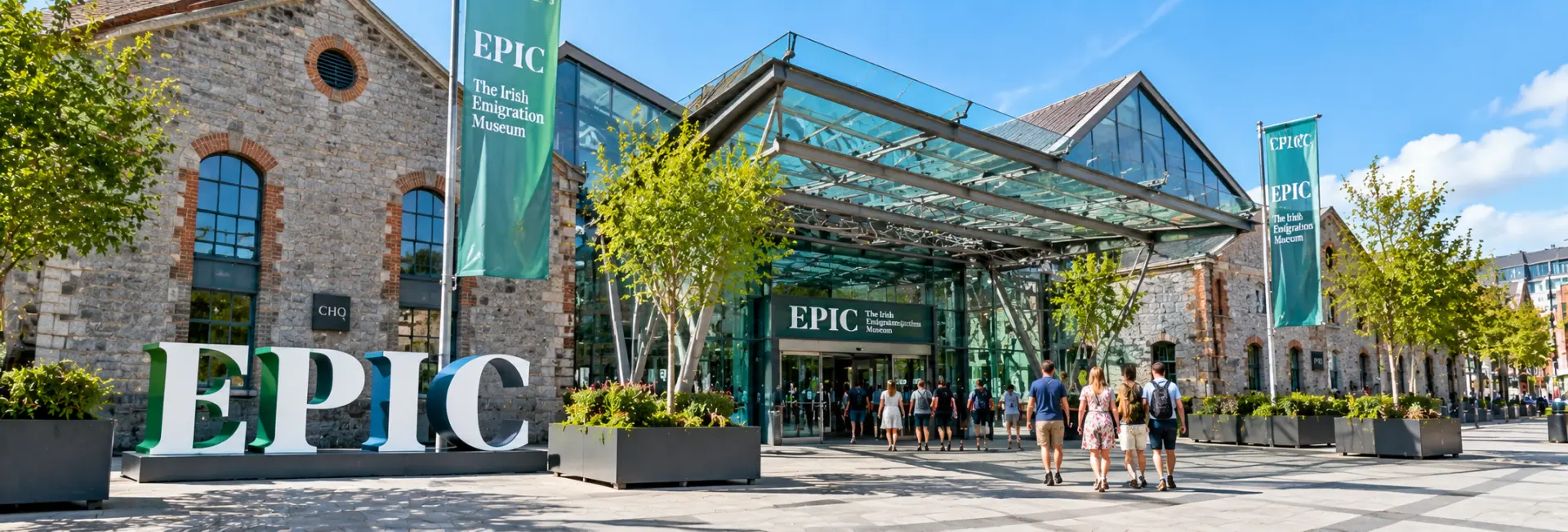
EPIC The Irish Emigration Museum sits in the vaulted cellars of the CHQ Building on Custom House Quay, in the heart of Dublin's Docklands. Billed as the world's first fully digital museum, it uses touchscreens, motion sensors and archive audio and video, rather than glass cases of objects, to tell the story of the roughly 10 million people who have left Ireland since around 500 AD, and the estimated 70 million people worldwide who claim Irish heritage today.
Visitors follow a self-guided route through 20 themed galleries, collecting a stamp in a souvenir passport at each stop. Since opening in 2016, EPIC has become one of Dublin's most decorated attractions, shortlisted for the European Museum of the Year Award and named Europe's Leading Tourist Attraction at the World Travel Awards three years running.
History of the Museum
EPIC was the vision of Neville Isdell, the former chairman and chief executive of The Coca-Cola Company and a member of the Irish diaspora himself. In 2013, Isdell bought the CHQ Building and decided to fund and house a museum dedicated to Irish emigration within it, an idea driven by his belief that the diaspora's role in shaping Ireland, and the countries emigrants settled in, deserved a dedicated cultural institution.
Isdell assembled an academic advisory panel to research the museum's content and appointed Event Communications, a London-based museum design consultancy that had previously worked on Titanic Belfast, to design and build the galleries. Around €15 million was invested in the project before it opened to the public in May 2016, officially launched by former Irish President Mary Robinson.
In its first year, EPIC drew around 120,000 visitors and a nomination for the European Museum of the Year Award. It went on to be named Europe's Leading Tourist Attraction at the World Travel Awards in 2019, 2020 and 2021, ahead of established sites such as the Colosseum and the Acropolis.
Part of the museum's stated aim was to move beyond a narrative built solely around hardship. Alongside chapters on famine and forced departure, EPIC set out to celebrate the achievements of the diaspora, presenting emigration as a story of resilience and global influence rather than loss alone, a balance the museum's founders and curators have described as central to its design from the outset.
The CHQ Building
EPIC occupies the stone vaults beneath the CHQ Building, one of Dublin's most historic dockside structures. Built between 1817 and 1820 and originally known as Stack A, or the Tobacco Store, the warehouse was begun by the engineer John Rennie and completed by Thomas Telford to hold valuable cargoes of tobacco, tea and spirits arriving through Dublin Port.
The building's barrel-vaulted chambers, supported by an early iron structural frame, once stored bonded goods; today they house EPIC's digital galleries, while the floor above operates as a retail, dining and events hub. The site carries a symbolic weight for a museum about emigration, since it stands on the quay from which many ships carrying Irish emigrants once departed, overlooking the River Liffey.
Fitting a fully digital exhibition into a two-century-old, protected structure required a careful touch. Designers had to route modern cabling, screens and motion-sensor equipment through the building's historic ironwork and stonework without altering its protected fabric, so that the museum's contemporary technology and the warehouse's original industrial character sit side by side rather than competing with one another.
Collections & Galleries
Rather than a traditional collection of artifacts, EPIC's "collection" is entirely digital, drawing on letters, photographs, testimonies and archive recordings gathered from Irish communities around the world. Its 20 galleries are arranged into four broad themes that trace roughly 1,500 years of emigration history.
- Migration (Galleries 1–2) charts patterns of Irish movement abroad from around 500 AD onward.
- Motivation (Galleries 3–7) explores why people left, including the Great Famine, religious and social persecution, and criminal transportation.
- Influence (Galleries 8–18) covers the diaspora's impact on politics, business, science, sport, music, dance, literature and fashion around the world.
- Diaspora Today (Galleries 19–20) brings the story into the present through social media posts, emails and personal accounts from Irish people currently living abroad.
The CHQ Building also houses the Irish Family History Centre, a genealogy service where professional researchers help visitors trace their own Irish ancestry using historical records, available as an add-on to a museum visit.
Because so much of the underlying documentation of Irish emigration survives only in scattered archives, and because a large share of Ireland's own official records were destroyed in a fire in 1922, EPIC's galleries lean heavily on personal testimony, letters and oral history gathered from families abroad to fill in the gaps that official records cannot, giving the collection much of its distinctly personal, story-led character.
Must-See Highlights
The Passport Experience
On arrival, visitors pass through mock departure gates and receive a souvenir passport, which is stamped in each gallery along the route and doubles as a keepsake of the visit.
Video Testimonies and Personal Stories
Several galleries feature video testimony from real emigrants, alongside poignant touches such as a display built around packing a single suitcase with the belongings of a life left behind.
Notable Figures of the Diaspora
Displays highlight individual figures whose Irish roots shaped world history, including James Hoban, architect of the White House, Cedric Gibbons, designer of the Oscar statuette, and the numerous United States presidents who claim Irish ancestry.
Music & Dance Gallery
One of the more playful stops lets visitors try out Riverdance-style steps on a motion-sensor dance floor, guided by an on-screen instructor, alongside remastered recordings of traditional Irish music.
Diaspora Today
The final galleries turn from history toward the present, gathering social media posts, emails and blog entries contributed by Irish people currently living abroad, a running, crowd-sourced snapshot of what the diaspora looks like today rather than a fixed historical record.
Ways to Experience It
EPIC is designed as a self-guided experience: there are no scheduled tour times, and visitors move through the 20 galleries at their own pace, engaging with touchscreens, video walls and interactive quizzes as they go. A typical visit takes roughly ninety minutes to two hours, though some visitors linger closer to three.
Those curious about their own family history can extend the visit with a consultation at the on-site Irish Family History Centre, where professional genealogists help trace Irish ancestors using historical records, for an additional fee. The museum is fully wheelchair accessible, with lifts between floors, seating throughout the galleries, a Quiet Room, and sensory supports for visitors who need them.
EPIC is also frequently combined with other Dublin sightseeing options, appearing as part of multi-attraction city passes and joint tickets alongside hop-on hop-off bus tours and other Docklands attractions, which can suit visitors planning a fuller day of sightseeing around the museum itself.
Best Time to Visit
EPIC is open daily year-round, though exact opening and closing times can vary by season, so it is worth checking the current hours before setting out, especially around public holidays. Weekday mornings tend to be quieter than weekend afternoons, when the museum can be busy with families and tour groups.
Because the galleries are entirely indoors and screen-based, EPIC also makes a good option on a wet Dublin afternoon, when an open-air sightseeing plan is less appealing. From time to time the museum takes part in citywide evening events with extended opening hours, which is worth watching for if a quieter, after-hours visit appeals.
Visitors travelling with a strong interest in genealogy may also want to build extra time into their schedule beyond the standard museum route, since a family history consultation at the on-site centre is normally booked as a separate, timed appointment rather than something to fit in casually between galleries.
Visitor Tips
- Booking tickets online in advance is recommended, particularly for weekend visits, since walk-in availability is not guaranteed.
- Allow ninety minutes to two hours to see the museum properly, longer if you plan to read every display or add a genealogy consultation.
- Children aged five and under are usually admitted free, and children must be accompanied by an adult throughout the visit.
- Luggage storage is available on site, useful for visitors arriving straight from a train or heading on afterward.
- The nearest stop is George's Dock on the Luas Red Line; DART services at Connolly, Tara Street and Pearse stations are also within walking distance.
- Keep your stamped passport at the end of the tour, as it doubles as a memento of the visit and, at times, unlocks a small surprise.
Nearby Attractions
EPIC's Docklands location puts several other emigration-themed and historic sites within a short walk. The Custom House, an 18th-century landmark on the Liffey, stands close by, as does the Jeanie Johnston, a replica famine-era emigrant ship that can be toured separately.
- The National Famine Memorial sculptures line the quayside a short walk from the museum, depicting gaunt figures heading toward the emigrant ships.
- The Custom House, one of Dublin's grandest 18th-century civic buildings, overlooks the river nearby.
- Dublin's Convention Centre and the IFSC business district are both within easy walking distance, along the Docklands quays.
- The city centre's main shopping streets and O'Connell Street are around a fifteen-minute walk to the west.
FAQs about visiting EPIC The Irish Emigration Museum
What is EPIC The Irish Emigration Museum? +
It is a fully digital, interactive museum in Dublin's CHQ Building that tells the story of Irish emigration and the global impact of the Irish diaspora through 20 themed galleries.
How long does a visit take? +
Most visitors spend around ninety minutes to two hours moving through the galleries, though it is possible to linger longer or move through more quickly.
Is EPIC suitable for children? +
Yes, the interactive, screen-based galleries appeal to children as well as adults, and children under five are usually admitted free, though they must be accompanied by an adult.
Do I need to book tickets in advance? +
Walk-ins are sometimes possible, but booking online in advance is recommended, especially for weekend visits, since the museum can sell out.
Can I research my own Irish ancestry at EPIC? +
Yes. The on-site Irish Family History Centre offers genealogy consultations with professional researchers as an add-on to a museum visit, for an additional fee.
Is the museum accessible for visitors with disabilities? +
Yes, EPIC is fully wheelchair accessible, with lifts between floors, seating throughout the galleries, a Quiet Room and sensory supports available.
How do I get to EPIC? +
The museum is in the CHQ Building on Custom House Quay in Dublin's Docklands; the nearest stop is George's Dock on the Luas Red Line, with DART stations at Connolly, Tara Street and Pearse also within walking distance.
