
Table of Contents
Overview
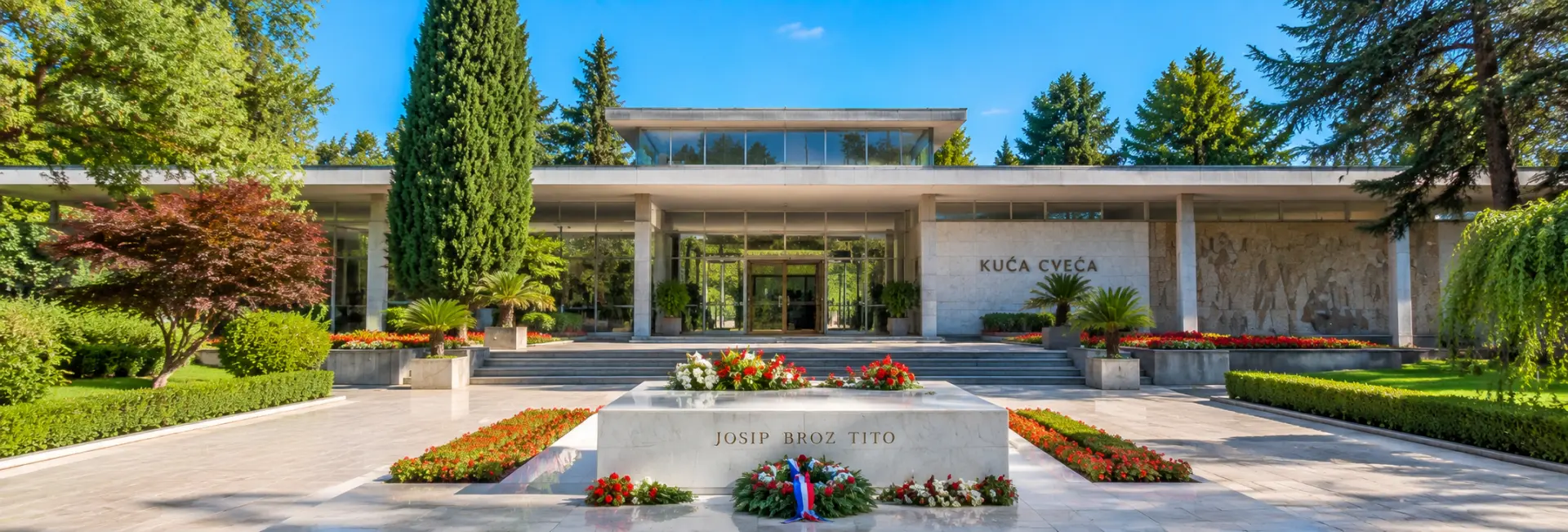
The House of Flowers, known in Serbian as Kuća Cveća, is the burial place of Josip Broz Tito, the long-time leader of socialist Yugoslavia, and of his wife Jovanka Broz. It sits in the green Dedinje district of Belgrade, within the grounds of the Museum of Yugoslavia, and it is one of the most visited and most talked-about historical sites in the city.
The building was never intended to be a mausoleum. It began life as a bright, glass-walled winter garden where Tito could work and relax, and only later became a tomb. That origin explains its unusual feel: light, calm and almost domestic, rather than solemn and monumental like many national memorials.
Visitors come for many reasons. Some want to understand the Yugoslav era, others to pay their respects, and others out of curiosity about a leader who remains a divisive and fascinating figure across the Balkans. The House of Flowers offers all of them a quiet, memorable place to reflect.
History
A Winter Garden for the President
The House of Flowers was completed in 1975 to a design by the architect Stjepan Kralj. During Tito's lifetime it was known informally as the flower shop, because it served as a covered garden with a few rooms for work and rest. It stood close to his official residence, so he spent much of his time there whenever he was in Belgrade.
The Burial of 1980
Tito died on 4 May 1980. In line with his own wish, he was buried in the central part of the House of Flowers on 8 May, only a few days later. At the time it was considered inappropriate to call the place a grave or mausoleum, so the existing name stayed in use, and it is still the name everyone uses today.
Opening to the Public
The site was opened to visitors in the early 1980s as part of the memorial centre dedicated to Tito. People travelled from all over Yugoslavia to see it, and the building became a place of pilgrimage for citizens of a country that spanned six republics.
After the Breakup of Yugoslavia
When Yugoslavia broke apart, the memorial complex was closed to the public for a long period and the military guards at the tomb were withdrawn. The House of Flowers was later integrated into the newly created history museum, and the site reopened to visitors, who have been coming ever since.
Jovanka Broz
Jovanka Broz, Tito's wife, died in 2013 and was laid to rest beside him. Her burial added a second grave to the central hall and brought renewed attention to the site.
Architecture & Design
A Modernist Pavilion
The House of Flowers is an example of Yugoslav modernism in its calmer, more intimate form. Clean lines, large glass surfaces and an open central space give the building a light, airy quality. It covers about 900 square metres, which is modest for a national burial place.
The Central Atrium
The heart of the building is a sunlit central hall. It once held a fountain and was surrounded by flowers and greenery, which is where the name comes from. When the tomb was installed, the fountain was removed to make room for it. Today, white stones lie where the flowers used to be, and natural light falls across the white marble.
Side Rooms and Corridors
Around the central hall, rooms originally planned for work and rest were arranged along two side corridors. These spaces now hold the exhibition of Relay of Youth batons, so the layout of the old winter garden still shapes how you move through the building.
The Terrace
On the side opposite the entrance, an open terrace looks out over Belgrade. The view is a pleasant pause after the quiet of the interior and a reminder of the garden-like purpose the building once had.
The Tomb of Tito and Jovanka Broz
The Central Grave
Tito's tomb lies in the middle of the atrium and is made of white marble. It is plain compared with many national memorials, and its simplicity is one of the things visitors often remark on. Jovanka Broz's grave lies beside it.
Atmosphere Inside
The hall tends to be quiet, with visitors speaking in low voices. Light from the glass walls and ceiling gives the space a calm, almost serene quality, which is unusual for a site connected with such a prominent political figure.
Remembrance Days
Many visitors from across the former Yugoslavia travel to the site on anniversaries tied to Tito, such as 4 May, the date of his death, and 25 May, which was celebrated in Yugoslavia as Youth Day. These dates can bring a stronger sense of ceremony and larger crowds.
The Relay of Youth Exhibition
What the Relay Was
The Relay of Youth was an annual tradition in which young people carried a baton from town to town across the country, ending with a ceremony in Belgrade on 25 May. From 1957, that date was celebrated as Youth Day, and the relay became one of the most recognisable rituals of the Yugoslav state.
The Batons on Display
The permanent exhibition in the House of Flowers presents batons from local, republic and federal relays. They come in many shapes and materials, and many were handmade by the communities that sent them. Messages, photographs and programmes from the celebrations accompany them, so the display works as a record of community life as well as of politics.
Why It Matters Today
The collection is among the most visually interesting in the museum complex. It shows how symbols of unity were created and shared, and it offers a human-scale way into a political era that can otherwise feel abstract.
Cultural & Political Significance
For many people, the House of Flowers is a symbol of nostalgia for Yugoslavia, a place where memories of a shared country, a stable economy and international prestige are still strong. For others, it is a reminder of a one-party system and its costs. Both views are part of the story, and the site invites visitors to consider them side by side.
The building also plays a quiet role in how Serbia and the wider region remember the 20th century. Its location inside a state museum means that debates about Yugoslavia's legacy continue within the same grounds that preserve its history.
Seen in that light, a visit is less about hero worship or criticism and more about understanding how a single person and a single state shaped the lives of millions. Many visitors leave with more questions than answers, which is part of the site's value.
Ways to Experience It
As Part of the Museum Complex
The House of Flowers stands within the grounds of the Museum of Yugoslavia, so it is easy to combine with the museum's other buildings, the park and the exhibitions. Many visitors begin with the main museum and finish at the tomb, which gives historical context first.
A Short, Focused Visit
If you only want to see the tomb and the batons, a short visit is possible. Walk up through the park, spend time in the central hall, explore the side corridors, and finish on the terrace.
Guided Tours
The museum has offered guided tours, and a guide can help place the site in its political and cultural context. Ask about current options, since the schedule may change.
Best Time to Visit
Season
Spring and early autumn are the most comfortable seasons, because the park is green and the walk up to the building is pleasant. Summer can be hot on the open paths, and winter is quiet and often cold.
Time of Day
Mornings and weekday afternoons are usually calm and suit those who want a reflective visit. Natural light is strongest around midday, which gives the central hall its characteristic brightness.
Anniversary Dates
The dates around 4 May and 25 May bring larger gatherings and a stronger commemorative atmosphere. They can be moving to witness, but expect more people and slower movement through the building.
Visitor Tips
- Treat the building as a place of remembrance: keep your voice low and follow any posted guidance on photography.
- Opening days, hours and ticket arrangements can change, and the museum has traditionally been closed on Mondays, so check the official website before going.
- Allow about 30 to 45 minutes for the House of Flowers itself, or two to three hours if you also tour the rest of the museum complex.
- Wear comfortable shoes, since the route runs through a park with gentle slopes.
- Be mindful that visitors hold very different opinions about Tito, and keep conversations respectful.
- Consider arriving by taxi or ride-hailing from the city centre, as Dedinje is a residential district a little outside the old town.
Nearby Attractions
The House of Flowers is part of a larger complex and is close to several other points of interest.
- Museum of Yugoslavia: The surrounding museum, with the 25 May Museum and the Old Museum showing the wider history of the state.
- Hajd Park: A large green space nearby, good for a walk after the visit.
- Dedinje Royal Compound: The royal residences in Dedinje, an elegant neighbourhood with a very different historical story.
- Topčider Park: A historic park a short ride away, closely tied to 19th-century Serbian history.
FAQs about visiting the House of Flowers
What is the House of Flowers? +
It is the burial place of Josip Broz Tito and his wife Jovanka Broz, located in the grounds of the Museum of Yugoslavia in Belgrade. It was built in 1975 as a winter garden and later became a tomb.
Why is it called the House of Flowers? +
The name comes from the flowers that once filled the central hall and surrounded the tomb. The flowers were later replaced with white stones, but the name stayed.
Who designed the House of Flowers? +
It was designed by the architect Stjepan Kralj and completed in 1975. It was first used as a winter garden with rooms for work and rest.
When was Tito buried there? +
Tito died on 4 May 1980 and was buried at the House of Flowers on 8 May 1980, in line with his own wish. Jovanka Broz was buried beside him in 2013.
What can I see inside? +
You can see the white marble tomb in the central hall and the Relay of Youth exhibition along the side corridors. A terrace on the far side offers a view over Belgrade.
What is the Relay of Youth? +
It was an annual tradition in which a baton was carried across Yugoslavia, ending with a celebration on 25 May, known as Youth Day. The museum displays many of the batons, along with messages and photographs.
How long does a visit take? +
Most visitors spend 30 to 45 minutes at the House of Flowers. If you also visit the other buildings of the Museum of Yugoslavia, plan two to three hours in total.
Is there an entrance fee? +
Entry is usually handled as part of the Museum of Yugoslavia complex, but prices and any free-entry days can change. Check the official website before you go.
Is there a dress code or etiquette? +
There is no strict dress code, but the site is a memorial, so dress modestly, speak quietly and follow any photography rules posted at the entrance.
