Table of Contents
Overview
The City of Arts and Sciences is a sprawling complex of white, sculptural buildings that stretches for roughly two kilometres along the dried-out bed of Valencia's old river, and it has become the city's most photographed modern landmark. Rather than a single museum or monument, it is a cluster of separate attractions, including a planetarium, an interactive science museum, an opera house, and Europe's largest aquarium, all unified by one architect's futuristic visual language.
Much of the appeal lies simply in walking among the buildings themselves, which sit reflected in long, shallow pools that double their visual impact and make the whole site feel almost otherworldly, especially at night when the structures are lit up. Whether or not a visitor buys a ticket to any single attraction inside, the complex works as a free open-air architecture experience in its own right, and it draws millions of visitors a year for exactly that reason.
For a city best known internationally for its historic old town and its Las Fallas festival each March, the complex represents a deliberate attempt to give Valencia a second, thoroughly modern identity, and by most measures of visitor numbers it has succeeded, becoming one of the most visited paid attractions anywhere in Spain.
History
A New Life for an Old Riverbed
The site occupied by the complex today did not exist as usable land until the middle of the 20th century. A catastrophic flood struck Valencia in 1957 when the Turia River overflowed its banks and swept through the city centre, causing serious damage and loss of life. In response, authorities diverted the river's course around the southern edge of the city, leaving behind a long, dry riverbed cutting straight through Valencia that stood empty and unused for decades.
From Riverbed to Cultural Complex
In the late 1980s and early 1990s, regional Valencian authorities began planning how to make use of that reclaimed land, partly inspired by science and technology museums built in other European cities around the same period. The project was formally organized under a dedicated public company in 1996, and construction of the first buildings had already begun a few years earlier under the direction of Valencia-born architect Santiago Calatrava, working alongside the Spanish-Mexican architect and engineer Félix Candela for one major element of the site.
Built in Stages Over a Decade
Rather than opening all at once, the complex grew piece by piece. The Hemisfèric, its planetarium and cinema, opened first in 1998, followed by the Science Museum and the Umbracle promenade in 2000, the Oceanogràfic aquarium in 2003, the Palau de les Arts opera house in 2005, and finally the Ágora events hall in 2009, alongside two Calatrava-designed bridges completed in 2007 and 2008. In total the project took roughly a decade to reach the form visitors see today, at a cost widely reported in the range of 1.2 billion euros, making it one of the most expensive cultural developments undertaken in Spain in recent decades. That cost, along with delays affecting some of the later buildings, drew ongoing debate within Spain even as the completed complex grew into a major source of tourism revenue for the city.
Architecture & Design
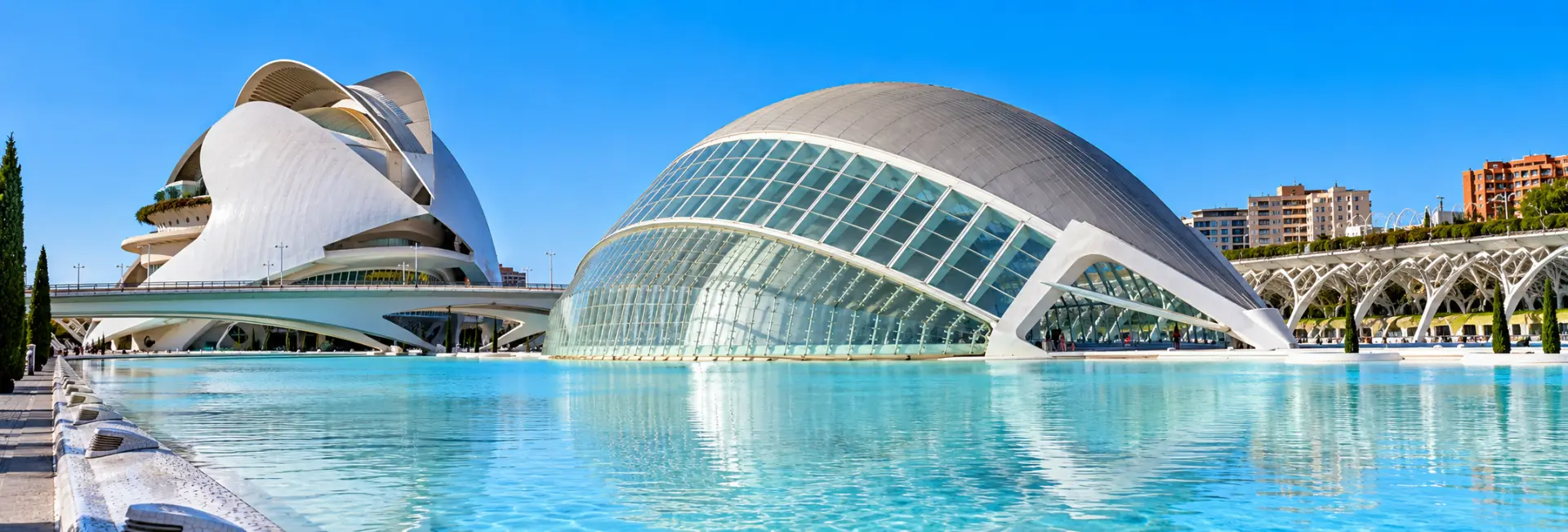
Nearly every building in the complex borrows its form from something organic rather than a conventional geometric shape. The Hemisfèric is built to resemble a giant human eye, set within an elliptical pool so that its reflection completes the illusion, with movable panels on its facade that open and close somewhat like an eyelid. The Science Museum's long ribbed structure evokes a whale skeleton or the ribcage of some enormous animal, while other buildings on the site draw more loosely on shapes found in shells, fins, and plant forms.
Santiago Calatrava, who was born in Valencia in 1951 and trained as both an architect and structural engineer, designed the majority of the complex, giving it a consistent language of white concrete, exposed structural ribs, and sweeping curves that few other architectural complexes in Europe attempt at this scale. His dual background in engineering as well as design shows in details such as the Hemisfèric's moving eyelid panels and the long cantilevered forms found throughout the site, which rely as much on structural calculation as on visual composition.
The one major exception is the Oceanogràfic aquarium, designed by the veteran architect and engineer Félix Candela, whose long career specializing in thin-shell concrete construction gave that particular building a softer, more organic profile than Calatrava's sharper geometric forms elsewhere on the site. Candela's individual pavilions within the Oceanogràfic, representing different climate zones and marine habitats, each take on a distinct shape rather than repeating a single architectural formula across the aquarium.
Water plays as large a role in the design as any of the buildings themselves. Long reflecting pools run along much of the complex, turning each structure into two, one built and one mirrored, and creating some of the most recognizable photographs taken anywhere in Valencia.
Key Areas
The complex is made up of several distinct buildings, each functioning as its own attraction with a separate entrance and, in most cases, a separate ticket, spread along a corridor roughly two kilometres long.
- L'Hemisfèric, a combined planetarium, IMAX cinema, and laser show venue, and the most photographed single building on the site, built to resemble a giant eye set within its reflecting pool
- Museu de les Ciències Príncipe Felipe, a large hands-on science museum aimed at both children and adults, spread across several floors and covering subjects from physics to biology through interactive exhibits
- L'Oceanogràfic, Europe's largest aquarium, organized around different marine ecosystems from the Mediterranean to the Arctic and tropical waters, with a separate entrance and ticketing system from the rest of the complex
- Palau de les Arts Reina Sofía, an opera house at the western end of the site, closest to the city centre, with four separate auditoriums for opera, theatre, and music performances
- L'Umbracle, a raised, landscaped promenade and garden that also functions as a viewpoint over the rest of the complex, planted with species native to the region
- L'Ágora, a large covered multi-purpose venue used for concerts, exhibitions, and sporting events, including an annual professional tennis tournament
Ways to Experience It
Because the site is really several attractions in one, most visitors pick and choose rather than trying to see everything on a single visit. Combined tickets covering two or more attractions are generally available and can work out cheaper than paying for each one separately, particularly for families visiting more than one museum in a day.
- Walking the length of the complex for free, simply to see the architecture and reflecting pools
- Visiting the Oceanogràfic on its own, which typically takes the better part of a day given its size
- Combining the Hemisfèric and Science Museum for a shorter science-focused half-day visit
- Attending an opera, concert, or event at the Palau de les Arts or L'Ágora, booked separately through their own box offices
- Taking a guided architecture tour focused specifically on Calatrava's design choices across the site
- Returning after sunset to see the buildings and their reflections lit up, even without visiting any paid attraction
Best Time to Visit
The complex is enjoyable at almost any time of year, though spring and autumn offer the most comfortable temperatures for spending long stretches walking outdoors between buildings. Summer visits are still popular, especially for the Oceanogràfic, but the exposed walkways between buildings can get very hot in the middle of the day.
Evenings add a different dimension entirely, since the buildings are lit at night and reflected in the pools, making a return visit after dark worthwhile even for those who explored the site earlier in the day. Weekday mornings tend to be quieter than weekends and school holiday periods, particularly at the Oceanogràfic and Science Museum, both of which are popular with families and school groups.
Visitor Tips
Because each building charges its own admission, it's worth deciding in advance which attractions matter most rather than assuming a single ticket covers the whole complex.
- Book Oceanogràfic tickets online in advance, especially in summer, since it is the site's most popular single attraction
- Wear comfortable shoes, since the complex is large and involves considerable walking between buildings
- Bring sun protection, as much of the walkway between attractions is exposed with little shade
- Check show times for the Hemisfèric's planetarium and laser presentations, which run on a fixed schedule
- The outdoor areas and walkways are free to enter and photograph at any time the complex is open
Nearby Attractions
The complex sits at the eastern end of the old Turia riverbed, now a long landscaped park, making it easy to combine with other sights along the same corridor and elsewhere in the city.
- Jardín del Turia, the long public park occupying the rest of the former riverbed, popular for walking and cycling
- Valencia's historic old town, including the Cathedral and Central Market, a longer walk or short ride away
- Bioparc Valencia, a naturalistic zoo elsewhere in the city built around open, immersive enclosures
- Malvarrosa Beach, Valencia's main city beach, a short taxi or bus ride from the complex
FAQs about visiting the City of Arts and Sciences
What is the City of Arts and Sciences? +
It's a large complex of futuristic buildings in Valencia designed mainly by architect Santiago Calatrava, including a planetarium, science museum, opera house, and Europe's largest aquarium.
Is it free to visit? +
Walking through the complex and viewing the architecture and pools is free; individual attractions like the Oceanogràfic, Science Museum, and Hemisfèric each charge separate admission.
How much time should I plan for a visit? +
A quick walk through the outdoor areas takes under an hour, but visiting even one or two of the paid attractions, especially the Oceanogràfic, typically takes half a day or more.
Do I need to book tickets in advance? +
It's strongly recommended for the Oceanogràfic, particularly in summer, since it is the most visited single attraction on the site; other buildings are generally more flexible.
Is the City of Arts and Sciences suitable for children? +
Yes, the Oceanogràfic and Science Museum in particular are designed with families and children in mind, with hands-on exhibits and marine life displays.
How do I get there from central Valencia? +
It sits at the eastern end of the old Turia riverbed park and is reachable by several bus routes or by metro to Alameda station followed by a walk of about 20 minutes.
Can I visit all the attractions in one day? +
It's possible but tiring, since the site is large and each attraction can take an hour or more; most visitors choose one or two buildings per visit rather than attempting everything at once.
What's nearby if I want to see more of Valencia? +
The Turia riverbed park runs the length of the city toward the historic old town, and Valencia's main city beach is a short ride away in the opposite direction.