Table of Contents
Overview
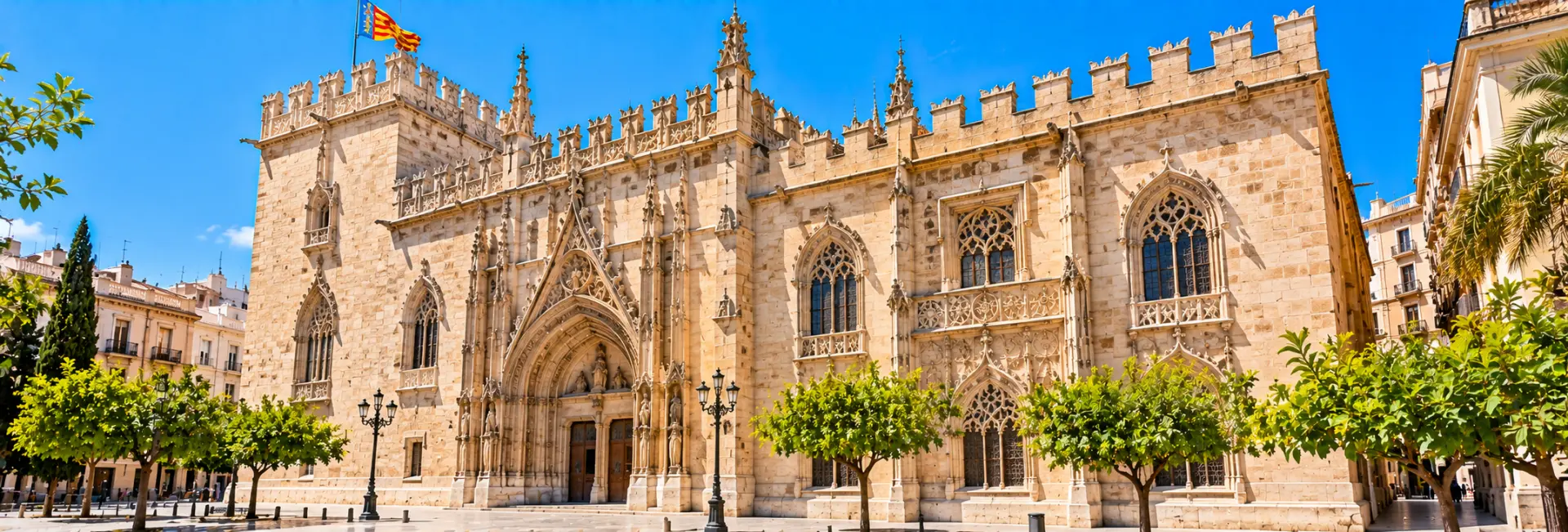
Facing Valencia's Mercado Central in the heart of the old town, La Lonja de la Seda (the Silk Exchange) is one of the most complete surviving examples of civil Gothic architecture in Europe. It was raised in the late 15th century by the city's silk merchants, at the height of a trading boom that made Valencia one of the wealthiest ports on the Mediterranean, and it was built to project that wealth as much as to house it.
Behind its crenellated, gargoyle-lined facade sits a working monument to commerce rather than a palace or a church: a soaring trading hall held up by spiralling stone columns, a walled orange garden, a tower that once served as both chapel and prison, and a later Renaissance wing built for the city's maritime court. Together they make La Lonja one of Valencia's most rewarding stops for visitors curious about the city's mercantile golden age.
History
Origins and Construction
By the second half of the 15th century, Valencia's silk trade had outgrown the city's existing exchange, the older Llotja de l'Oli, and the municipal council and silk guild agreed to fund a new, purpose-built hall. Ground was broken in the early 1480s, with master builder Pere Compte overseeing the project from designs that drew on earlier exchange buildings in the western Mediterranean, including Palma de Mallorca's own Llotja.
Compte did not live to see the building finished, and later masters completed the work in stages over the following decades. The main trading hall was usable well before the whole complex was complete, and construction of the full site continued into the mid-16th century.
Later Uses
Once the silk trade declined, the building took on other roles: it served at times as a grain and produce market, and during a 19th-century cholera outbreak in Valencia it was pressed into use as an emergency hospital. It has since been carefully restored and today functions purely as a heritage site and cultural venue rather than a working exchange.
Recognition & Status
La Lonja de la Seda was declared a National Historic-Artistic Monument in 1931, recognising its architectural and civic importance long before international heritage designations existed for Spanish buildings. In 1996, UNESCO inscribed it as a World Heritage Site, citing it as an outstanding and largely intact example of a secular Gothic building that vividly reflects the power and wealth of a major Mediterranean trading city.
- Declared a national monument in 1931
- Inscribed as a UNESCO World Heritage Site in 1996
- Cited by UNESCO for its exceptional value as a secular late-Gothic building
Architecture & Design
La Lonja is built in the Valencian variant of Flamboyant Gothic, a regional style distinct from the heavier Gothic of central and northern Spain. Its exterior is defined by a crenellated roofline studded with grotesque gargoyles, tall traceried windows, and a corner tower that breaks up the otherwise fortress-like silhouette of the main facade.
Inside, the effect shifts from severe to almost weightless. The main hall's ceiling is carried on slender columns that spiral gently as they rise, fanning into ribbed vaults without the visual bulk typical of Gothic interiors elsewhere in Europe. A later wing added onto the courtyard breaks from this style entirely, adopting an early Renaissance vocabulary and a lavish coffered ceiling, a reminder that the complex was built in phases spanning several decades of shifting architectural fashion.
Key Areas & Notable Spaces
Sala de Contratación (Hall of Columns)
The building's centrepiece is its vast trading hall, where merchants once negotiated contracts and settled deals beneath a forest of eight twisted columns. A carved inscription band runs along the walls near the ceiling, a text that once welcomed traders into the hall and set out an expectation of honest dealing.
The Tower
A three-storey tower anchors one corner of the building. Its ground floor held a small chapel where merchants prayed before setting out on sea voyages, while its upper floors were later used to hold debtors, a stark counterpoint to the hall of commerce just below.
Patio de los Naranjos (Orange Tree Courtyard)
An enclosed garden separates the Gothic trading hall from the later Consulado del Mar wing. Orange and cypress trees surround a star-shaped fountain, and the surrounding walls are lined with carved gargoyles, giving the courtyard a quieter, more intimate feel than the grand hall next to it.
Consulado del Mar
Added onto the courtyard some years after the main hall, this wing housed Valencia's maritime tribunal, the body that resolved disputes between merchants and shipowners. Its upper floor holds a richly decorated chamber with a gilded wooden ceiling that was originally built for the city's old Gothic town hall and relocated here after that building was lost to fire.
Cultural & Historical Significance
Beyond its architecture, La Lonja is a physical record of how Valencia organised its trade during its 15th-century golden age. The building housed the Taula de Canvis, an early municipal bank that handled deposits and payments for merchants, functioning as a forerunner of modern public banking. The maritime court in the Consulado del Mar wing, meanwhile, applied a body of maritime law used across the medieval Mediterranean to settle shipping and cargo disputes.
Together, the trading hall, the bank and the maritime tribunal made La Lonja the commercial and legal engine room of a city whose silk, and later its citrus and other exports, connected it to ports across the Mediterranean and beyond.
Ways to Experience It
Most visitors explore La Lonja independently, moving at their own pace through the main hall, the courtyard, the chapel and the Consulado del Mar. Information panels throughout the building explain each space, and an audio guide is available for those who want more depth on the building's history and symbolism.
- Self-guided visit through the hall, tower, courtyard and Consulado del Mar
- Guided walking tours, often combined with other old-town sights, that include skip-the-line access
- Occasional cultural events and exhibitions staged inside the historic hall
Best Time to Visit
La Lonja is busiest in the late morning, when its free entry on Sundays and public holidays draws larger crowds and it shares foot traffic with the neighbouring Mercado Central. Arriving soon after opening on a weekday tends to mean a quieter visit, especially in the trading hall, where the long, uninterrupted views along the columns are best appreciated without a crowd.
Because much of the visit is indoors, La Lonja works well as a midday stop during Valencia's hottest summer months, offering a cool break between time spent outside in the old town.
Visitor Tips
- Plan for roughly 45 minutes to an hour and a half, depending on whether you take a guided tour or explore independently
- Opening hours and ticket prices can change seasonally, so it's worth checking the official listing shortly before your visit
- The tower and upper floor of the Consulado del Mar involve stairs, which may not suit visitors with mobility limitations
- Photography is generally permitted inside, but flash and tripods may be restricted in some areas
- Pair a visit with the Mercado Central directly across the square to make the most of the trip to this part of the old town
Nearby Attractions
La Lonja sits at the centre of Valencia's historic Ciutat Vella district, within easy walking distance of several other major sights. The Mercado Central, one of Europe's largest covered markets, faces it directly across the square, and the Iglesia de los Santos Juanes stands immediately alongside it.
- Mercado Central – Valencia's grand covered food market, right across the plaza
- Iglesia de los Santos Juanes – a Baroque church adjoining La Lonja's square
- Valencia Cathedral and the Torres de Serranos – both a short walk into the old town
FAQs about visiting La Lonja de la Seda
What is La Lonja de la Seda? +
It's a late-Gothic building in central Valencia that served as the city's silk exchange from the 15th century onward, and it's now a UNESCO World Heritage Site open to visitors.
Why is La Lonja de la Seda famous? +
It's considered one of Europe's finest surviving examples of secular Gothic architecture, known especially for the spiralling columns in its main trading hall and its walled orange-tree courtyard.
How much time should I set aside for a visit? +
Most visitors spend around 45 minutes to an hour and a half inside, longer if joining a guided tour that also covers nearby sights.
Is La Lonja de la Seda free to visit? +
There is normally a small entry fee, with free admission on Sundays and public holidays, though exact prices and hours are best confirmed on the official site before you go.
Is the building accessible for visitors with mobility needs? +
The main hall and courtyard are accessible, but the tower and the upper floor of the Consulado del Mar are reached by stairs, so those areas may be difficult for visitors with limited mobility.
What's the best time to visit to avoid crowds? +
Weekday mornings shortly after opening tend to be quieter, since free-entry days and the neighbouring market draw larger crowds later on.
What else is nearby worth combining with a visit? +
The Mercado Central sits directly across the square, and the Iglesia de los Santos Juanes is right next to it, making it easy to see several old-town landmarks in one outing.