Table of Contents
Overview
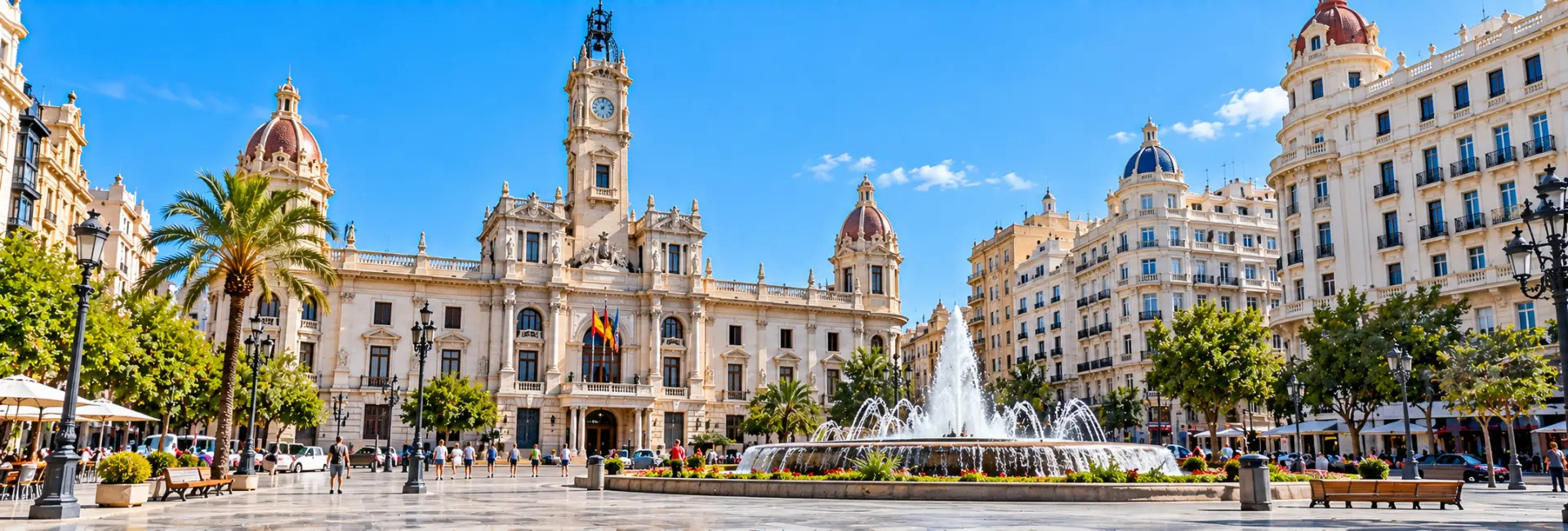
Plaza del Ayuntamiento is Valencia's largest and most central square, an unusually shaped triangular space framed by grand early 20th-century buildings, palm trees and a large central fountain. It functions as the administrative heart of the city, home to Valencia's City Hall, while also serving as one of the busiest meeting points and gathering spaces in the old town.
Lined with flower stalls by day and lit up by the fountain and surrounding facades at night, the square is rarely quiet. It's the backdrop for some of Valencia's biggest civic moments, from daily fireworks during Las Fallas to the city's New Year's Eve countdown, making it as much a stage for public life as a place to admire architecture.
History
From Convent Grounds to City Square
The square occupies the site of a former convent, demolished in 1881 to make way for a larger public space at the heart of the growing city. Known by several different names over the following decades, reflecting the political changes Spain went through across the 20th century, it eventually settled on its current name, tied to the City Hall that faces it.
Its Present Form
The square's layout was substantially reshaped between 1931 and 1934 under architect Javier Goerlich, a renovation that removed an underground flower market built in a neo-Baroque style. Flower stalls still operate today in the square's southern end, a direct echo of that earlier market, alongside the grand civic and commercial buildings added around the same period.
Recognition & Status
Plaza del Ayuntamiento isn't itself individually listed as a monument, but it's recognised as the civic centrepiece of Valencia's historic centre and is bordered by several separately valued buildings, most notably the City Hall and the Central Post Office. It's consistently identified as the city's most important public square, both for its scale and for its role in Valencia's political and cultural life.
- Valencia's largest and most central public square
- Home to the seat of the city's municipal government
- Site of the city's largest and most closely watched Fallas monument each March
Landmark Buildings Around the Square
Ayuntamiento de Valencia (City Hall)
The square's namesake building combines an 18th-century former school with an early 20th-century extension designed by architects Francisco Mora and Carlos Carbonell, its facade blending Renaissance and Baroque elements beneath a pair of small domes. Inside, visitors can see the ornate Salón de Cristal and the city's history museum, which holds items such as the sword associated with King Jaume I's conquest of Valencia.
Edificio de Correos y Telégrafos (Central Post Office)
Built in the 1920s, this white, Baroque-influenced building still functions in part as a post office, with a grand marble staircase inside and a striking glass cupola above the main hall. Its entrance is decorated with allegorical figures representing communication by land and sea.
Ateneo Mercantil and Teatro Rialto
Slightly set back from the square, the Ateneo Mercantil has served as a meeting place for the city's business community since the 19th century, while the nearby Teatro Rialto, built in an Art Deco and Rationalist style, now houses the region's film archive and public theatre programme.
Key Features
The square's most distinctive feature is its triangular shape, unusual among Valencia's public spaces and made possible by the layout of the streets and buildings that grew up around the old convent site. A large central fountain anchors the space, illuminated at night and often surrounded by visitors pausing to take photos.
- An unusually triangular layout rather than the square or rectangular shape typical of most city plazas
- A large central fountain, lit up after dark
- Flower stalls along the square's southern edge, a remnant of an earlier flower market
Cultural Significance
Every day from the 1st to the 19th of March, at exactly 2pm, Plaza del Ayuntamiento hosts the mascletà, a daytime fireworks display built around rhythm and sound rather than visual spectacle, as part of the city's Fallas festival. The square also holds the largest and most elaborate of the festival's giant sculptures, traditionally the last to be burned when the festival closes.
Beyond Fallas, the square plays a role in several other Valencian traditions, including a temporary ice rink during the Christmas season and a local version of Spain's New Year's Eve custom of eating twelve grapes as the City Hall clock strikes midnight.
Ways to Experience It
Most visitors experience the square simply by walking through it and taking in the surrounding architecture, though a number of specific activities make the most of what's on offer here throughout the year.
- Free visits to parts of the City Hall, including the Salón de Cristal and the municipal history museum
- Watching the daily mascletà fireworks at 2pm during Las Fallas in March
- Browsing the flower stalls along the square's southern edge
- Joining locals for the New Year's Eve countdown beneath the City Hall clock
Best Time to Visit
The square is lively at almost any time of day, but early morning offers the quietest views of the fountain and surrounding facades before the crowds and traffic build up. Evenings bring a different atmosphere, with the buildings and fountain illuminated and outdoor cafes filling with visitors.
For a livelier experience, visiting during Las Fallas in March means catching the mascletà and the square's largest festival sculpture, while December brings Christmas markets and ice skating, and New Year's Eve draws large crowds for the midnight countdown.
Visitor Tips
- Arrive at the square well before 2pm if you want a good view of the mascletà during Las Fallas, since the crowds fill in quickly
- City Hall's free areas are generally open on weekday mornings, so plan a visit accordingly if you want to see the interior
- The square is flat and fully pedestrianised in its central areas, making it easy to navigate
- Cafes and restaurants around the square can be pricier than elsewhere in the old town, given the location
Nearby Attractions
Plaza del Ayuntamiento sits close to several other major sights in Valencia's historic centre, making it a natural hub for exploring the old town on foot.
- Mercado Central and La Lonja de la Seda, a short walk through the old town
- Plaza de la Reina and Valencia Cathedral, just north of the square
- Colón shopping street, leading toward the Turia Gardens and the modern city centre
FAQs about visiting Plaza del Ayuntamiento
What makes Plaza del Ayuntamiento different from other squares in Valencia? +
It's Valencia's largest square and has an unusual triangular shape, framed by the City Hall and the Central Post Office.
What is the mascletà and when can I see it? +
It's a daytime fireworks display focused on sound and rhythm rather than visuals, held every day at 2pm from the 1st to the 19th of March as part of Las Fallas.
Is it free to visit Plaza del Ayuntamiento and City Hall? +
Yes, the square is a free public space, and several areas inside City Hall, including its history museum, can also be visited for free on weekday mornings.
How much time should I spend at the square? +
A short visit of twenty to thirty minutes covers the main sights, though many visitors linger longer, especially during festivals or in the evening.
Is Plaza del Ayuntamiento accessible for visitors with mobility needs? +
Yes, the square is flat and largely pedestrianised, making it one of the more accessible spots in central Valencia.
What's the best time of year to visit? +
Las Fallas in March offers the most spectacle, with daily fireworks and the festival's largest sculpture, while December brings Christmas markets and ice skating to the square.
What else is nearby worth visiting? +
Mercado Central, La Lonja de la Seda, and Valencia Cathedral are all within easy walking distance of the square.