Table of Contents
Overview
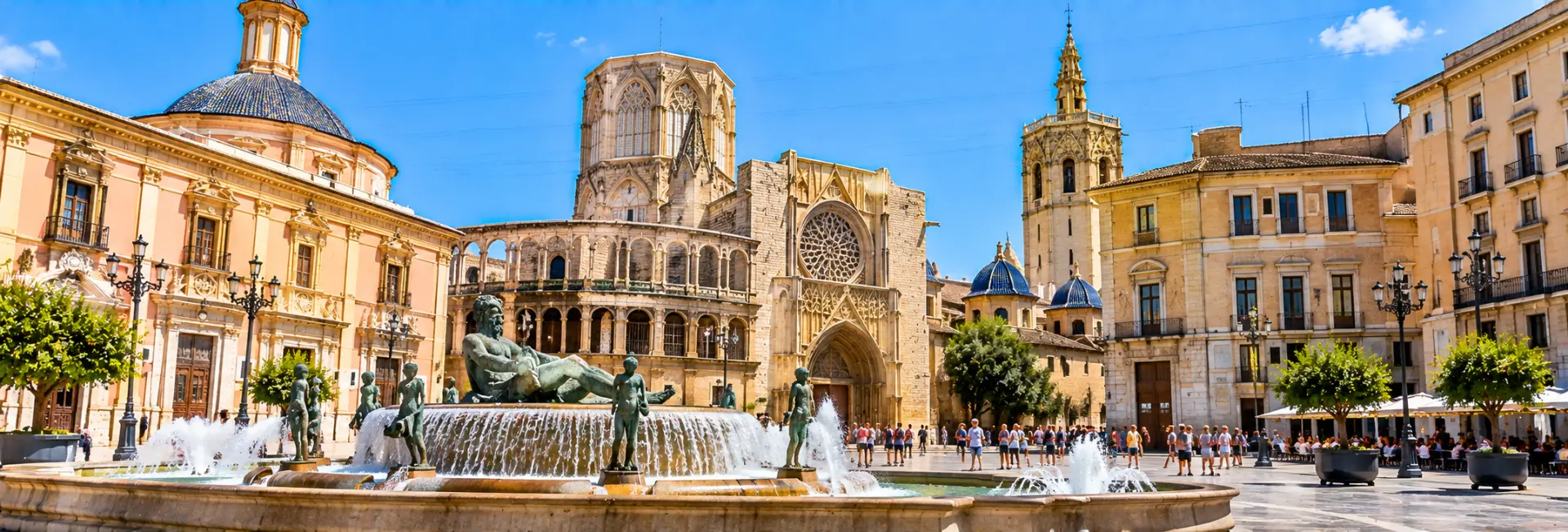
Plaza de la Virgen sits at the very centre of Valencia's old town, an open, pedestrianised square framed by the city's cathedral, a baroque basilica and the seat of the regional government. It is the oldest continuously used public space in the city, laid out over the site of the original Roman forum, and it still functions today much as it always has: a meeting point, a stage for civic and religious ritual, and a shaded place to pause between the surrounding monuments.
Unlike Valencia's more commercial squares, Plaza de la Virgen has kept a quieter, more ceremonial character. Its centrepiece fountain, its Gothic cathedral doorway and its weekly water court together give visitors a compact but genuinely layered introduction to the city's Roman, medieval and early modern history, all within a few steps of each other.
History
Roman and Medieval Origins
The square occupies the ground once used as the forum of the Roman city of Valentia, founded in 138 BCE, and archaeological remains from that period have been uncovered beneath and around the surrounding buildings. Through the medieval period the area developed into the religious and administrative core of the city, anchored by the growing cathedral and, later, the palace of the region's governing body.
Later Development
The square's present form took shape gradually as the buildings around it were added or rebuilt: the cathedral's Gothic doorway facing the plaza, the Baroque basilica built in the 17th century, and the ornamental river fountain installed in the 20th century. Despite these additions, the square has kept its Roman-era footprint at the heart of the old town.
Recognition & Status
Plaza de la Virgen is not itself individually listed, but it sits at the centre of Valencia's protected historic centre and is bordered by several separately protected monuments, including the cathedral and the Palau de la Generalitat. The weekly Tribunal de las Aguas that convenes on the square was recognised by UNESCO in 2009 as an Intangible Cultural Heritage of Humanity, one of the clearest formal recognitions tied directly to this specific location.
- Sits within Valencia's protected historic centre, alongside separately listed monuments
- Site of the Tribunal de las Aguas, recognised by UNESCO in 2009
- Built over the archaeologically significant remains of the Roman forum
Landmarks Around the Square
Valencia Cathedral
The cathedral's Puerta de los Apóstoles, a richly carved Gothic portal decorated with figures of the apostles, prophets and angels beneath an image of the Virgin, opens directly onto the square and serves as the traditional meeting point for the water court.
Basilica de la Virgen de los Desamparados
This Baroque basilica, built in the mid-17th century, houses the statue of Valencia's patron saint and connects to the cathedral by an elevated passage above a side street, allowing processions to move between the two buildings.
Palau de la Generalitat
The historic seat of the Valencian regional government also faces the square, its Gothic tower and courtyards representing centuries of continuous political use, though the building is generally viewed from the outside rather than toured.
Key Features
Fountain of the Turia
The square's large fountain personifies the River Turia as a reclining male figure surrounded by eight female figures representing the historic irrigation canals that draw water from the river to farm the surrounding countryside. It has become one of the most photographed spots in the old town.
Casa de la Vestuario
A modest building on the square serves as the meeting room where the Tribunal de las Aguas gathers before its public session, a functional counterpart to the ceremony that plays out at the cathedral door each week.
Cultural Significance
Every Thursday at noon, eight robed judges representing the region's traditional irrigation communities gather at the cathedral's Puerta de los Apóstoles to hear and resolve disputes over water rights in Valencia's fertile farmland. Believed to have roots going back to the period of Andalusi rule and formalised in the centuries that followed, the Tribunal de las Aguas is widely considered the oldest continuously functioning judicial institution in Europe, and its rulings remain final and legally recognised.
The square also plays a central role each March during Las Fallas, when thousands of Valencians process through it to lay flowers at a towering wooden frame beside the basilica, forming a large image of the Virgin out of flowers, one of the festival's most emotionally charged traditions.
Ways to Experience It
Most visitors simply walk through Plaza de la Virgen as part of a wider stroll around the old town, pausing to take in the fountain and the cathedral facade. Timing a visit for Thursday at noon adds the chance to watch the Tribunal de las Aguas in session, a free and unscripted piece of living history rather than a staged performance for tourists.
- Free, unstructured visit to see the fountain, cathedral doorway and basilica facade
- Thursday midday sessions of the Tribunal de las Aguas at the Puerta de los Apóstoles
- Entry into the basilica and cathedral interiors, each with its own separate access point
Best Time to Visit
Early morning or early evening gives the square a calmer feel, with softer light on the fountain and cathedral facade and fewer tour groups passing through. Thursdays around midday are busier by design, since that is when the water court draws a crowd, so visitors mainly seeking a quiet look at the square are better off avoiding that hour.
During Las Fallas in mid-March, the square becomes one of the festival's focal points and is extremely crowded, which suits visitors wanting to experience the atmosphere but is worth avoiding for anyone hoping for a peaceful visit.
Visitor Tips
- Arrive at least fifteen to twenty minutes before noon on Thursdays to get a clear view of the Tribunal de las Aguas
- The basilica and cathedral have separate entrances and, in some cases, separate opening hours worth checking in advance
- The square is fully pedestrianised and level, making it easy to cross regardless of mobility
- Cafes lining the square offer a good vantage point for watching the fountain and passersby without needing to book ahead
Nearby Attractions
Plaza de la Virgen opens directly onto several of Valencia's other major old-town sights, making it a natural starting or ending point for a walking route through the historic centre.
- Valencia Cathedral and its Micalet bell tower, reachable from the square
- Palau de la Generalitat, facing the square's northern side
- Plaza de la Reina and the Central Market district, a short walk away
FAQs about visiting Plaza de la Virgen
What is Plaza de la Virgen known for? +
It's Valencia's oldest public square, built over the Roman forum, and it's best known for its river fountain, the cathedral's Gothic doorway, and the weekly Tribunal de las Aguas.
What is the Tribunal de las Aguas and when can I see it? +
It's a centuries-old water court that meets every Thursday at noon at the cathedral's Puerta de los Apóstoles to resolve irrigation disputes, and it's open for anyone to watch for free.
Is Plaza de la Virgen free to visit? +
Yes, the square itself is a public open space with no entry fee, though the cathedral and basilica facing it may charge separately to go inside.
How much time should I spend at the square? +
A short visit of fifteen to thirty minutes covers the highlights, though many visitors linger longer at a nearby cafe, especially around the Thursday water court sessions.
Is the square suitable for visitors with mobility needs? +
Yes, it is flat, paved and fully pedestrianised, making it one of the more accessible spots in Valencia's old town.
What's the best time to visit? +
Early morning or early evening offers a quieter experience, while midday on Thursdays is livelier thanks to the water court, and mid-March during Las Fallas is the busiest time of all.
What else is nearby? +
Valencia Cathedral, the Palau de la Generalitat, and Plaza de la Reina are all within a short walk, making it easy to combine with other old-town sights.