Table of Contents
Overview
Valencia Cathedral, known locally as La Seu, sits at the heart of the city's old town and has been the seat of the Archdiocese of Valencia since the 13th century. Its full name, the Metropolitan Cathedral-Basilica of the Assumption of Our Lady of Valencia, rarely comes up in everyday conversation, since most visitors and locals alike just call it the cathedral or La Seu.
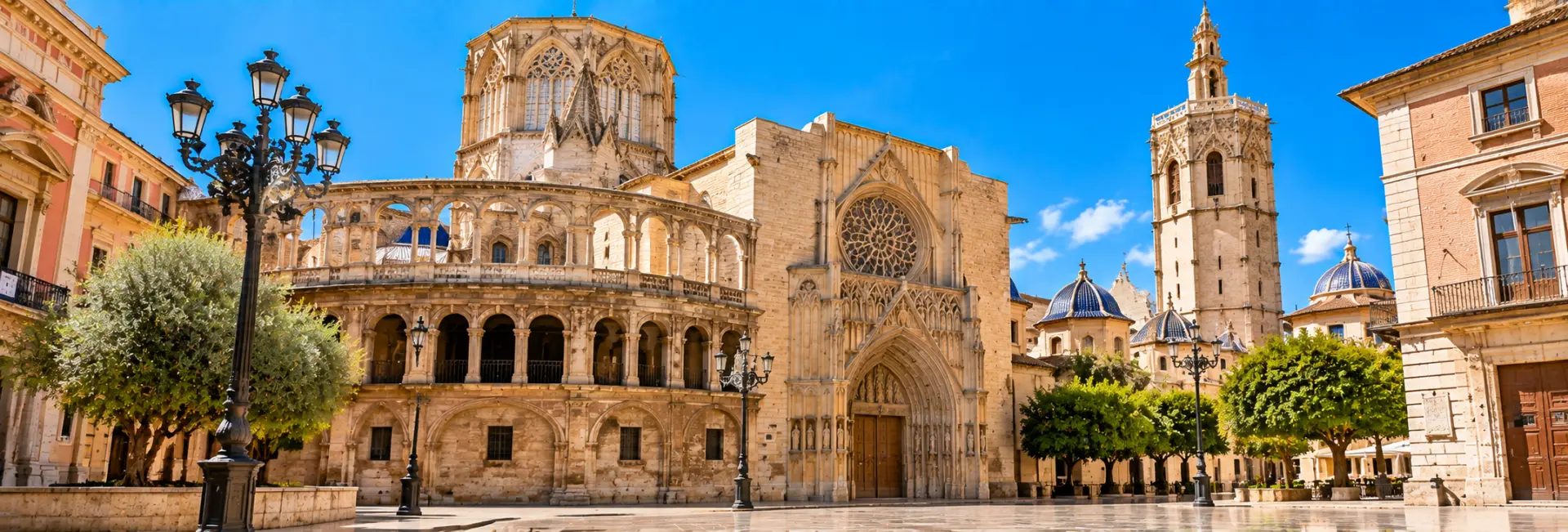
What draws people through its doors is not only the building itself, a patchwork of Romanesque, Gothic, Renaissance, Baroque, and Neoclassical work layered over seven centuries, but also a small agate cup kept in a side chapel that a significant number of scholars and pilgrims believe is the Holy Grail. Climb the attached bell tower for one of the best rooftop views in Valencia, and you get a sense of how central this building has been to the city's identity since the Christian reconquest of 1238.
History
Built Over a Mosque and a Roman Temple
The site has been used for worship for close to two thousand years. Archaeologists have traced a Roman temple beneath the cathedral, later replaced by a Visigothic church, which was in turn converted into the main mosque of Islamic Valencia. When King James I of Aragon captured the city in 1238, the mosque was reconsecrated as a Christian church almost immediately, and construction of the current cathedral began in earnest in 1262.
Centuries of Building
Work on the main structure continued through the 13th, 14th, and into the 15th century, which explains why the cathedral reads as Gothic at its core but picks up other styles as you move through it. The chapter house, now the Holy Grail chapel, went up between 1356 and 1369. The bell tower known as the Miguelete was built between 1381 and 1429. Later centuries brought a Baroque main facade and, in the 18th century, a Neoclassical remodeling of parts of the interior that briefly covered over earlier Gothic and Renaissance work.
Rising to Metropolitan Status
Valencia's standing within the church grew over time as well. In 1492, at the request of Cardinal Rodrigo de Borgia, a Valencian who would later become Pope Alexander VI, Pope Innocent VIII elevated Valencia to the rank of an archdiocese. The promotion tied the cathedral more closely to the powerful Borgia family, whose patronage helped bring Italian Renaissance artists and craftsmen to work on the building in the years that followed.
A Hidden Fresco Rediscovered
One of the more remarkable chapters in the cathedral's history is recent by comparison. Renaissance frescoes above the main altar, painted in the late 15th century, were plastered over during the Baroque period and forgotten for roughly three hundred years. Restorers uncovered them again in 2004, and they are now one of the highlights of a visit.
Architecture and Design
Valencian Gothic With Later Additions
The cathedral's underlying style is what architectural historians call Valencian or Levantine Gothic, a regional variation known for its relatively plain exterior walls and octagonal crossing tower, which lets light pour into the center of the building through a ring of windows rather than a single dome. Wrapped around that Gothic core are later additions in Romanesque, French Gothic, Renaissance, Baroque, and Neoclassical styles, added as tastes and funds allowed over the centuries.
Three Doors, Three Eras
The cathedral's three main entrances make the building's layered history easy to see in a single walk around the block. The Puerta del Palau, facing the Plaza de la Almoina, is the oldest and simplest, built in a Romanesque style. The Puerta de los Apóstoles, opening onto the Plaza de la Virgen, is a richly carved Gothic portal lined with statues of the apostles and is also where the centuries-old Water Tribunal still meets every Thursday to settle irrigation disputes among local farmers. The Puerta de los Hierros, facing Plaza de la Reina, is an 18th-century Baroque addition with a dramatic curved facade.
The Octagonal Lantern
Above the crossing, where the nave meets the transept, sits an octagonal lantern tower pierced with tall windows on each of its eight sides. This design lets natural light spill down into the center of the cathedral rather than relying only on side windows, a feature that gives the interior a brighter, more open feel than many Gothic cathedrals of a similar period. Restorers uncovered the frescoes around the base of this lantern during the same 2004 project that revealed the paintings above the main altar.
The Holy Grail Chapel
The cathedral's best-known feature is a small, dark red agate cup kept in the Capilla del Santo Cáliz, a Gothic chapel that was originally the cathedral's chapter house. Archaeological analysis has dated the cup itself to somewhere between the 2nd century BC and the 1st century AD, with a stemmed gold and gemstone base added during the Middle Ages.
According to tradition, the cup was carried from Jerusalem to Rome, hidden in northern Spain during the Moorish invasions, and eventually passed through the hands of the medieval kings of Aragon before King Alfonso the Magnanimous gave it to Valencia Cathedral in 1437. It has stayed in the cathedral's care ever since, aside from brief periods of safekeeping elsewhere during wartime, and has been displayed in its current chapel since 1916.
- The Vatican has never formally confirmed or denied the chalice's authenticity
- Popes John Paul II and Benedict XVI both used the cup to celebrate Mass during visits to Valencia
- The chapel's star-vaulted ceiling depicts the twelve apostles and the coronation of the Virgin Mary
The Miguelete Bell Tower
Attached to the cathedral but built as a freestanding structure, the octagonal Miguelete tower took nearly fifty years to complete, from 1381 to 1429. It takes its name from a bell blessed on the feast day of Saint Michael in 1418, and at 51 meters to its terrace, its height is famously said to match the length of its perimeter exactly.
A spiral staircase of 207 steps leads up through the tower, passing a small stone chamber once used as a refuge for people claiming ecclesiastical asylum, before opening onto an open-air terrace with sweeping views over the old town's rooftops. On a clear day, the view stretches as far as the Mediterranean.
- Tower access is separate from the main cathedral entrance and requires its own ticket
- There is no elevator, and the stairs are narrow, so the climb suits visitors comfortable with tight spiral staircases
- The tower holds eleven bells, including the large Miguel bell that gives it its name
Art and Treasures
The Rediscovered Frescoes
Above the main altar, a set of Renaissance frescoes painted around 1472 by Italian and Spanish artists shows scenes from the life of the Virgin Mary in vivid color. Hidden under Baroque plasterwork for nearly three centuries, they were restored and revealed to the public again in 2004, and their survival in such good condition is considered unusual for a fresco of that age.
Goya and the Cathedral Museum
The Chapel of Saint Francis Borgia holds two paintings by Francisco de Goya depicting scenes from the life of the saint, among the artist's early religious commissions. The cathedral's own museum, reached from inside the building, displays vestments, sculpture, and reliquaries collected over the institution's long history, giving a fuller picture of Valencia's religious art beyond what hangs in the main nave.
Doorways as Sculpture Galleries
Beyond the frescoes and paintings kept inside, the cathedral's exterior doors double as open-air sculpture displays. The Gothic Puerta de los Apóstoles carries detailed stone figures of the twelve apostles set into its arches, weathered by centuries of exposure but still recognizable, while the later Baroque facade at Puerta de los Hierros shows the shift toward the more theatrical, sculptural style that took hold across Spain in the 18th century.
Visitor Tips
- Entry to the cathedral is by paid ticket and typically includes an audio guide covering the main chapels and the Holy Grail chapel
- Climbing the Miguelete tower requires a separate ticket and is not included in the standard cathedral entrance
- The cathedral is a working place of worship, so modest dress covering shoulders and knees is expected, and visits are paused during Mass
- The building is wheelchair accessible, though the tower's spiral staircase is not
- Photography without flash is generally allowed inside, but check current signage, since rules can change for temporary exhibitions
- Buying tickets online in advance can help avoid queues, especially in the middle of the day
Best Time to Visit
Mornings shortly after opening tend to be the quietest time to see the cathedral, before tour groups arrive from the cruise terminal and nearby hotels. Weekday visits are generally calmer than weekends, when the surrounding Plaza de la Reina and Plaza de la Virgen fill with both tourists and locals.
For the tower climb, aim for a clear day, since the views over the city and out to the Mediterranean are the main reward for the 207 steps. Late afternoon light tends to suit photography well, though the terrace can get warm on summer afternoons given the lack of shade at the top.
Nearby Attractions
- Plaza de la Virgen, the square facing the Gothic Apostles' door, lined with cafes and home to the Turia Fountain
- The Almudín and the Holy Grail Visitor Centre, which trace the chalice's history in more depth
- La Lonja de la Seda, Valencia's UNESCO-listed former silk exchange, a short walk away
- Mercado Central, one of Europe's oldest working food markets, housed in an Art Nouveau building nearby
- Torres de Serranos and Torres de Quart, the surviving medieval gateways into the old city
FAQs about visiting Valencia Cathedral
Is the Holy Grail really at Valencia Cathedral? +
The cathedral holds an agate cup that many scholars and church officials, including two recent popes, have treated as a strong candidate for the Holy Grail, though the Vatican has never officially confirmed its authenticity one way or another.
How long does a visit to the cathedral take? +
Most visitors spend around one to two hours inside the cathedral itself, and closer to two and a half hours if the Miguelete tower climb is included, since the narrow staircase moves slowly when it gets busy.
Do I need to buy tickets in advance? +
It is not strictly required, but buying online ahead of time is a good idea in peak season, since it saves time at the door and guarantees entry during busier midday hours.
Is the Miguelete tower climb included with the cathedral ticket? +
No, the tower has its own separate ticket and entrance, so plan for an additional cost and a bit of extra time if you want to climb it.
Is Valencia Cathedral suitable for children or visitors with mobility needs? +
The main cathedral is wheelchair accessible and generally fine for children, but the Miguelete tower's 207-step spiral staircase has no elevator and is not practical for wheelchairs, strollers, or anyone unsteady on stairs.
What should I wear to visit? +
As an active place of worship, the cathedral expects modest dress that covers shoulders and knees, so it is worth packing a light layer even in warm weather.
What else is nearby that I can combine with the visit? +
The cathedral sits within easy walking distance of Plaza de la Virgen, the Lonja de la Seda silk exchange, and the Mercado Central, so it pairs naturally with a longer stroll through Valencia's old town.