Table of Contents
Overview
The Central Market of Valencia, known locally as the Mercado Central or Mercat Central, is one of the largest fresh food markets in Europe and one of the city's most photographed buildings. Set on the Plaza del Mercado in the historic center, it has been supplying Valencia with produce, meat, and seafood since 1928, and it still operates as a working market rather than a tourist recreation of one.
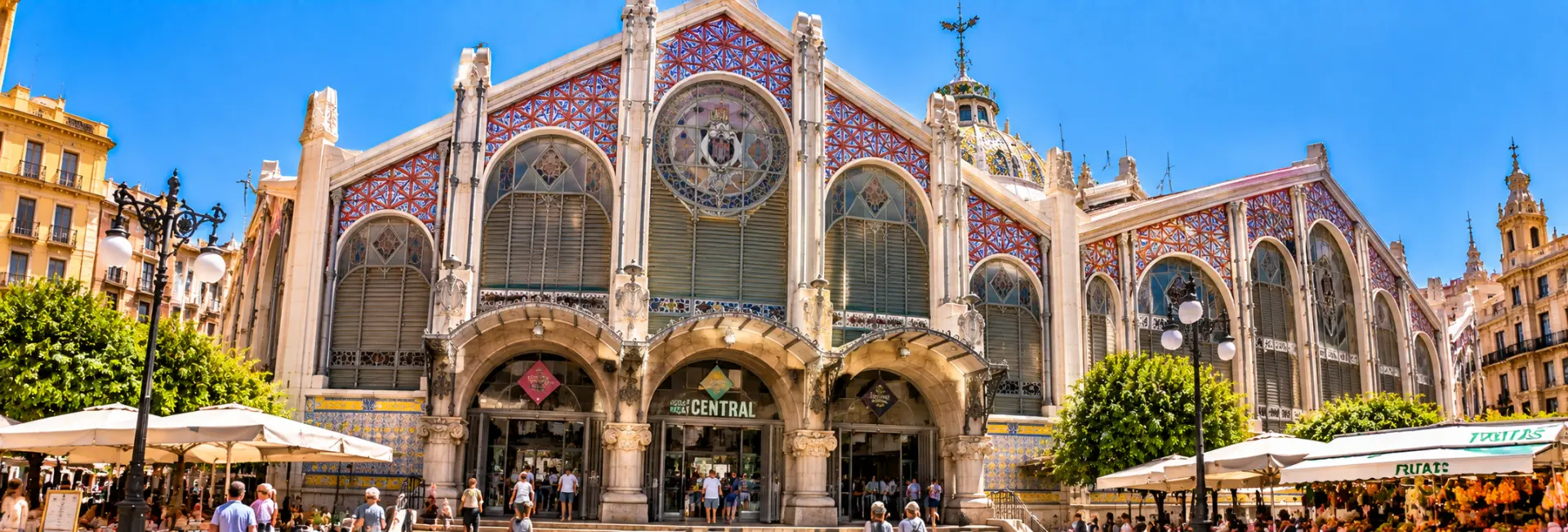
Walking in under its iron and glass domes, visitors find more than 250 stalls arranged along straight aisles, selling everything from Valencian oranges and rice to fresh fish brought in daily from the coast. The building itself, a landmark of Valencian modernist architecture, is worth the visit even for people who have nothing on their shopping list.
The market sits directly across the square from La Lonja de la Seda, Valencia's UNESCO-listed silk exchange, and next to the Church of the Santos Juanes, so the surrounding plaza brings together several centuries of the city's architecture in one small area. For visitors trying to understand how Valencians actually eat and shop day to day, rather than just what restaurants serve tourists, a stop at the Central Market tends to explain more than most guidebook descriptions can.
History
From Open-Air Stalls to a Purpose-Built Hall
The Plaza del Mercado has served as a trading spot since medieval times, when King James I granted the newly reconquered city the right to hold a public market there. An open-air market called the Mercado Nuevo opened on the site in 1839, but by the end of the 19th century it could no longer keep up with a growing city, and the town council began looking for a permanent, purpose-built replacement.
A Competition and a Long Construction
In 1910, the city council held a design competition for the new market, won by architects Alejandro Soler March and Francisco Guardia Vial with a project dated November 1914. Both architects had trained in Barcelona and worked under Lluís Domènech i Montaner, one of the leading figures of Catalan modernism, and their design carried his influence into Valencia. King Alfonso XIII himself took part in the ceremony marking the start of demolition work on the old buildings that stood on the site, striking the wall of a house on the square with a silver pick to open the way for construction.
Construction dragged on through a difficult political and economic period, and the building was ultimately completed in 1928 under architects Enrique Viedma and Ángel Romaní, who saw the project through to its official opening that January. The formal opening ceremony took place on January 23, though the market did not fully begin operating until March of that year, once the stalls inside were ready for business.
Still a Working Market
Unlike some historic European markets that have shifted almost entirely toward tourism, the Central Market has kept its original purpose. Locals still do their weekly shopping among the stalls, even as the building has become one of the most visited sites in the city. The market was also an early adopter of technology among Spain's traditional food markets, introducing online ordering and home delivery well before most comparable markets elsewhere in the country.
Architecture and Design
Iron, Glass, and Ceramic
The Central Market is built almost entirely from iron, glass, and ceramic, materials that were closely associated with industrial progress in early 20th-century Spain. The structure's iron framework, visible throughout the interior, echoes the engineering of other landmark buildings from the period, such as Valencia's North railway station. Colorful ceramic tiles line the base of the exterior walls, while decorative iron grilles run along the upper facade, and large panels of stained and patterned glass let daylight into the hall without exposing the produce below to direct sun.
Domes and Weathervanes
The building is topped by a series of domes built from iron, glass, and ceramic, the largest of which rises about 30 meters above the market floor and floods the central hall with natural light. Two decorative weathervanes crown the domes, shaped like a parrot and a fish, playful nods to the noise and bustle of the market below and to the seafood sold within it.
A Rationalist Layout
Inside, the layout is strictly rationalist, with stalls arranged along straight aisles crossed by two wider central passageways, a design meant to keep customers and goods moving efficiently through the roughly 8,000 square meters of floor space. The floor plan follows the irregular shape of the plot it sits on, so the building's outline is not a simple rectangle, and its roofline is broken up by a mix of domes and sloped sections rather than one uniform covering.
The result is a building that reads as ornate from the outside but works as a highly practical, organized space once inside, a combination its architects intended from the start, drawing as much from large iron-framed industrial buildings of the period as from decorative modernist design.
Inside the Market
Once inside, the market divides loosely into sections by product type. Fruit and vegetable stalls cluster in the brightest parts of the hall, piled with produce from Valencia's fertile surrounding farmland known as the Huerta. Butchers, delicatessens, and cheese stalls fill other aisles, offering dozens of varieties of cured meat and cheese, and a dedicated seafood section, sometimes called the fish market within the market, keeps its catch on beds of ice under a separate section of the dome, arranged by the morning's arrivals from the nearby fishing fleet.
Alongside the food stalls, a handful of vendors sell kitchenware, spices, and Valencian souvenirs such as ceramics and paella pans, and a market bar near the center offers a spot to sit down with a coffee or a quick bite while watching the market move around you.
Many stall holders have run their business at the same spot for generations, and it shows in how they work, calling out prices, greeting regular customers by name, and offering a taste of cheese or fruit before a purchase. That mix of family-run businesses and a striking historic building is part of what separates the Central Market from more polished, tourist-oriented food halls in other cities.
What to Buy and Eat
- Valencia oranges and other seasonal fruit, often the freshest and most flavorful sold anywhere in the city
- Valencian rice varieties, including the Bomba and Senia types used in paella
- Cured meats, jamón serrano, and a wide selection of Spanish cheeses
- Fresh fish and shellfish brought in daily, along with salted and cured seafood
- Saffron, horchata, and chufa, the tiger nut used to make Valencia's signature drink
- A quick esmorzaret, the traditional Valencian mid-morning snack, at the market's central bar
Many of the packaged goods, like vacuum-sealed jamón, olive oil, and tins of Valencian rice, are sold specifically with travelers in mind and hold up well in checked luggage, which makes the market a practical last stop for picking up edible gifts before heading to the airport.
Visitor Tips
- The market operates as a working food hall, so it gets crowded with local shoppers, especially on Saturday mornings
- Bring cash for smaller stalls, though many now accept cards as well
- Avoid sitting on the entrance steps, since they are a main thoroughfare for shoppers carrying groceries
- Some stalls offer vacuum-packed products such as ham, olives, and cured fish that travel well for visitors flying home
- The market closes by early-to-mid afternoon and is shut entirely on Sundays, so plan a morning visit rather than an afternoon one
- Photography is generally welcome, but it is polite to ask before photographing individual vendors closely
- A short stop pairs naturally with a visit to the neighboring Lonja de la Seda, since both sit on the same square and can be combined into one outing
Best Time to Visit
The market is busiest on Saturday mornings, when local shoppers do their weekly rounds alongside visiting tourists, so arriving right at opening on a weekday gives a calmer, less crowded experience. Since the market closes in the early afternoon and does not open at all on Sundays, a morning visit is really the only option.
Arriving close to opening time also means seeing the stalls at their freshest and best stocked, before the most popular items sell out for the day. Outside of peak tourist season, the market is quieter overall, though it never fully empties out, since it remains a genuine part of daily life for people living in the surrounding old town neighborhoods.
Nearby Attractions
- La Lonja de la Seda, Valencia's UNESCO-listed Gothic silk exchange, directly across the square
- The Church of the Santos Juanes, a baroque church facing the market's main facade
- Plaza del Ayuntamiento, Valencia's main civic square, a short walk away
- Valencia Cathedral and the surrounding old town streets
- The Carmen neighborhood, Valencia's old town district known for its narrow streets, street art, and small bars
FAQs about visiting the Central Market of Valencia
Is the Central Market of Valencia a real working market or mainly for tourists? +
It is a genuine working market where locals do everyday grocery shopping, though its architecture and food have also made it a major stop for visitors touring the old town.
What are the opening hours? +
The market is open Monday to Saturday, roughly from 7:30 in the morning to 3:00 in the afternoon, and it is closed on Sundays and public holidays.
How much time should I plan for a visit? +
Most visitors spend around forty-five minutes to an hour walking the stalls and grabbing something to eat, though food lovers can easily spend longer browsing and tasting.
Can I eat at the market instead of just buying groceries? +
Yes, several stalls sell ready-to-eat snacks and drinks, and the market's central bar serves traditional Valencian bites for a sit-down break during the visit.
Is the Central Market a good place to buy souvenirs? +
It works well for edible souvenirs like saffron, rice, olive oil, and vacuum-packed cured meats, plus a small selection of ceramics and paella pans, though it is not primarily a souvenir market.
Is the market crowded, and when should I avoid it? +
Saturday mornings are the busiest time, since local shoppers and tourists overlap, so a weekday morning shortly after opening is the quietest option.
Is the Central Market accessible for visitors with mobility needs? +
Yes, the main hall is on a single level with wide aisles, making it straightforward to navigate with a wheelchair or stroller, though the building can get crowded at peak times.