Table of Contents
Overview
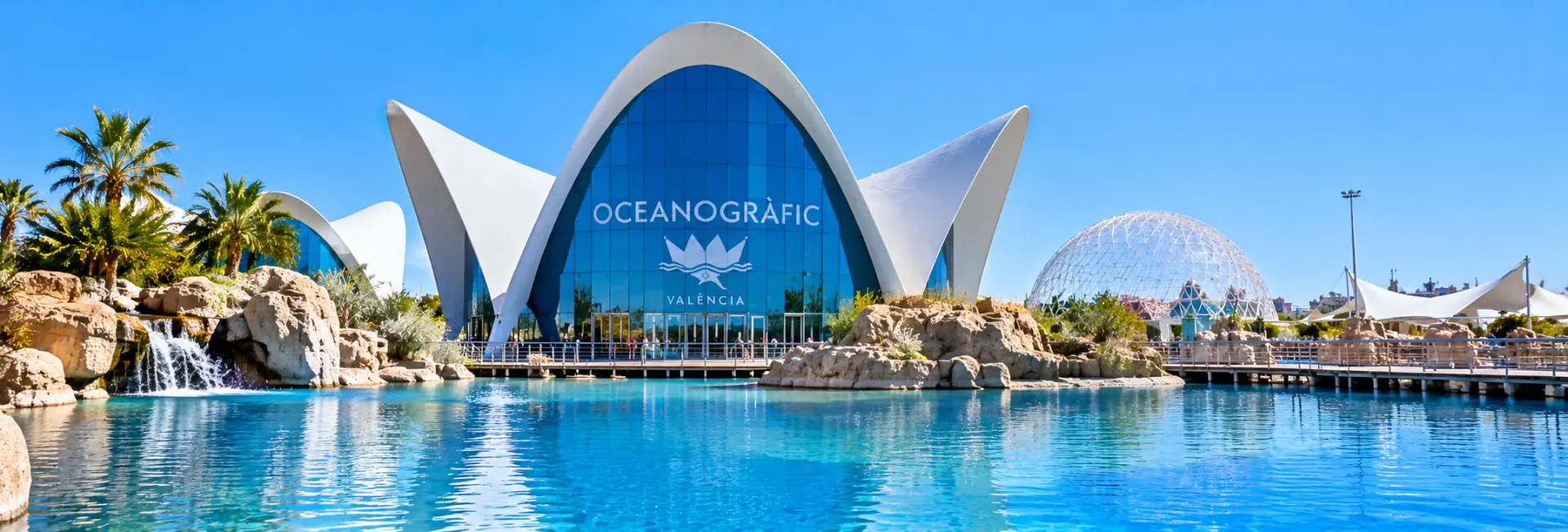
The Oceanogràfic is the largest aquarium in Europe and one of the main draws of Valencia's City of Arts and Sciences complex, built on the dry bed of the old Turia riverbed south of the city center. Rather than one large tank, it is laid out as a series of striking buildings set around a central lake, each one recreating a different ocean or sea from around the world.
Visitors move between zones representing the Mediterranean, tropical seas, the Arctic and Antarctic, wetlands, and more, encountering sharks, belugas, penguins, and jellyfish along the way. With around 110,000 square meters of grounds and more than 20,000 animals from roughly 650 species, a full visit is as much a walk through varied architecture as it is a trip through the world's oceans.
History and Architecture
Part of a Larger Vision
The Oceanogràfic opened to the public in 2003 as the final major piece of the City of Arts and Sciences, a complex conceived to turn a stretch of the old Turia riverbed into a cultural and scientific district after the river itself was diverted around the city following a damaging flood in 1957. While the complex's other buildings were designed by Santiago Calatrava, the Oceanogràfic itself is the work of a different architect.
Félix Candela's Water Lily
The park's main entrance building was designed by the Spanish-Mexican architect Félix Candela, working with structural engineers Alberto Domingo and Carlos Lázaro. Its concrete shell roof, made up of overlapping curved petals, is meant to evoke a water lily floating on the surface of a pond, and it set the tone for the rest of the site's design. Candela had spent much of his career in Mexico refining thin concrete shell structures, and the Oceanogràfic became one of his last major projects before his death in 1997, completed by his collaborators after his passing.
Eleven Buildings Around a Lake
Eleven separate buildings make up the rest of the site, arranged around a large central lake and linked above ground by floating walkways and gardens, and below ground by tunnels and ramps that let visitors move between zones without needing to cross back outside each time. Each building was designed to suit the climate and lighting needs of the ecosystem it houses, so the polar buildings are built to hold cold, dim interiors, while the tropical and Mediterranean zones let in more natural light.
Marine Zones and Exhibits
Rather than following a single continuous route, the Oceanogràfic is organized into distinct zones, each built as its own structure with a climate and design suited to the ecosystem inside. The Mediterranean zone recreates the rocky coastline and marine life closest to home, while the temperate and tropical seas buildings hold coral reef species and warm-water fish in brighter, more colorful tanks.
Polar zones for the Arctic and Antarctic keep beluga whales, walruses, and penguins in cooler enclosures, and a Red Sea building focuses on the reef fish and coral of that particularly biodiverse stretch of water. A wetlands area modeled partly on the nearby Albufera nature reserve near Valencia houses birds and other wildlife typical of marshland habitats, alongside a separate zone recreating tropical mangroves.
- Mediterranean zone, focused on species native to nearby coastal waters
- Tropical and temperate seas, home to coral reef fish and warm-water species
- Arctic and Antarctic zones, housing belugas, walruses, and penguins
- Red Sea zone, dedicated to reef fish and coral
- Wetlands and mangroves, recreating marshland and tropical coastal habitats
A separate building houses a large open-sea tank, home to bigger pelagic species such as sharks and rays that need more room to move than the themed regional zones can offer. This tank sits above the underwater tunnel, so the two exhibits work together as one continuous experience rather than as two unrelated stops on the route.
The Underwater Tunnel and Dolphinarium
The Oceanogràfic's best-known feature is a 70-meter underwater tunnel running beneath the main oceans tank, where visitors can look up and see sharks and rays swimming directly overhead. It is usually the highlight of a visit for families, since it puts large predators within close, safe view rather than behind a single flat pane of glass, and the walkway is slow enough to give people time to stop and watch without holding up the line behind them.
The park is also home to one of the largest dolphinariums in Europe, with a main show pool and four smaller pools used for training, breeding, and veterinary care. The grandstand around the main pool seats more than 1,500 people for scheduled presentations that focus on the dolphins' natural behavior and the research the park carries out on the group, including studies on communication and cognition that feed into wider marine mammal research beyond Valencia.
Beyond the tunnel and the dolphin pools, several buildings include their own smaller viewing points designed to bring visitors close to specific animals, from a coral nursery in the tropical seas building to a walrus viewing area in the Arctic zone where the animals can sometimes be seen resting on rocks just behind the glass.
Conservation and Research
Behind the exhibits, the Oceanogràfic runs a foundation dedicated to marine research and conservation, working on projects ranging from sea turtle recovery to breeding programs for threatened species. A significant share of the animals kept at the park are classified at some level of risk on the IUCN Red List, and the park uses that as part of its case for keeping and studying them on site rather than purely for display.
The park's turtle recovery area treats sick or injured sea turtles found along the Spanish coast, with the aim of releasing them back into the wild once they have recovered, and the facility also participates in wider European breeding programs for endangered marine species. Staff and visiting researchers use the recovery pools to monitor each turtle's progress before a release is judged safe, a process that can take months depending on the animal's injuries.
The foundation also runs education programs aimed at school groups and the general public, with the goal of connecting what visitors see in the tanks to broader issues facing the world's oceans, such as plastic pollution, overfishing, and the effects of a warming climate on coral reefs and polar ice.
Ways to Experience It
- Self-guided visits following the marked route through each zone, typically taking most of a day
- Scheduled dolphin presentations at the main dolphinarium
- An underwater restaurant set inside one of the main tanks, offering meals with fish swimming past the surrounding glass
- Combined tickets covering the Oceanogràfic alongside other City of Arts and Sciences attractions, such as the science museum or planetarium
- Educational workshops and behind-the-scenes activities aimed at children and school groups
Night visits are also offered at certain times of year, when parts of the park stay open after dark and some tanks are lit differently, giving a noticeably different view of nocturnal species than a daytime visit provides.
Visitor Tips
- The park is large and involves a lot of walking between buildings, so comfortable shoes are worth it
- Buying tickets online in advance is recommended, since the Oceanogràfic gets busy during school holidays and peak tourist season
- Check the daily schedule for dolphin presentations on arrival so the visit can be planned around show times
- All buildings are fitted with ramps or lifts, and wheelchairs can be requested for visitors with reduced mobility
- Tripods are generally not permitted inside the buildings, so handheld photography works best in the lower light of the tanks
- Baby-changing and nursing areas are available at several points around the site
Best Time to Visit
Weekday mornings shortly after opening tend to be the quietest time to explore, before the largest crowds arrive and before the dolphinarium's first show draws people toward that end of the park. Visiting outside the summer school holidays and major Spanish public holidays also helps avoid the busiest days, and arriving right at opening time gives visitors a better chance of walking through the underwater tunnel without a crowd.
Since most of the route runs through covered or climate-controlled buildings, the Oceanogràfic works well as a year-round visit regardless of Valencia's weather outside, though the outdoor walkways and terraces between buildings are more pleasant to linger in during spring and autumn than in the height of summer. Public and school holidays across Spain and neighboring countries tend to bring the largest crowds, so checking a school calendar before booking can help set expectations for how busy the park will be.
Nearby Attractions
- The rest of the City of Arts and Sciences complex, including the Hemisfèric planetarium, the Príncipe Felipe science museum, and the Palau de les Arts opera house
- The Turia Gardens, the long park that now runs through the old riverbed across much of the city
- The Bioparc Valencia zoo, on the opposite side of the city
- Valencia's old town and Valencia Cathedral, a short drive or metro ride from the complex
- Valencia's beaches, including Malvarrosa and Patacona, reachable by tram from the city center
FAQs about visiting the Oceanogràfic
How much time should I set aside for the Oceanogràfic? +
Most visitors spend around four to six hours exploring the full site, since the zones are spread across separate buildings connected by outdoor walkways, and the underwater restaurant or a dolphin show can easily add extra time.
Is the Oceanogràfic suitable for young children? +
Yes, the mix of large viewing tanks, the underwater tunnel, and the dolphin presentations tends to appeal to children, and buggies are easy to bring along since the route is largely flat and paved.
Do I need a separate ticket for the dolphin show? +
No, dolphin presentations are included in standard entry and run on a schedule throughout the day, so it is worth checking show times when you arrive.
Can I visit the Oceanogràfic together with the rest of the City of Arts and Sciences in one day? +
It is possible but tight, since the Oceanogràfic alone can take most of a day. Many visitors either buy a combined ticket and spread the complex over two days, or focus on the Oceanogràfic and one other building in a single visit.
Is the Oceanogràfic accessible for visitors with mobility needs? +
Yes, all of the buildings are fitted with ramps or lifts connecting the upper and lower levels, and wheelchairs are available on request for visitors who need one.
What is the underwater restaurant like? +
The Submarino restaurant sits inside one of the main tanks, letting diners eat surrounded by a curved glass wall with fish and rays visible outside, and it is popular enough that booking ahead is worth doing.
Is it better to visit in summer or another season? +
Since most of the exhibits are indoors or climate-controlled, the Oceanogràfic works well any time of year, though spring and autumn tend to be more comfortable for the outdoor walkways and shorter queues than the height of summer.