Table of Contents
Overview
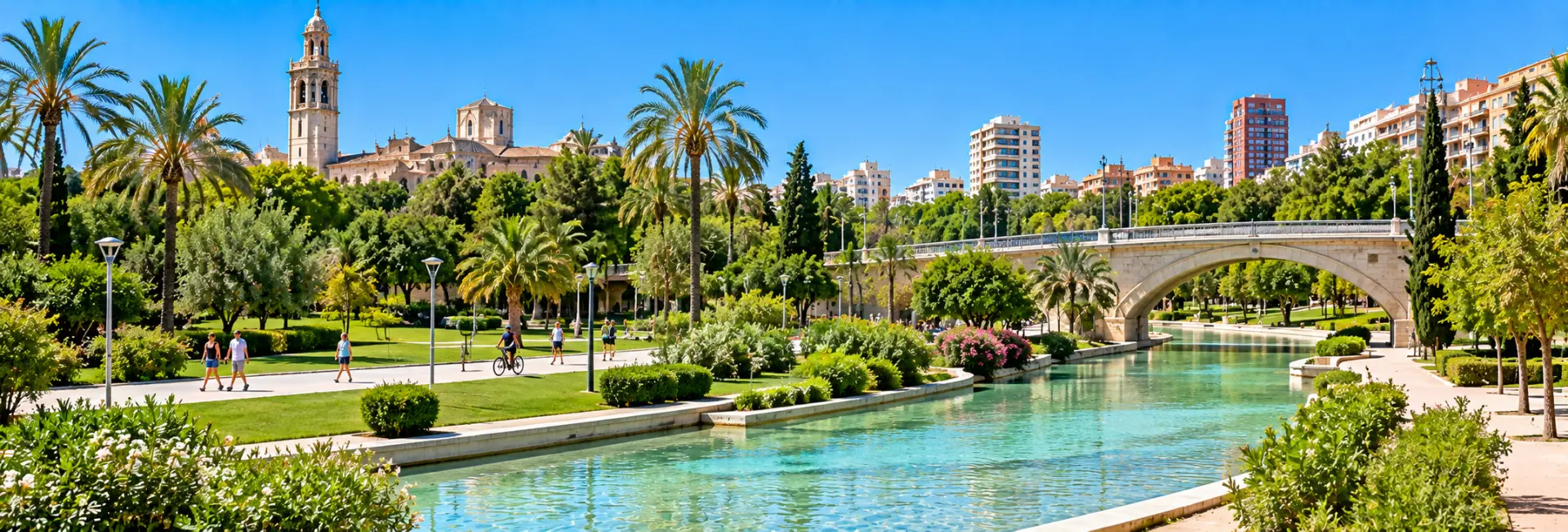
The Turia Gardens, known locally as the Jardín del Turia, are a nine-kilometer stretch of parkland that winds through the middle of Valencia along what used to be the bed of the Turia River. Rather than one uniform park, they are more like a chain of connected green spaces, each with its own character, running from the Bioparc and Cabecera Park in the west to the City of Arts and Sciences near the coast in the east.
What makes the gardens unusual is their origin. The space exists only because the river that once ran through it was rerouted around the city after a disastrous flood, and Valencians then fought to keep the empty riverbed as parkland rather than let it become a highway. The result is one of the largest urban parks in Spain, crossed by eighteen historic bridges that once carried traffic over water and now arch over football pitches, running tracks, and gardens instead.
History: From Riverbed to Park
The Great Flood of 1957
The Turia River had flooded Valencia repeatedly over the centuries, but the flood of October 14, 1957 was by far the most destructive, killing dozens of people and causing extensive damage across the city. In its aftermath, Spanish and local authorities agreed on a plan to divert the river's course to the south of the city, a project completed between 1965 and 1969, leaving the old riverbed through the city center completely dry.
A Fight Over What to Build
With the riverbed empty, city and national planners initially proposed running a motorway through it to connect the port with the airport. Valencian residents pushed back, organizing under the slogan "el riu és nostre i el volem verd," meaning "the river is ours, and we want it green." The campaign succeeded, and the authorities agreed to turn the old channel into public parkland instead of a road.
Built in Stages
The gardens were designed by a series of different urban planners and landscape architects working section by section rather than to one single master plan, which is part of why the park feels so varied as you move along it. The first stretches opened to the public in 1986, and construction of new sections has continued gradually since then, with the park's eastern end near the coast still being extended toward full completion today.
A Symbol of the City
Decades on, the gardens have become one of the clearest examples anywhere in Europe of a city reclaiming infrastructure for public life rather than traffic. The park's success helped shape how Valencia thought about later projects, including the decision to build the City of Arts and Sciences at the old riverbed's eastern end rather than on a separate site elsewhere in the city, and it has been cited by other European cities weighing similar conversions of disused infrastructure into parkland.
Key Sections Along the Gardens
Starting at the western end, the gardens begin at the Cabecera Park, a landscaped area built around an artificial lake that also serves as the entrance to the Bioparc, Valencia's zoo. From there, the park runs east through long stretches of lawns, pine groves, and orange trees, punctuated by sports facilities, playgrounds, and quiet corners planted with roses and aromatic herbs.
One of the best-known stops along the way is the Gulliver Park, a giant sculpture of Gulliver from Jonathan Swift's novel lying on his back, built as a climbable playground roughly 70 meters long and 9 meters high. Children scramble over his ropes and slides the way Lilliputians might have, making it one of the most photographed spots in the entire park.
Further east, the gardens widen out near the city's cultural district before narrowing again on their approach to the City of Arts and Sciences, whose futuristic buildings mark the park's eastern end near the sea. Along the way, the route also passes a rose garden, several ponds, and a series of sports facilities, including football pitches, baseball diamonds, and a running track that covers several kilometers of the park's length.
Because each section was designed separately, the park can feel like several different gardens strung together rather than one continuous design, ranging from formal, geometric planting near the city center to looser, more naturalistic stretches further out. Visitors who only have time for one section often pick the stretch nearest the City of Arts and Sciences or the Gulliver Park, since both sit close to other major attractions.
Landmarks and Cultural Venues
Bridges Old and New
Eighteen bridges cross the Turia Gardens, ranging from medieval stone structures such as the Puente de Serranos and the Puente del Real, both dating back centuries, to modern additions built once the park itself existed. Each bridge marks a different chapter in the city's growth, and walking beneath them in sequence is a quick way to trace Valencia's development from a walled medieval city to a modern one.
The Palau de la Música and Beyond
The Palau de la Música, Valencia's main concert hall, sits directly alongside the gardens partway along their route, its glass-domed hall visible from the park below. Near the eastern end, the gardens run past the City of Arts and Sciences, home to the Oceanogràfic aquarium, the Hemisfèric planetarium, and the Príncipe Felipe science museum, all built along the former riverbed rather than beside it.
Public Art and Open-Air Venues
Beyond its major landmarks, the park is dotted with smaller public artworks, fountains, and open spaces used for temporary exhibitions and events throughout the year. Several stretches double as informal concert or festival grounds during the warmer months, when the gardens' central location makes them an easy gathering point for events that would otherwise need a dedicated venue.
Flora and Wildlife
The gardens were planted to echo the landscape the old river once supported, with palm trees, orange trees, pines, and rose bushes spread across the park's roughly 130 hectares, along with ponds and fountains that recall the water that used to flow through the channel. More than ten thousand trees and shrubs are estimated to grow along the park's length, making it a genuine green corridor through a dense city rather than a single isolated garden.
Birdlife has settled into the gardens as the trees have matured, including feral parakeet species that have become a common sight overhead, along with hoopoes, warblers, and gulls that pass through or nest along the park's ponds and tree cover. The mix of dense tree canopy, open lawns, and standing water gives the park a wider range of habitats than most city green spaces, which is part of why it has become a modest but genuine spot for birdwatching in the middle of a major city.
Ways to Experience It
- Walking or jogging any stretch of the park, including a dedicated running track that covers several kilometers
- Cycling the full length of the gardens on marked bike paths, with rental points and bike-share stations along the route
- Letting kids loose at the Gulliver Park or one of the smaller playgrounds scattered through the gardens
- Watching or joining a game at one of the park's football pitches, baseball diamonds, or other sports facilities
- Catching a concert or event at the Palau de la Música or an open-air performance held within the park itself
Visitor Tips
- The park is free to enter and open around the clock, though walking alone after dark in quieter stretches is not generally recommended
- Since the gardens run for nine kilometers, decide on an entry and exit point in advance rather than trying to cover the whole length in one visit
- Renting a bike is the easiest way to see a large stretch of the park in a single outing, since walking the full length takes several hours
- Shade is limited in some open sections, so sun protection is worth bringing in summer
- Public restrooms and water fountains are available at several points but are spaced out, so plan accordingly on longer walks
Best Time to Visit
Mornings and early evenings tend to be the most comfortable times to walk or cycle the gardens, especially in the warmer months, when midday sun on the more open stretches can be intense. Spring is particularly pleasant, when orange blossoms and roses are in bloom along parts of the route.
Weekends bring out the largest crowds of joggers, cyclists, and families, so a weekday visit offers a quieter experience if avoiding crowds matters more than atmosphere. Since most of the park has little tree cover in its widest, most open stretches, midsummer visits are more comfortable early or late in the day rather than in the middle of the afternoon.
Nearby Attractions
- Bioparc Valencia, at the park's western end near Cabecera Park
- The City of Arts and Sciences, including the Oceanogràfic, at the park's eastern end
- The Palau de la Música concert hall, directly alongside the gardens
- Valencia's old town, Central Market, and Valencia Cathedral, a short walk from the park's central stretches
FAQs about visiting the Turia Gardens
How long is the Turia Gardens park? +
The park runs for about nine kilometers through the city, following the old course of the Turia River from the Bioparc and Cabecera Park in the west to the City of Arts and Sciences near the coast.
Is it free to visit the Turia Gardens? +
Yes, the gardens are open to the public at no cost, and most of the individual attractions within them, like the Gulliver Park playground, are also free to enter.
What is the best way to see the whole park? +
Renting a bike is the most practical way to cover a large stretch of the gardens in one visit, since walking the full length can take several hours depending on pace and stops along the way.
Is the Turia Gardens safe to visit at night? +
The park is open around the clock, but like many large city parks, quieter stretches are not recommended for walking alone after dark, even though busier sections near cultural venues can feel more populated in the evening.
What is the Gulliver Park inside the gardens? +
It is a giant climbable sculpture of Gulliver from Jonathan Swift's novel, built as a free playground where children scramble over ropes and slides across his body.
Can I combine a visit to the Turia Gardens with other attractions? +
Yes, the park connects directly to the Bioparc at one end and the City of Arts and Sciences at the other, so many visitors walk or cycle between the gardens and one of those attractions as part of the same outing.
Are there facilities like restrooms and water fountains along the park? +
Yes, though they are spread out along the nine-kilometer route rather than clustered together, so it helps to plan stops in advance on a longer walk or ride.