Table of Contents
Overview
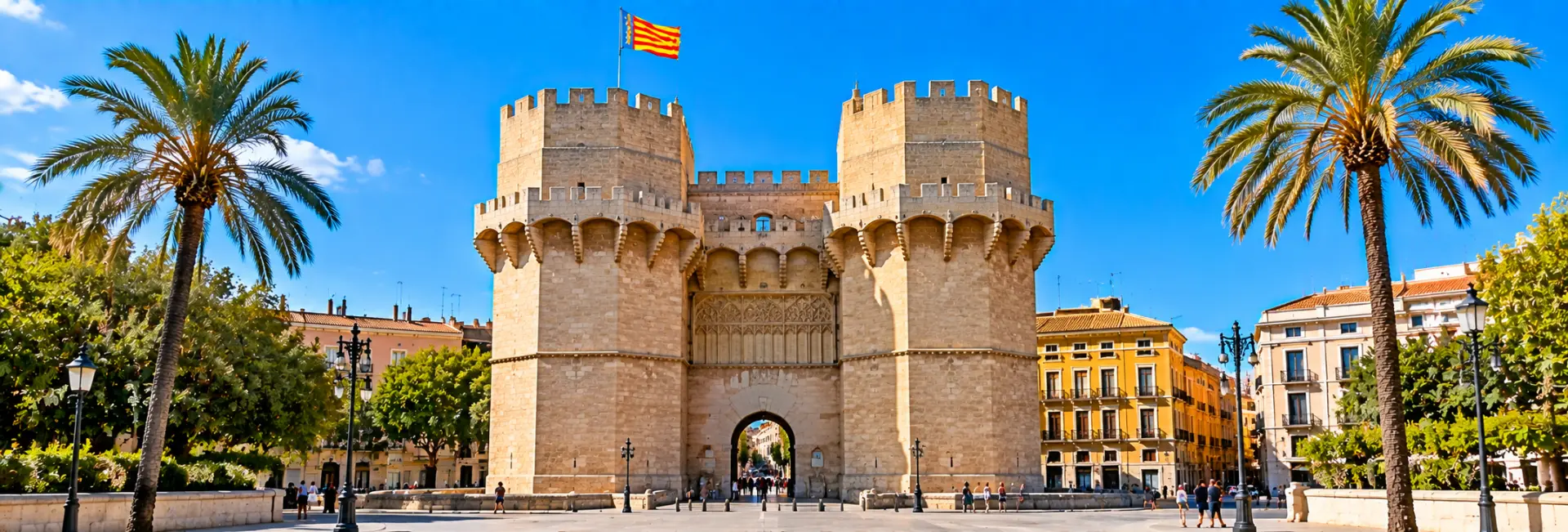
Torres de Serranos is a monumental twin-towered gate standing at the northern edge of Valencia's old town, facing the bridge that once carried traffic across the Turia riverbed and into the walled medieval city. Built at the end of the 14th century, it's the grandest surviving gateway from the fortifications that once ringed Valencia, and one of only two city gates still standing today.
Far more than a defensive checkpoint, the gate was designed to impress visiting royalty and merchants alike, and it still does the same job for modern-day visitors. Climbing to its rooftop terraces rewards the effort with sweeping views over the old town, the Turia Gardens and the surrounding hills, making it one of the best vantage points in Valencia.
History
Construction
King Peter IV of Aragon ordered the reinforcement of Valencia's medieval wall in the late 14th century, and master builder Pere Balaguer was commissioned to design a grand new gate to replace the older, simpler entrance on the same site. Construction ran from 1392 to 1398, drawing inspiration from the ceremonial gate of the Poblet Monastery in Catalonia.
Main Entrance to the City
Once complete, the gate became the principal entrance to Valencia from the north, the route used by travellers arriving from Aragon and the road toward Zaragoza and Barcelona. It's thought to have handled the vast majority of traffic in and out of the city, including a toll post for goods passing through, and it also served as a stage for the ceremonial entry of kings, queens and foreign ambassadors.
Later Uses and Survival
Between the 16th and 19th centuries, the towers were repurposed as a prison for nobles and knights. When Valencia's medieval walls were demolished in 1865 to make way for the city's expansion, Torres de Serranos and the smaller Torres de Quart were deliberately spared, leaving them as the two main surviving fragments of the old fortifications.
Recognition & Status
Torres de Serranos was declared a National Historic-Artistic Monument, formally recognising it as one of the city's most important surviving pieces of medieval architecture. Along with Torres de Quart, it stands today as one of the only tangible reminders of the walled city that once enclosed Valencia's historic centre.
- Declared a National Historic-Artistic Monument
- One of only two surviving gates from Valencia's medieval city wall
- Widely regarded as one of the finest examples of 14th-century military architecture in the region
Architecture & Design
Built in Valencian Gothic style, the gate consists of two tall, polygonal towers flanking a central archway, rising to around 33 metres and originally surrounded by a defensive moat. The design was deliberately grand rather than purely functional, intended to signal the wealth and standing of medieval Valencia to anyone approaching the city.
On the side facing the city, the towers are cut back and opened up with vaulted chambers rather than left as solid defensive mass, a design choice meant to stop the gate itself from being used as a stronghold by an enemy, or even by the city's own garrison, should either try to seize control of it.
Key Areas & What to See There
The Twin Towers
The two polygonal towers form the heart of the monument, connected by internal staircases that visitors can climb to reach several levels of chambers along the way to the top.
The Vaulted Chambers
On the city-facing side, a series of vaulted rooms once served as viewing galleries, where Valencia's nobility could watch the ceremonial arrival of kings and ambassadors passing through the gate below.
The Rooftop Terraces
At the top, open battlemented terraces offer panoramic views across the old town's rooftops, the green expanse of the Turia Gardens below, and the mountains beyond the city.
Cultural Significance
Beyond its role as a defensive structure, Torres de Serranos has long been a stage for Valencia's civic and festive life. Each year on the last Sunday of February, the Fallera Mayor, the young woman chosen to represent the city's Fallas festival, appears at the gate to formally invite locals and visitors to take part in Las Fallas, a ceremony known as La Crida.
Centuries earlier, the same gate hosted the ceremonial entries of monarchs and dignitaries into Valencia, and its imposing scale was as much about civic pride and spectacle as it was about defence, a role it continues to play in the city's traditions today.
Ways to Experience It
A visit typically means climbing through the towers' internal chambers and stairways to reach the rooftop terraces, taking in the views and the architecture along the way.
- Self-guided climb through the towers to the rooftop terraces
- Audio guides covering the gate's history and its place in the old city wall
- Attending La Crida in late February, when the Fallas festival is formally opened at the gate
Best Time to Visit
Because the visit involves open-air stairs and terraces, access can depend on daylight and weather, and the towers may close early or limit entry during rain, fog or strong wind. Visiting earlier in the day generally means fewer crowds on the stairs and better light for the views from the top.
Late February brings La Crida, when the square in front of the gate fills with crowds for the opening of Las Fallas, an atmospheric time to visit for the festival itself, though not the best time for a quiet look at the monument.
Visitor Tips
- Wear comfortable shoes, since the visit involves climbing stone stairs with no lift access
- Check opening hours before visiting, as they vary between weekdays, weekends and public holidays
- Entry is free on Sundays and public holidays, so those days tend to be busier
- Space at the top is limited, so avoid bringing large bags or backpacks if possible
- Combine the visit with a walk through the Turia Gardens just below the gate
Nearby Attractions
Torres de Serranos sits right at the edge of Valencia's old town, within easy reach of several other landmarks and green spaces.
- Turia Gardens: the long riverbed park running along the base of the old walls
- Serranos Bridge: the historic bridge facing the gate across the old riverbed
- IVAM contemporary art museum: a short walk into the surrounding neighbourhood
FAQs about visiting Torres de Serranos
What was Torres de Serranos originally used for? +
It was built as the main gate into medieval Valencia, combining defence, toll collection and a ceremonial entrance for royalty and dignitaries.
Can you climb to the top of Torres de Serranos? +
Yes, an internal staircase leads up through the towers to open rooftop terraces with panoramic views over the old town and the Turia Gardens.
How much time should I set aside for a visit? +
Most visitors spend around an hour, including the climb to the top and time to take in the views.
Is Torres de Serranos free to visit? +
There is a small entry fee on most days, with free admission on Sundays and public holidays, though it's worth checking current prices before visiting.
Is the climb suitable for everyone? +
The towers are reached by stone stairs with no lift, so the climb may not suit visitors with mobility limitations, and comfortable shoes are recommended for everyone.
What is La Crida? +
It's the ceremony held at the gate on the last Sunday of February, when the Fallera Mayor formally invites the city to take part in Las Fallas festival.
What's nearby worth visiting after Torres de Serranos? +
The Turia Gardens run right below the gate, and the Serranos Bridge and IVAM contemporary art museum are both within easy walking distance.