
Table of Contents
Overview
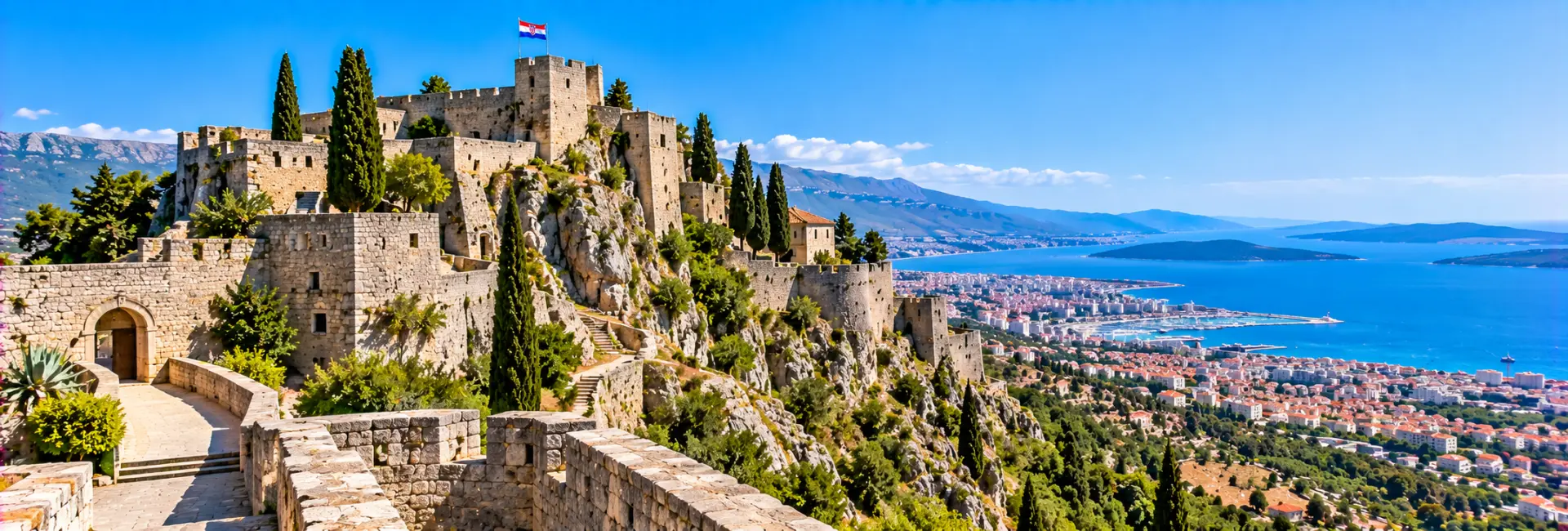
Perched on a bare limestone ridge about 15 kilometres north of Split, Klis Fortress is one of the most dramatic historic sites in Dalmatia. It occupies a narrow pass between the Mosor and Kozjak mountains, and for some 2,000 years whoever held this rock controlled the route between the coast and the interior.
The fortress has been an Illyrian stronghold, a target of Roman legions, a seat of Croatian dukes and kings, a bulwark against the Ottoman advance and, in recent years, a film set. From its upper walls, the view takes in Split, the ruins of ancient Salona, the town of Trogir and the islands scattered across the Adriatic.
Klis is a protected cultural good of Croatia and an easy half-day trip from Split. Many visitors arrive for the Game of Thrones connection, but they usually leave more impressed by the scale of the walls and the sweep of the landscape.
History
Illyrians and Romans
The first known inhabitants of the site were the Dalmatae, an Illyrian tribe who built a small stronghold here around 2,000 years ago. They were defeated several times by Rome and were finally absorbed into the empire in 9 AD. The Romans knew the place as Andetrium, and in later centuries as Clausura, the Latin name from which the forms Clissa and finally Klis developed.
A Seat of Croatian Rulers
From the early 7th century, Klis became an important Croat stronghold. In the 9th century Duke Mislav made it his seat, and his successor Trpimir I expanded the fortress and moved the ruler's main residence here from Nin. Trpimir issued a charter in 852 that mentions Klis as his own seat, and he founded a church and the first Benedictine monastery in Croatia in the valley below. Later, King Tomislav used Klis as one of his main residences.
Mongols, Magnates and Kings
In March 1242, Mongol forces pursuing King Béla IV of Hungary attacked the fortress but failed to take it, and the natural defences proved decisive. Saint Margaret of Hungary, the king's daughter, is recorded as having been born at Klis during that turbulent time. In the following centuries, the fortress passed between Croatian noble families, the powerful Šubić dynasty and various rulers under the Hungarian crown.
Ottomans, Venetians and Austrians
After falling to the Ottomans in 1537, Klis served as an Ottoman administrative centre for more than a century, apart from a brief recapture in 1596. In 1648, Venetian forces took the fortress, and they restored and enlarged it, giving it much of the form visitors see today. Austria took control in 1797, but the strategic frontier had moved eastward, and the military eventually abandoned the site in the 19th century.
Defending the Gateway to Dalmatia
Petar Kružić and the Uskoks
The most famous chapter in Klis's story unfolded between 1513 and 1537, when Captain Petar Kružić, known as the Prince of Klis, defended the fortress against the Ottomans. His garrison was made up largely of refugees from lands already conquered, and these fighters became known as the Uskoks. They nominally accepted Habsburg authority, but in practice they were fiercely independent and fought mostly without outside help.
The Final Siege
The last great siege lasted from late 1536 until March 1537. A relief force of Habsburg and papal troops landed nearby, but it proved badly drilled and fell apart when faced with the Ottoman army. Kružić himself was captured and executed, and with their leader gone and water supplies running low, the defenders surrendered on 12 March 1537 in return for safe passage. Many of the Uskoks went north to Senj, where they continued the fight.
A Brief Return in 1596
In April 1596, a force of Split nobles, Uskoks and local irregulars seized the fortress with help from dissident members of the Ottoman garrison. The Ottomans responded with a much larger army, and Klis was lost again by the end of May. Even so, the short-lived victory echoed across Europe at the time.
Architecture & Layout
A Fortress Built Into the Rock
Klis stands on an isolated rocky eminence, inaccessible on three sides, and its walls follow the natural contours so closely that the fortress is hard to pick out as a man-made structure from a distance. The only entrance is from the western side, which meant attackers always had to approach along a narrow and well-defended route.
Three Lines of Defence
The complex is arranged as three long defensive lines, each enclosed by walls and reached through its own gate. Visitors pass through three entrances before they arrive at the highest, inner part of the fortress. The main gate in its present form was built by the Austrians in the early 19th century, while the tower known as Oprah, first mentioned in 1355, is one of the oldest medieval elements.
Buildings Within the Walls
Inside the walls stand structures from several eras. The Church of St Vitus was originally an Ottoman mosque built on the foundations of an earlier chapel, and the Venetians later removed its minaret and converted it to Catholic use. Nearby are an armory and an 18th-century gunpowder store, and the mid-17th-century Bembo bastion held the fortress's largest artillery position. Much of what you see today dates from the Venetian rebuilding of the 17th century.
Cultural Significance
A Symbol of Resistance
Klis is remembered in a well-known Croatian saying that plays on the fortress's rocky setting, suggesting that life is hard for Klis because it stands on stone, and hard for the stone because Klis stands on it. The proverb captures the stubborn spirit of the people who defended the place for centuries.
The Uskoks Remembered
The Uskoks remain a point of local pride. A re-enactment association called Kliški uskoci helped develop the fortress as a visitor attraction, and the town stages a medieval-style festival around the last weekend of July, celebrating the Uskok defence with a re-enactment of a battle against Ottoman forces. Check the festival dates in advance if you hope to attend.
Klis on Screen
The fortress has also become familiar to television viewers as the setting for the fictional city of Meereen in the series Game of Thrones. An earlier film, the 1972 production Eagle in a Cage, also used the site. Inside the walls, an exhibition in an 18th-century gunpowder chamber displays stills from the show for fans who want to compare the screen version with the real thing.
Ways to Experience It
- Walk the three gates: Follow the stone paths upward through the successive entrances. Each level opens up broader views and shows a different era of construction.
- Visit the armory: A collection of muskets, swords, armour and Uskok-style costumes brings the military history to life, alongside panels that explain the fortress's long story.
- See the Game of Thrones display: The gunpowder chamber near the top holds the show exhibition, which is a quick but fun stop for fans.
- Take in the views: The upper walls offer panoramas over Split, Salona, Trogir and the islands, and are the best place for photographs.
- Join a tour: Many half-day and themed tours from Split include Klis, which is convenient if you prefer not to drive.
- Lunch in Klis village: The town below is known for its spit-roast restaurants, making a satisfying end to the visit.
Best Time to Visit
Seasons
Spring and early autumn are the most comfortable times to explore, with mild temperatures and clear views across the coast. Summer brings the longest opening hours but also strong heat, and the exposed stone gives little respite from the sun. In the off-season, opening days may be limited, so confirm the schedule before you set out.
Time of Day
Morning is ideal for a cooler climb and softer light. Late afternoon is another excellent option, when the stone turns golden and the views toward Split and the sea are at their best. The fortress has also been lit at night in recent years, which adds an atmospheric view from the road below.
Visitor Tips
- Tickets and hours: An entrance fee applies, and opening days and hours vary by season, with the longest hours in summer. Confirm current details before you go.
- Getting there: Klis lies about 15 kilometres north of Split and can be reached by car or public bus, as well as on organised tours. Check local services for current schedules.
- Footwear: Paths are made of worn stone with steps and uneven stretches, so wear shoes with good grip.
- Sun and water: There is little shade on the rock, so bring water, sun protection and a hat in warm months.
- Time needed: Allow a couple of hours or more to explore the three levels, enjoy the views and visit the exhibitions.
- Families: Children often enjoy the cannons, towers and open spaces, although steep drops and uneven ground call for supervision.
- Accessibility: The slopes, steps and rough surfaces make the site challenging for wheelchairs and for visitors with limited mobility.
Nearby Attractions
- Split: Diocletian's Palace and the old town lie only about 15 kilometres away and pair naturally with a visit to Klis.
- Salona (Solin): The ruins of the Roman capital of Dalmatia sit in the valley below the fortress and add context to Klis's Roman past.
- Trogir: The UNESCO-listed island town on the coast is visible from the fortress walls and makes a good follow-up day trip.
- Kaštela: A string of small coastal settlements lies along the bay visible from the fortress and offers an easy seaside break after the climb.
- Klis village restaurants: Local spit-roast restaurants serve traditional meat dishes and are a classic stop after the climb.
- Krka National Park: Some day tours combine Klis with the waterfalls of Krka, which makes an ambitious but rewarding itinerary.
FAQs about visiting Klis Fortress
What is Klis Fortress? +
It is a medieval fortress on a rocky ridge above the village of Klis, about 15 kilometres north of Split. Its history stretches back around 2,000 years, from Illyrian and Roman times to the Ottoman wars.
Why is Klis Fortress famous? +
It is best known for the long defence led by Petar Kružić against the Ottomans, which ended in 1537, and for the Uskoks who fought there. Many visitors also know it as the filming location for Meereen in Game of Thrones.
How far is Klis from Split and how do I get there? +
It lies roughly 15 kilometres north of the city. You can drive, take a public bus or join an organised tour, and the trip takes a short time from the centre.
How long should I spend at the fortress? +
Plan on a couple of hours or more. That gives you time to walk through the three gate levels, see the armory and Game of Thrones display, and enjoy the views.
Do I need to buy a ticket? +
Yes, an entrance fee applies. Prices and opening hours change with the season, so check the latest information before visiting.
Is it suitable for children and older visitors? +
Children often enjoy it, but the paths are steep and uneven, and some edges are exposed. Visitors with limited mobility may find parts of the site difficult.
What is the best time of year to visit? +
Spring and early autumn offer comfortable weather and clear views. Summer is hot, with little shade on the rock, so go early or late in the day.
Is it worth visiting even if I haven't seen Game of Thrones? +
Absolutely. The real draw is the dramatic setting, the layered history and the views over Split and the Adriatic, and the show is only one chapter of a much longer story.
