Table of Contents
Overview
In the heart of Munich's Kunstareal museum district, the Alte Pinakothek holds one of the world's most important collections of European Old Master paintings, spanning the fourteenth through the eighteenth centuries. Commissioned by King Ludwig I of Bavaria to display the centuries-old art treasures of the Wittelsbach family, the museum opened in 1836 as the largest gallery building in the world at the time.
Nearly two centuries later, it remains a cornerstone of Munich's art scene, home to major works by Durer, Rubens, Raphael, Rembrandt, and dozens of other painters who shaped the course of European art. Visitors can spend anywhere from an hour to a full afternoon moving through its long galleries, taking in everything from intimate early Netherlandish panels to some of the largest canvases Peter Paul Rubens ever painted.
History
A Royal Commission
The Alte Pinakothek's origins lie in the private art collection of the Wittelsbach family, Bavaria's ruling dynasty, which had been growing since the sixteenth century under Duke William IV. In 1826, King Ludwig I commissioned court architect Leo von Klenze to design a purpose-built gallery that would finally make this royal treasure trove accessible to the public, and construction proceeded over the following decade. The museum opened its doors in 1836, and at the time it was the largest museum building anywhere in the world.
War Damage and Postwar Rebuilding
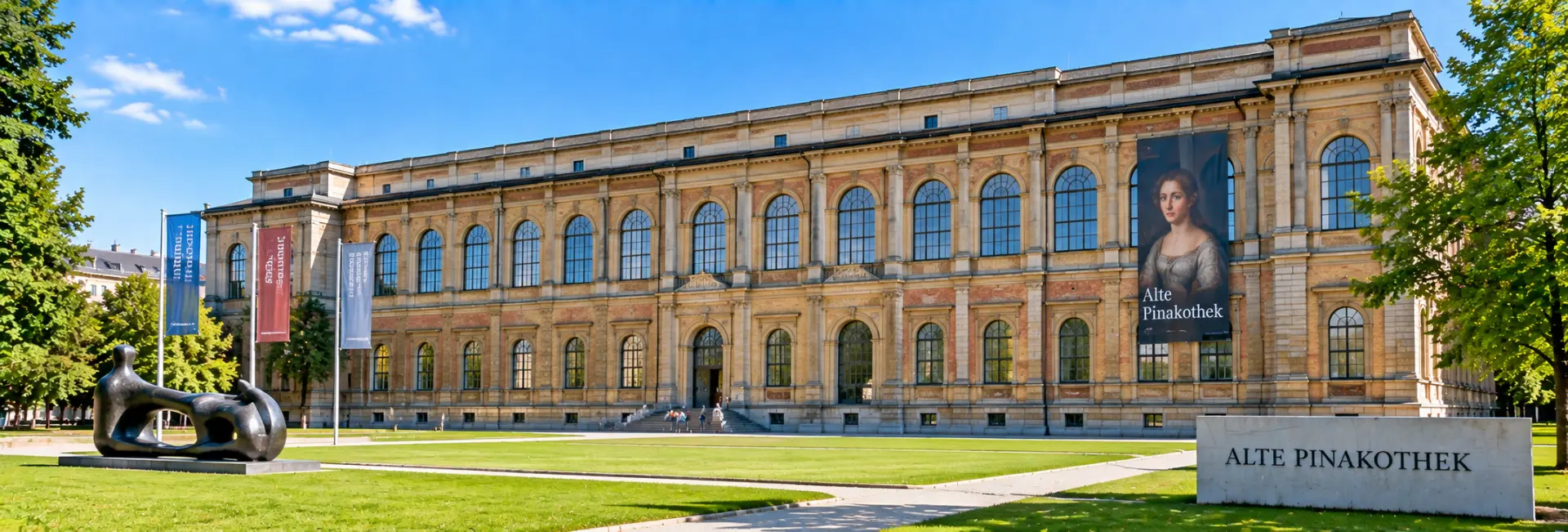
The museum closed in 1939 as the Second World War began, and its collection was evacuated for safekeeping, a decision that likely saved many of its most valuable paintings. The building itself was not so fortunate, suffering extensive bomb damage that destroyed roughly a third of the structure. Reconstruction in the 1950s was led by architect Hans Dollgast, who took the unusual approach of leaving some of the damaged sections visibly patched with plain, unplastered brick rather than fully restoring the original ornate stonework, a decision that has since made the building itself a recognized example of postwar German reconstruction architecture.
Architecture & Building
Leo von Klenze designed the Alte Pinakothek in a style loosely inspired by Italian Renaissance palace architecture, with a long facade and an arcaded loggia modeled on the decorative galleries of the Vatican. At the time, its most innovative feature was practical rather than decorative: the main galleries were lit by overhead skylights rather than side windows, a solution that let paintings be viewed in even, natural light and that went on to influence museum design across Europe.
The building's postwar reconstruction added its own architectural chapter. Hans Dollgast's light-filled double staircase, built during the 1950s rebuild, has become almost as celebrated as the paintings it leads visitors toward, while sections of unrendered brick left in place of the original ornamentation still mark where the building was struck during the war, a visible reminder folded into the museum's everyday visitor experience.
Collections & Exhibits
The Alte Pinakothek's collection covers roughly five centuries of European painting, from the early Netherlandish masters of the fourteen hundreds through to the end of the Rococo period in the late seventeen hundreds. It is especially renowned for its holdings of German and Flemish painting, including some of the largest groupings of works by Albrecht Durer and Peter Paul Rubens found anywhere in the world, alongside strong representation from nearly every other major European school of the period.
- Early Netherlandish and German painting, including works by Rogier van der Weyden and Albrecht Altdorfer
- Italian Renaissance painting, with major works by Raphael, Botticelli, and Titian
- Flemish and Dutch painting, anchored by an extensive collection of Rubens alongside Rembrandt and Frans Hals
- French and Spanish painting from the same centuries, including works by Poussin, Murillo, and El Greco
The collection forms the core of the wider Bavarian State Painting Collections, which also include the neighboring Neue Pinakothek and Pinakothek der Moderne, covering nineteenth-century and modern art respectively.
Must-See Highlights
A handful of paintings tend to anchor most visits to the Alte Pinakothek.
- Albrecht Durer's self-portrait from 1500, one of the most famous and closely studied self-portraits in Western art
- Rubens' "The Last Judgment," one of the largest canvases the artist ever painted, displayed in its own dedicated hall
- Three Madonna paintings by Raphael, grouped together in a single room
- Albrecht Altdorfer's "The Battle of Alexander at Issus," a densely detailed depiction of an ancient battle
- Leonardo da Vinci's "Madonna of the Carnation," the only painting by Leonardo held in any German museum
Because the collection is organized broadly by school and period, following the galleries in sequence gives a natural sense of how European painting evolved across these centuries.
Ways to Experience It
Most visitors explore the Alte Pinakothek at their own pace using the printed floor plan or an audio guide, moving through the upper and lower galleries in roughly chronological order.
- Guided tours covering the collection's highlights or specific schools of painting are offered on a regular schedule
- Audio guides are available in multiple languages for a self-paced but more detailed visit
- A combined ticket covers same-day entry to the neighboring Neue Pinakothek and Pinakothek der Moderne, useful for a fuller day in the Kunstareal
- Temporary exhibitions are held alongside the permanent collection and are worth checking in advance if a specific theme or artist is of interest
Because the museum can be seen thoroughly in two to three hours, it pairs well with a visit to one of the neighboring galleries on the same day.
Best Time to Visit
Weekday mornings tend to be the quietest time to visit, particularly outside of school holiday periods when the museum can draw larger groups. Sundays, when admission is reduced to a token price, are popular with local visitors and correspondingly busier.
Because the entire visit takes place indoors, the Alte Pinakothek makes a good option on days when Munich's weather is unfavorable for sightseeing outside. Visitors hoping to combine it with the other Pinakothek museums or a walk through the surrounding Kunstareal district may find spring and autumn especially pleasant for the outdoor portions of the day.
Visitor Tips
A few practical notes help visitors plan a smooth trip to the Alte Pinakothek.
- The museum is closed on Mondays, along with several public holidays, so check the schedule before visiting
- Admission is reduced to a token price on Sundays, making it a popular day for local visitors
- A combined day pass covers the Alte Pinakothek, Neue Pinakothek, Pinakothek der Moderne, and other Bavarian State collections
- The building is wheelchair accessible, with lifts available between floors
- The nearest public transport connections are the Konigsplatz U-Bahn station and the number 27 tram to Pinakotheken
Nearby Attractions
The Alte Pinakothek sits at the center of Munich's Kunstareal, a compact district built almost entirely around art and culture.
- The Neue Pinakothek and Pinakothek der Moderne, covering nineteenth-century and modern and contemporary art respectively
- The Egyptian Museum and other smaller galleries scattered throughout the surrounding streets
- Konigsplatz, a grand neoclassical square a short walk away
- The Englischer Garten, one of the world's largest urban parks, within easy walking or cycling distance
FAQs about visiting the Alte Pinakothek
What is the Alte Pinakothek known for? +
It is one of the world's great collections of European Old Master paintings, especially strong in works by Albrecht Durer and Peter Paul Rubens.
How much time should I plan for a visit? +
Most visitors need two to three hours to see the collection at a comfortable pace, making it easy to combine with another museum on the same day.
Is the museum open every day? +
No, the Alte Pinakothek is closed on Mondays and several public holidays, so it is worth checking the schedule in advance.
What are the must-see paintings? +
Highlights include Durer's 1500 self-portrait, Rubens' monumental "The Last Judgment," Raphael's three Madonnas, and the museum's only painting by Leonardo da Vinci.
Can I visit the other Pinakothek museums on the same ticket? +
Yes, a combined day pass covers same-day entry to the Alte Pinakothek, Neue Pinakothek, Pinakothek der Moderne, and other Bavarian State collections.
Why does the building's exterior look patched in places? +
Sections of the facade were rebuilt with plain, unplastered brick after World War II bombing, a deliberate choice by the postwar architect to leave the building's war damage visible.
Is the Alte Pinakothek wheelchair accessible? +
Yes, the building is accessible, with lifts available between floors.
How do I get to the Alte Pinakothek? +
The museum is a short walk from the Konigsplatz U-Bahn station, and the number 27 tram stops directly at Pinakotheken.