
Table of Contents
Overview
The Franciscan Monastery sits at the very beginning of Stradun, just inside Pile Gate, and it is easy to walk past without realizing how much lies behind its doors. Behind a quiet stone portal is a calm cloister garden, a museum, an old library and one of the longest-running pharmacies in Europe.
This is not a retired monument. The complex is still home to a community of Franciscan friars, who share the residential parts of the building with the museum and church that visitors come to see. That living character gives the place a hush that is rare in the busiest part of the Old Town.
The monastery is best known for two things: its graceful cloister, with pairs of slender columns carved with a different design on every capital, and its pharmacy, which has been dispensing remedies since the early 14th century. Both survived centuries of fire, earthquake and war, and both can be enjoyed in a visit of an hour or less.
For travelers who want a break from the crowds on Stradun, or who enjoy history told through everyday objects, the monastery is one of the most rewarding small stops in Dubrovnik.
History
From the suburb to the city walls
The Franciscans arrived in the Dubrovnik area in the 13th century. The first written record of the community, dating to 1235, mentions a monastery dedicated to Saint Thomas in the suburb of Pile, which lay outside the city walls at that time.
In 1317, when war with the Serbian king Uroš II Milutin seemed imminent, the old monastery outside the walls was torn down so that it could not be used by attackers. The friars moved inside the fortifications, close to Pile Gate, and the monastery you see today grew from that move.
Building the cloister
The most celebrated part of the complex, the cloister, was built around the middle of the 14th century. It is credited to the local master builder Mihoje Brajkov, who came from the town of Bar, and it has long been counted among the finest works of its kind on this coast.
The earthquake of 1667
On 6 April 1667, a powerful earthquake devastated Dubrovnik. The monastery church, which had been one of the richest in the city, was largely destroyed and later rebuilt in the Baroque style. One of the few elements of the old church to survive was the decorated south portal facing Stradun, and it remains the monastery's most recognizable outside feature.
The library and later centuries
A large library was added to the monastery in the 17th century, as part of the rebuilding after the earthquake. Over the following centuries the friars continued to collect books, manuscripts and works of art, and the complex took on the role of a center of learning as well as prayer.
Damage and restoration in the 1990s
During the siege of Dubrovnik in 1991 and 1992, the monastery was hit by shelling. The bell tower, the library and the portal were among the parts damaged, and all were carefully restored after the war. Marks left by the bombardment can still be seen on some stonework around the Old Town.
Architecture and Design
The Pietà portal
The south portal on Stradun is a late-Gothic work completed at the end of the 15th century. Above the door, a sculpted Pietà shows the grieving Virgin holding the body of Christ, with saints on either side. Gothic in form but already softened by Renaissance influence, it is the best-preserved piece of the church that stood here before 1667.
The Romanesque-Gothic cloister
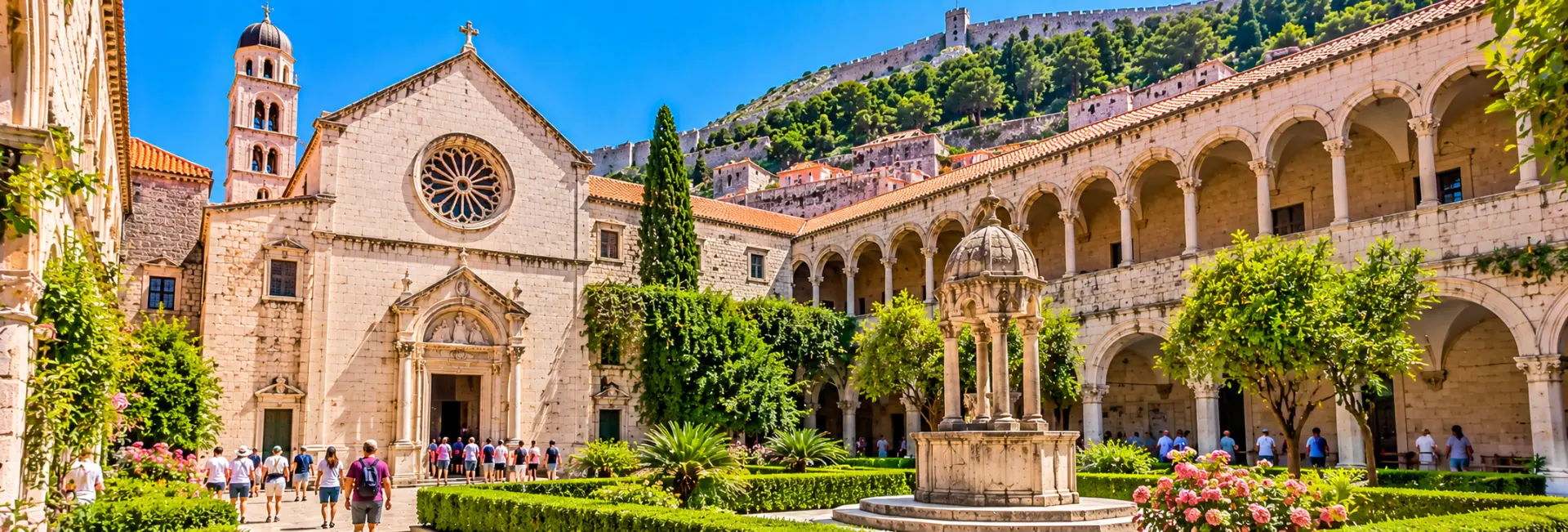
Step through the entrance passage and you reach the lower cloister, a square courtyard framed by arcades. Its arches rest on slim paired columns, with twelve heavier pilasters, for a total of about 120 columns by the commonly cited count. Together they create a rhythm of light and shadow that is especially beautiful in the morning.
- Every capital is carved differently, with human faces, animals, grotesque figures and plant motifs.
- Paintings on the walls recall the life of Saint Francis, added in the 19th century.
- A fountain with a statue of Saint Francis stands in the middle of the courtyard.
The garden
At the center of the cloister, a small garden of orange trees and palms fills the space with scent and shade. Historically such gardens supplied the herbs and plants needed by the monastery pharmacy, which makes the greenery here part of the story rather than just decoration.
The Baroque church
The church itself, rebuilt after the earthquake, is Baroque in style, with ornate altars and large paintings. It contrasts strongly with the older, quieter forms of the cloister, and together the two spaces trace how the monastery evolved over several centuries.
The Old Pharmacy
A pharmacy since 1317
The monastery's pharmacy was established in 1317, soon after the friars settled inside the city walls. It began by serving the monks, but it quickly opened its doors to the citizens of Dubrovnik, which makes it one of the earliest pharmacies in Europe to serve the general public.
It is commonly described as the third oldest pharmacy in Europe and one of the few that have continued to operate to the present day. Over the centuries it moved within the complex, and the working pharmacy now stands near the entrance on Stradun.
What you can see
The museum holds the historic inventory of the old pharmacy. Visitors can see the carefully preserved furniture from the 16th century, laboratory equipment, mortars, jars and bowls, and a number of old medical books. Several ceramic vessels from the 15th and 16th centuries came from workshops in Siena and Florence, a reminder of how far trade networks reached.
The pharmacy today
The modern pharmacy sells creams, lotions and other products made following traditional Franciscan recipes, as well as ordinary pharmacy goods. It is open to the street, so you can step in and browse without entering the museum, which makes it a pleasant place to look for a small, unusual souvenir.
Museum, Library and Treasures
The museum
The monastery museum is small and focused, and it rewards unhurried looking. Its collection includes liturgical objects such as chalices and crucifixes, relics, paintings and old goldwork gathered by the friars over the centuries.
Highlights include a gilded silver crucifix from the 15th century, works by earlier painters, and a copy of an image showing how Dubrovnik looked before the earthquake of 1667. That image is especially valuable because so much of the old city disappeared that day.
The library
The monastery library is among the richest in Croatia. It holds many thousands of books, together with hundreds of manuscripts and a notable group of incunabula, which are books printed in Europe before the year 1501. A large collection of musical manuscripts also survives here. The library is a working research collection, so it is not freely open to the public, but selected items are shown in the museum.
Tombs and memorials
The cloister and church hold a number of tombstones and memorials, including the grave of Mihoje Brajkov, the builder of the cloister. Ivan Gundulić, the celebrated Dubrovnik poet of the Baroque age, is buried in the church, and his memory is still a point of local pride.
Cultural and Religious Significance
A living religious community
The monastery belongs to the Order of Friars Minor, the community founded by Saint Francis of Assisi in the early 13th century. Franciscans live by vows of poverty and service, and the friars here continue the routines of prayer and care that have shaped the building since it was founded. Visitors are guests in an active religious house.
Care for the sick
The presence of a pharmacy inside a monastery reflects a long tradition of religious communities caring for the sick. In an age when few people had access to trained physicians, monastery pharmacies grew herbs, prepared medicines and gave advice, and the Dubrovnik pharmacy is a rare survivor of that tradition.
Learning and the arts
Books, music and painting also found a home here. The library and its manuscripts helped preserve the written heritage of the Dubrovnik Republic, while the friars supported artists and craftsmen who decorated the church and cloister. The monastery therefore stands for the spiritual, medical and intellectual life of the old republic all at once.
A place of resilience
Surviving the 1667 earthquake and the damage of the 1990s, the monastery has become a quiet symbol of the city's ability to rebuild. Its restored portal and cloister are reminders that Dubrovnik's heritage is both fragile and remarkably durable.
Visiting Etiquette and Tips
Respectful behavior
Because this is a working monastery and an active church, visitors are expected to dress modestly, with shoulders and knees covered, and to keep their voices low. Photography is usually welcome in the cloister, but it is best to follow any posted signs and to avoid flash in the church and museum.
Practical tips
- The church can be entered from Stradun, while the cloister and museum are reached through the narrow passage beside the church. Look for the ticket desk near the entrance.
- Hours and ticket prices vary by season and change over time, so check the current details before you go.
- If you hold a city pass, check whether it includes the monastery museum, as arrangements differ between passes and years.
- Allow thirty to sixty minutes, or a little longer if you want to read the museum labels and sit in the cloister.
- Visit the pharmacy shop at the entrance, which can be browsed without a museum ticket.
Accessibility
The entrance is close to street level, but the complex includes steps, uneven stone floors and narrow passages. Visitors who use wheelchairs or have limited mobility should ask about access before visiting.
Best Time to Visit
Season
The monastery is open for much of the year, with longer hours generally offered in the warmer months. Summer is the busiest time in Dubrovnik, and Stradun can be extremely crowded, but the cloister remains a peaceful refuge even then. Spring and autumn offer comfortable weather and fewer visitors, while winter is the quietest season, with shorter opening hours.
Time of day
- Early morning is calm, with soft light in the cloister and few other visitors.
- Midday can be hot and busy on Stradun, which makes the shaded cloister a welcome break from the sun.
- Late afternoon is pleasant for a quieter visit, though it is wise to arrive well before closing time.
Because the church holds services, the interior may be closed to sightseeing at certain times, so plan a little flexibility into your visit.
Nearby Attractions
Pile Gate
The main western entrance to the Old Town is only steps away. Crossing the drawbridge and passing under the arch is a memorable way to arrive, and the nearby walls are a good starting point for a walk along the ramparts.
Large Onofrio's Fountain
This 15th-century fountain stands just inside Pile Gate, close to the monastery. Its sixteen carved faces once supplied fresh water to the city, and it remains a popular meeting spot.
Church of St Saviour
Standing beside the monastery, this small Renaissance church was built as a thanksgiving after an earlier earthquake and is one of the few buildings that came through the 1667 disaster nearly unharmed.
Stradun
The limestone-paved main street of the Old Town begins right outside the monastery door. A stroll along it leads to Luža Square, the bell tower and Sponza Palace.
Dominican Monastery
On the opposite side of the Old Town, the Dominican monastery has its own cloister and museum, making a natural companion visit for anyone interested in the city's religious and artistic heritage.
FAQs about visiting the Franciscan Monastery
What is the Franciscan Monastery in Dubrovnik known for? +
It is best known for its Romanesque-Gothic cloister and for its pharmacy, which has operated since 1317 and is often described as the third oldest in Europe. The complex also includes a museum, a library and a church.
Where is the Franciscan Monastery located? +
It stands at the very start of Stradun, just inside Pile Gate, beside the Church of St Saviour. The address is usually given as Placa 2.
Is the Franciscan Monastery still in use? +
Yes, it is home to a community of Franciscan friars, and the church is still used for worship. Visitors share the space with an active religious community, so quiet and respectful behavior is expected.
Do you need a ticket for the Franciscan Monastery? +
The church can usually be entered from Stradun, while the cloister and museum require a ticket that is sold near the entrance. Prices and hours change by season, so check the current details before you visit.
Can you visit the pharmacy without buying a museum ticket? +
Yes, the working pharmacy near the entrance is open to the street, so you can browse its products without entering the museum. The historic pharmacy collection is shown inside the museum.
How long does a visit take? +
Most visitors spend between thirty and sixty minutes seeing the cloister, museum and pharmacy. Allow a little more time if you want to rest in the garden or look closely at the cloister capitals.
What should I wear to visit? +
Dress modestly, with shoulders and knees covered, because the monastery is an active religious site. Light, breathable clothing works well in summer, and a scarf or light layer is handy for the church.
Is the Franciscan Monastery suitable for visitors with limited mobility? +
Access can be challenging because the complex has steps, narrow passages and uneven stone floors. Visitors who use wheelchairs should contact the monastery ahead of time to ask which areas are reachable.
