
Table of Contents
Overview
Freedom Square (Vabaduse väljak) is the broad, open plaza where Tallinn's medieval Old Town meets the modern city centre. Measuring roughly 110 by 75 metres, it serves as the capital's ceremonial stage, a favourite meeting point for locals, and a natural first stop for visitors heading into the Old Town on foot.
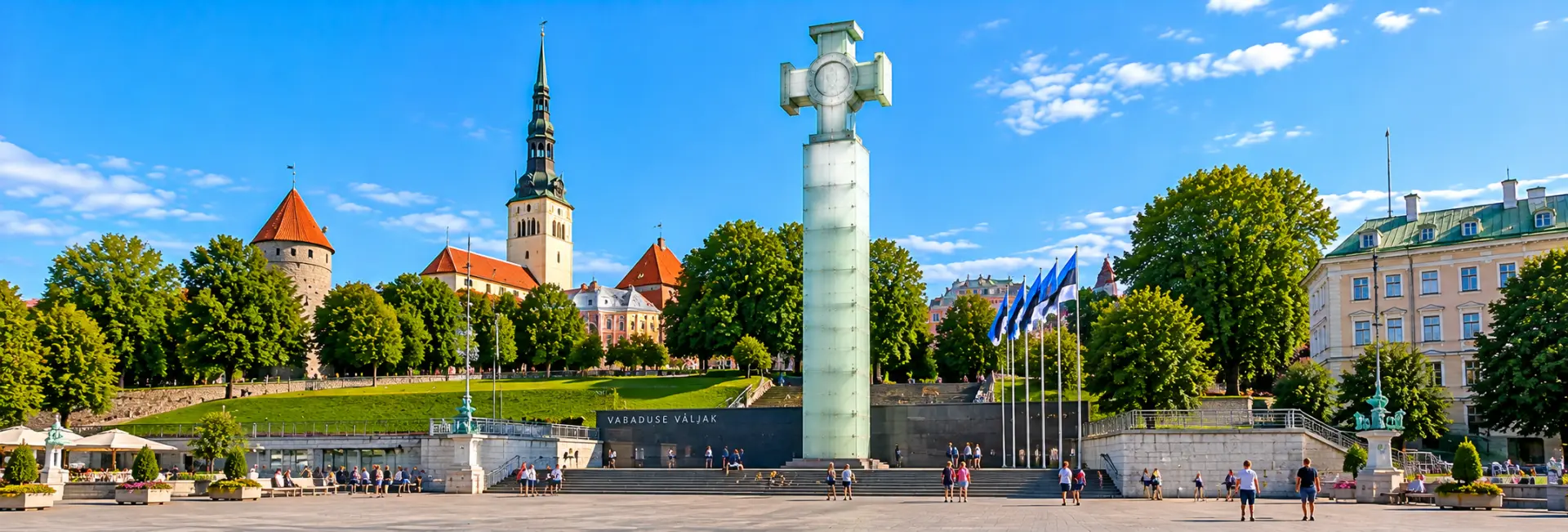
Two landmarks define the view. At the western end rises the tall glass War of Independence Victory Column, a pillar bearing the Cross of Liberty, while the bright yellow neo-Gothic tower of St. John's Church closes off the eastern side. Between them you will find paved walkways, benches, café terraces and a row of interwar buildings, with centuries of fortification history preserved underneath.
Entry is free and the square is open around the clock, so it suits a quick half-hour pause as easily as a longer wander combined with the churches, galleries and viewpoints nearby.
History
From Bastion to Hay Market
The ground beneath the square was once part of Tallinn's defences. The plaza grew over former bastions and earthworks in front of the old Harju Gate, and when those fortifications were levelled in the middle of the 19th century, the open space left behind became a place to trade timber and hay. Older records still refer to it simply as the Hay Market.
St. John's Church rose on the eastern edge between 1862 and 1867. In 1910 the market was closed and the surface paved with stone, and the same year a statue of Peter the Great was unveiled to mark two centuries of Russian rule over the city. The statue was taken down in 1922, after Estonia had become independent.
A Name That Kept Changing
Few public spaces in Estonia have worn as many labels. Hay Market, Peter's Square and Victory Square all appear in the records, and the Estonian form Vabaduse väljak, meaning Freedom Square, was in use by the late 1930s. During the Soviet decades the square was renamed Victory Square and hosted official parades for Soviet holidays.
The freedom name returned in 1989, two years before Estonia restored its independence. For many residents the change meant far more than a street sign, which is part of why the square still feels like a civic centrepiece rather than just a convenient open space.
Rebirth in 2009
By the early 21st century the square functioned largely as a car park. A city-funded reconstruction designed by architects Tiit Trummal, Veljo Kaasik and Andres Alver turned it into a pedestrian plaza, with archaeological digs in 2008 uncovering the old defences and a new underground parking and shopping level built below. The renewed square opened with a large public celebration in 2009, and the Victory Column was unveiled the same summer.
The War of Independence Victory Column
A Memorial in Glass
The column stands 23.5 metres tall and is built from 143 glass plates. It incorporates the Cross of Liberty, an award established in 1919 and regarded as Estonia's most distinguished. The memorial was unveiled on 23 June 2009, which is Victory Day in Estonia, and it honours everyone who fought and fell in the War of Independence of 1918 to 1920.
That conflict cost around 4,000 Estonian lives and left roughly 14,000 wounded, which explains why the monument is treated as a place of remembrance rather than a victory monument in the triumphal sense.
Design and Selection
The winning concept, titled "Libertas", came from Rainer Sternfeld, Andri Laidre, Kadri Kiho and Anto Savi. It was chosen in a 2006 design competition that drew more than 40 entries. The use of glass gives the structure a lightness that contrasts with the heavy stone monuments common elsewhere in Europe, and the column is illuminated after dark.
A Long Road to Completion
The idea of a national war memorial dates back to 1919, before the fighting had even finished. A law establishing one was passed in 1936, but the Second World War and the decades of Soviet occupation halted all progress. After independence was restored, the question returned, and in spring 2005 the Riigikogu decided that a victory column would be raised in Freedom Square.
- Height: 23.5 metres
- Material: 143 glass plates
- Unveiled: 23 June 2009
- Commemorates: the Estonian War of Independence, 1918 to 1920
Architecture Around the Square
St. John's Church
The bright yellow church on the eastern side is a three-nave neo-Gothic Lutheran building designed by the Tallinn-born architect Christoph August Gabler and completed in 1867. Its tower holds what is described as the oldest church bell in Estonia carrying an Estonian inscription, cast in 1872, and the interior features ten stained-glass windows by Dolores Hoffmann illustrating stories from the Gospel of John.
By the 1930s the surrounding blocks had been rebuilt in art deco and functionalist styles, leaving the Gothic church looking quite different from its neighbours. The church has survived more than one attempt to demolish it in the past century, and it is now one of the square's most recognisable features.
Interwar Buildings
The building boom of the 1920s and 1930s left a distinctive mark on the square. The former Gloria Palace cinema, dating from 1926, is now home to the Russian Theatre and is decorated with sculpted wreaths, grapes and lions. Nearby sit the Tallinn Art Hall and its galleries, and the Wabadus restaurant, which has operated beside the square since 1937.
A Pedestrian Plaza
Today's layout is open, paved and easy to cross on foot, with benches and cafés along the edges. The size of the space makes it one of the few places in central Tallinn where large crowds can gather comfortably, a quality that the narrower lanes of the Old Town cannot offer.
What Lies Beneath
The square sits on top of the former Pommeri Bastion and the later Berghi Ravelin, parts of the fortification system that once guarded the approach to the city. During the 2008 excavations, archaeologists exposed sections of these defences, and some of the structures were preserved and left on view inside the underground car park.
Another reminder of the old walls can be found at the end of Harju Street, where the remains of the guard gates of a defence tower are visible through a glass screen. It is a small detail that is easy to miss, but it connects the modern plaza directly to the medieval city line a few steps away.
Events and Civic Life
National Days
Freedom Square is closely tied to Estonia's patriotic calendar. On Independence Day, 24 February, celebrations in Tallinn have included a military parade in the square in years when the capital hosts the main events. Victory Day on 23 June and Restoration of Independence Day on 20 August are also marked with ceremonies, concerts or public gatherings, though the exact programme changes from year to year.
Everyday Life
Outside of official occasions, the square is simply where the city meets. Office workers cross it at lunchtime, friends arrange to meet by the column, and visitors rest on the benches between sightseeing stops. Seasonal markets and festive events appear on the city's calendar during the colder months, so it is worth checking what is on before you arrive.
Both St. John's Church and nearby St. Charles's Church are popular concert venues, which means a visit to the square can easily turn into an evening of classical or choral music.
Ways to Experience It
There is no ticket, queue or fixed route, so you can shape the visit however you like. The following approaches work well:
- Take a self-guided walk around the edges, reading the facades of the interwar buildings and stopping at the column.
- Step inside St. John's Church to see the stained glass and altar painting, subject to its opening hours.
- Look at an exhibition at the Tallinn Art Hall or one of the neighbouring galleries.
- Sit on a bench or at a café terrace and watch the plaza change with the light.
- Use the square as the starting point for an Old Town walk, or climb the walkway toward Harju Hill and Toompea for a view over the rooftops.
- Return after dark to see the Victory Column lit up.
Best Time to Visit
By Season
Summer brings long daylight hours, open terraces and the most comfortable weather for lingering in a wide, exposed space. Spring and early autumn are quieter and cooler, with fewer crowds. In winter the square can be cold and dark early in the day, but seasonal decorations and events add a festive feel in the weeks around the holidays.
By Time of Day
Early morning is the calmest moment and the best time for photographs of the column and church without crowds. Late afternoon light is flattering on the interwar facades, while the evening lighting gives the glass memorial a different character.
Around National Days
If you want to see the square in ceremonial mode, aim for 23 or 24 February, 23 June or 20 August. Be aware that parts of the plaza may be fenced off or crowded during official events, so plan some flexibility.
Visitor Tips
- Entry is free and the square is open 24 hours a day, all year.
- Most visitors spend between 20 minutes and an hour here, depending on whether they add the church or a gallery.
- Visit Estonia lists the square as wheelchair accessible, and the paved surface makes it easy to move around.
- Treat the Victory Column as a memorial: keep noise down near commemorations and avoid climbing on the structure.
- The space is open and offers little shelter, so bring a layer in cool or windy weather and sun protection in summer.
- Opening hours for St. John's Church and nearby galleries vary, so confirm them on the day.
- Check the Visit Tallinn events calendar before you go, as concerts and ceremonies can change access to parts of the square.
- Drivers can use the underground car park beneath the plaza, which also lets you see the preserved fortification remains.
Nearby Attractions
Freedom Square is a convenient hub for exploring central Tallinn, and several highlights are within an easy walk.
- St. Charles's Church (Kaarli kirik): a large historicist limestone church with twin steeples, designed by Otto Pius Hippius and known for its organ.
- Tallinn Old Town: begins just steps from the square, with its medieval streets and Town Hall Square.
- Toompea and Harju Hill: a short walk up from the square, with viewpoints over the city.
- Towers' Square (Tornide väljak): a park beside the town wall near the railway station, known for its summer flower festival.
- Tallinn Art Hall and neighbouring galleries: right on the square, for art exhibitions.
FAQs about visiting Freedom Square
What is Freedom Square in Tallinn known for? +
It is the city's main ceremonial plaza, best known for the glass War of Independence Victory Column, the yellow neo-Gothic St. John's Church and its role as a stage for national celebrations.
Is Freedom Square free to visit? +
Yes, it is a public space with no entry fee, and it is open around the clock throughout the year.
How long should I spend at Freedom Square? +
About 20 to 30 minutes covers the plaza and the column, while an hour allows time for St. John's Church or a nearby gallery.
What is the tall glass column in the square? +
It is the War of Independence Victory Column, a 23.5-metre memorial built from 143 glass plates and unveiled in 2009 to honour those who fought for Estonian independence from 1918 to 1920.
When is the best time to visit? +
Summer offers long days and terrace seating, early mornings are the quietest for photos, and 24 February or 23 June are good choices if you want to see national celebrations.
Why was the square once called Victory Square? +
During the Soviet period the authorities renamed it Võidu väljak, and it hosted official parades. The original Freedom Square name was restored in 1989.
Is Freedom Square suitable for children and wheelchair users? +
Yes, the open paved plaza is easy to navigate with strollers and wheelchairs, and Visit Estonia lists the square as wheelchair accessible, though access to individual buildings can vary.
What can I combine with a visit? +
Walk to St. Charles's Church, Toompea, Towers' Square or the Old Town, all within a short stroll of the square.
