
Table of Contents
Overview
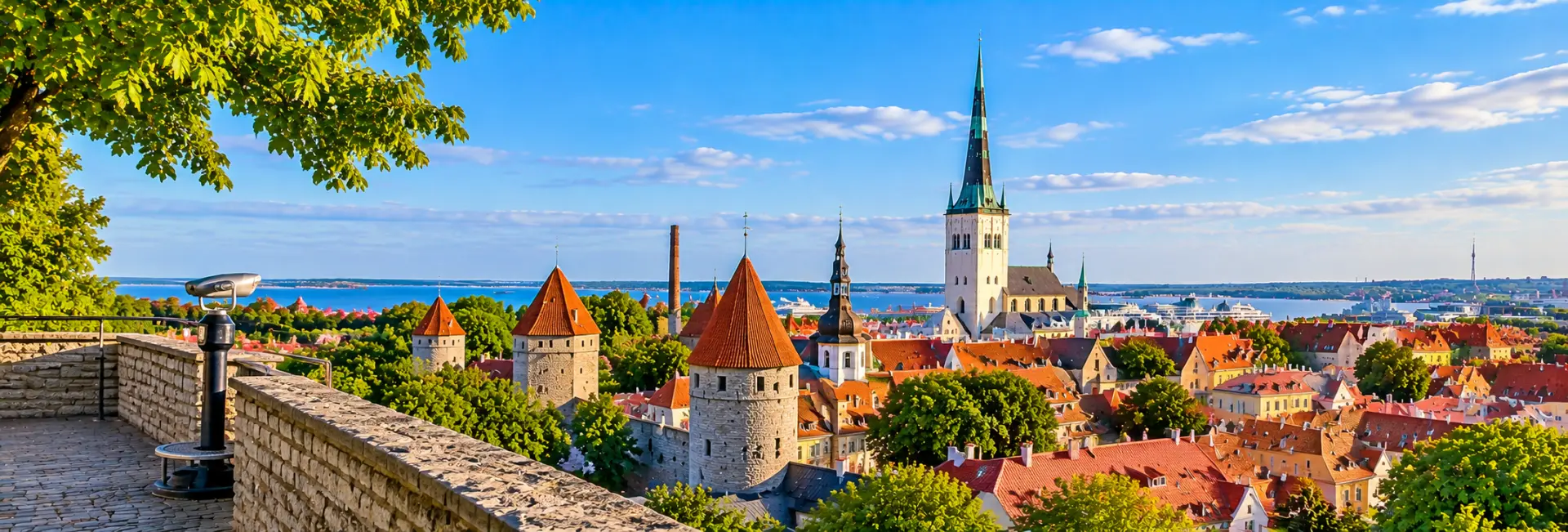
Patkuli Viewing Platform is a small stone terrace on the edge of Toompea Hill, the limestone bluff that rises above Tallinn's Old Town. From its railing the medieval town spreads out below you: a tight cluster of red roofs, church spires, and the long line of the old city wall with its pointed towers. On a clear day your eye can follow the rooftops all the way to the harbour and the sea.
The platform is free, has no gates or ticket desks, and stays open around the clock all year. That simplicity is a big part of its charm. It works as a public lookout that locals use as much as visitors, and it usually feels calmer than some of the busier viewpoints on the hill.
The name Patkuli belongs to both the viewpoint and the 157-step stairway that climbs to it from the park below. Both sit inside Tallinn's UNESCO-listed Old Town, so nearly everything in your field of view is part of a protected historic ensemble.
History of the Platform and Stairway
A Stairway From 1903
The stairway leading up to the platform was built in 1903. It gave people a direct way to climb between Toompark, beside Snelli pond, and the hilltop above, using 157 steps. For much of Tallinn's earlier history the upper town and the lower town were separate communities, so a purpose-built stair like this was a practical way of tying the two halves together.
The 1950s Rebuild
Between 1956 and 1958, the retaining wall and staircases on this side of Toompea went through a major restoration. The lower part of the Patkuli stairway was redesigned, and the viewing platform itself was extended. That work gave the lookout a larger footprint than it had before.
Closure and Renewal
The retaining wall that holds back the natural cliff of Toompea began to deteriorate again in the 1990s, and the stairway was closed for a few years. More recent work has been extensive. A 130-metre stretch of the wall running from the platform toward the Kitseaed park was restored, and the stairs were renovated at a cost of nearly half a million euros.
Steps that had sunk or shifted were reset, the landings received new granite surfacing, and the handrails and lighting were brought up to date. The result is a stairway that still feels old but is much safer to use.
Where the Name Comes From
Patkuli is used for both the steps and the lookout. A reference work on Tallinn street names links it to Dietrich Friedrich Patkul, a soldier from the Swedish period who served as vice-governor of Tallinn between 1707 and 1710, although it treats the connection with some caution.
The wider Patkul name is better known through Johann Reinhold von Patkul, a Livonian nobleman executed in 1707 for his role in the Great Northern War.
The Setting on Toompea Hill
Toompea, the Upper Town
Toompea, known in German as Domberg or "Cathedral Hill", is the limestone height that overlooks central Tallinn. A fortress is thought to have stood here as early as the 10th or 11th century, and the hill later became the base of feudal rulers and the church. The lower town developed differently, growing into a Hanseatic merchant community that received Lübeck city rights in the 13th century and ran its own affairs.
That divide between upper and lower town lasted for centuries, and each side kept its own defences. Patkuli sits right at the seam, so standing on the platform lets you read the old separation in stone: the hill's retaining wall beneath your feet and the lower town's fortifications spread out below.
The Defensive Wall
The first wall around Tallinn is credited to Margaret Sambiria, who ordered it in 1265, and it was strengthened and extended many times afterward. Close to two kilometres of wall survive today, together with roughly half of the original towers. That is a big reason Tallinn is so often described as one of Europe's best preserved medieval fortified towns.
Patkuli is regularly named as one of the best places to take in this fortification system from above, because the platform looks across the wall and its towers rather than straight over the rooftops.
The Castle Above
A short walk along the hilltop leads to Toompea Castle, now home to the Estonian parliament. Its north-western corner is marked by the Pilsticker tower, whose German name means "arrow sharpener", one of several medieval towers that once guarded the castle's corners.
What You See From the Platform
The City Wall and Its Towers
The wall is the first thing most visitors notice. Round and square towers topped with steep roofs march along its length, and from this height you can see how the wall hugs the contours of the old town. It is a rare chance to see the fortifications as a connected system rather than as isolated towers glimpsed from the street.
Stenbock House
Perched on the ledge above the retaining wall is Stenbock House, completed in 1792 to the designs of architect Johann Caspar Mohr. It was first planned as a courthouse, but when state support for construction was withdrawn, Count Jakob Pontus Stenbock took the building over and turned it into a grand town palace. Since 2000 it has been the seat of the Estonian Government, and from the platform it can be admired from the outside.
Red Roofs and Church Spires
Beyond the wall lies a dense carpet of red-tiled roofs, broken by the spires of the old town's Gothic churches. St. Olaf's tower is the easiest to pick out and a favourite subject for photographers. The mix of steep gables, narrow streets and tall steeples explains why the Old Town earned its place on the UNESCO World Heritage List.
Harbour and Sea
Look further out and the rooftops give way to the port and the open water beyond. On clear days the line of the sea is sharp, while hazy or misty conditions soften everything into layers of grey and rust.
The Green Foreground
Directly below the platform are the trees of Toompark and the water of Snelli pond. This band of greenery separates Patkuli from many other Toompea viewpoints, since it adds colour and depth to the foreground and changes dramatically between the seasons.
Ways to Experience It
Climbing the Patkuli Stairway
The most atmospheric approach starts in Toompark near Snelli pond, where the stairway rises into the trees. There are 157 stone steps with landings along the way, and most people with reasonable fitness take only a few minutes to reach the top. The shade of the trees keeps the climb pleasantly cool on warm days.
The steps are not suitable for wheelchairs or pushchairs, and the stone can be slippery after rain or frost.
Arriving From the Hilltop
If you would rather avoid stairs, you can reach the platform on foot from the top of Toompea instead. Follow the streets of the upper town toward Rahukohtu street, where the platform is found beside Stenbock House. This route is step-free, although the cobblestones are uneven in places.
As Part of a Toompea Walk
Many visitors treat Patkuli as one stop on a loop around the hill. The Kohtuotsa lookout is only a few minutes away on foot, and the cathedral, castle and old fortifications all sit within the same compact area. Allow about 15 to 30 minutes at the platform itself, longer if you want to photograph the view in changing light.
Best Time to Visit
The platform is open at all hours, so the best time depends mostly on the light, the season and how much company you want.
- Early morning is the quietest period, and low light catches the church spires and the stone of the wall.
- Late afternoon and evening bring warmer, more directional light across the rooftops. In summer, Tallinn's evenings stretch very late, so there is plenty of time to linger.
- Midday in summer is the busiest period, when tour groups are moving around Toompea, though the platform rarely feels as packed as the more famous lookout nearby.
- Autumn adds colour to the trees of Toompark, which makes the foreground more interesting.
- Winter opens up the sightlines as the branches go bare, and a dusting of snow on the roofs gives the view a storybook look. Early dusk means the lights of the lower town come on while it is still afternoon.
Visitor Tips
- Wear shoes with decent grip. The stone steps and the top of the stairway can be slick in wet weather and icy in winter.
- Pack a layer or two. The platform is exposed, it can get windy, and there is no cafe or shelter on site, with only limited seating.
- Check local notices before planning to use the stairway. It has been closed for repair work more than once, and the step-free route from the hilltop is the reliable fallback.
- For layered photos, try shooting from the ends of the railing rather than the middle. The angled view shows more depth between the rooftops, towers and spires.
- Remember that Toompea is a government and residential district. Keep noise down, and do not block the narrow lanes while setting up shots.
- Do not plan to drive. Vehicle access in the Old Town is restricted and there is no parking at the platform, so most visitors walk up from a tram or bus stop at the edge of the Old Town.
- Stenbock House is a working government building, so enjoy it from the outside rather than expecting to go in.
Nearby Attractions
Patkuli sits in the middle of the best-known sights on Toompea, so it is easy to build a half-day around it.
- Kohtuotsa Viewing Platform: a second lookout just a few minutes away, with a wider outlook toward the modern city.
- Alexander Nevsky Cathedral: an Orthodox cathedral completed in 1900, with a striking onion-domed silhouette at the top of the hill.
- Toompea Castle and Tall Hermann: the seat of the Estonian parliament, with the slender Tall Hermann tower rising from its corner.
- Danish King's Garden: a small, free park tucked in among the old fortifications.
- Kiek in de Kök: a museum in a medieval artillery tower, with tunnels running beneath the nearby bastions.
- Town Hall Square: the heart of the lower town, a short walk down from Toompea.
FAQs about visiting Patkuli Viewing Platform
Is Patkuli Viewing Platform free to visit? +
Yes. It is an open public space with no tickets, gates or booking, so you can simply walk up and enjoy the view.
What are the opening hours? +
The platform is open around the clock, every day of the year. Visiting in daylight gives you the clearest view, but the lights of the Old Town after dark are worth seeing too.
How many steps are there? +
The Patkuli stairway has 157 steps. It starts in Toompark near Snelli pond and climbs to the platform on Toompea Hill.
Is there a way to reach it without climbing stairs? +
Yes. You can approach from the top of Toompea along Rahukohtu street, which avoids the stairway entirely. The cobblestones on that route are uneven, so take care if you have limited mobility.
How long should I spend there? +
Most people stay between 15 and 30 minutes. Add a few more if you climb the stairs or want to photograph the view in changing light.
What is the difference between Patkuli and Kohtuotsa? +
Both are free lookouts on Toompea, only a few minutes apart. Patkuli is known for its view across the city wall and towers with a leafy foreground, while Kohtuotsa gives a wider outlook toward the modern city. Many visitors do both in a single walk.
Is it a good spot for photography? +
Very much so. The wall, towers, spires and harbour layer neatly into one frame, and the light is especially good in the early morning and the evening hours.
