
Table of Contents
Overview
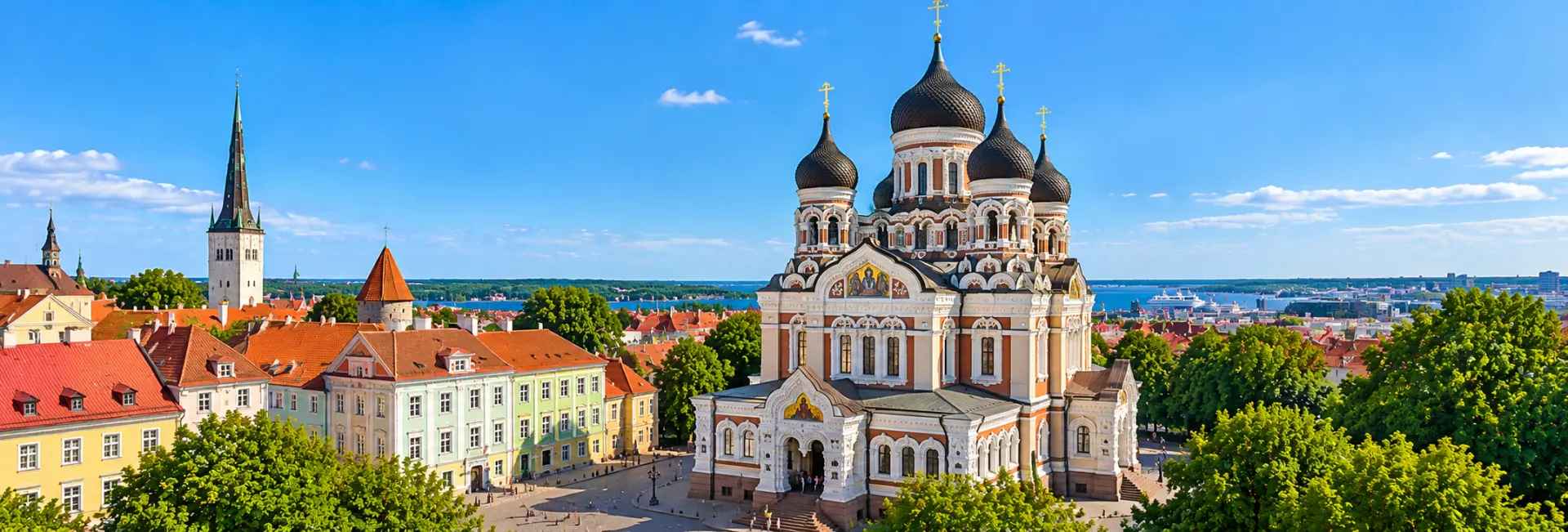
Alexander Nevsky Cathedral crowns Toompea hill in Tallinn's Old Town, facing Castle Square with its cluster of onion domes. It is the largest and most elaborately decorated Orthodox cathedral in the city, and one of the most photographed buildings in Estonia.
Its appearance is a deliberate contrast to the surrounding streets. While the Old Town is full of grey limestone, steep gables and Gothic spires, the cathedral brings in richly patterned walls, gilded details, bright mosaics and a roofline borrowed from Russian church traditions. Few buildings in Tallinn tell a story of power, identity and change as clearly as this one.
It remains an active place of worship rather than a museum, which gives a visit a quiet, reflective character. The scent of candles, the sound of chanting during services and the ringing of the bells make it feel very different from the sightseeing stops nearby.
History
Building the Cathedral
The cathedral was built during the 1890s and completed in 1900, when Estonia was part of the Russian Empire. At that time the imperial authorities were pursuing a policy of strengthening Russian influence in the Baltic provinces, and the site chosen reflects that aim. It sits directly opposite Toompea Castle, the seat of the imperial governor, on a prominent spot long linked with local power.
The design was drawn up by the architect Mikhail Preobrazhensky, and funding came from donations gathered across the empire. The church was dedicated to Saint Alexander Nevsky, the medieval prince of Novgorod celebrated for his 1242 victory over the Teutonic Order in the Battle of the Ice, fought on the frozen waters of Lake Peipus in what is now Estonia.
A Contested Landmark
Many Estonians viewed the cathedral as a symbol of foreign domination rather than a place of beauty. After Estonia gained independence in 1918, authorities discussed removing it. The building was scheduled for demolition in 1924, but the plan was never carried out, partly because of the cost and the sheer solidity of the construction.
The Soviet Era and After
During the Soviet period, the building was not a priority for upkeep, and many churches across the country fell into decline. Since Estonia restored its independence in 1991, extensive conservation work has returned the cathedral to a well-maintained condition, and it is now widely accepted as an important part of the city's layered heritage.
Architecture & Design
Russian Revival Style
The cathedral follows the Russian Revival style popular in the late 19th century, which drew on the look of 16th and 17th century churches in Moscow and other Russian cities. The result is a building of strong shapes, with a tall bell tower, a cluster of domes and richly patterned walls and decorative arches.
Domes and Towers
Five onion domes, each topped with a cross, form the signature silhouette. They are visible from many parts of the Old Town and from the harbour approach, which is part of the reason the building was meant to carry such symbolic weight. The bell tower stands apart in the composition and anchors the corner of the square.
Mosaics and Façade
Mosaic panels above the entrances are among the most admired decorative elements. Their gold and deep blue colours stand out against the dark masonry, and they depict sacred scenes in the Orthodox tradition. Arched windows and carved details add rhythm to the walls without competing with the main mosaics.
Proportions and Scale
The cathedral is large for a church on a hill so tightly packed with older buildings, and its height lets it dominate views from the Lower Town. That scale was part of the intention, since the builders wanted a landmark that could be seen from far across the city and out toward the sea. Standing close to the walls, you can appreciate how much decoration was packed into every surface, from the window frames to the roof edges.
The Interior
Inside, the space is lit by candles and filled with icons, painted panels and a richly decorated iconostasis, the screen that separates the sanctuary from the main hall. Visitors usually stay in the entrance area and along the side aisles, which is enough to take in the atmosphere and the quality of the craftsmanship.
Cultural & Religious Significance
A Living Orthodox Church
Alexander Nevsky Cathedral is a working place of worship for Orthodox believers, and services take place throughout the week. Many local worshippers come to light candles, pray before icons and attend major religious holidays, so the cathedral is a social and spiritual centre as much as a landmark.
Layers of Meaning
Few buildings in Estonia carry as many interpretations. For some it stands for imperial power and the Russification era, and for others it is a treasured part of Tallinn's Orthodox community and a showcase of historic craftsmanship. These different views are part of why the cathedral continues to attract strong opinions and thoughtful conversation.
The Legend of Kalevipoeg
Local tradition says the hill is the burial place of Kalevipoeg, the giant hero of Estonian folklore. The story, found in several places across the country, adds a mythic layer to the hilltop and is often shared by guides when they describe the history of Toompea.
Notable Features
The Bell Ensemble
The tower holds a set of eleven bells, cast in Moscow, which together form the most powerful church bell ensemble in Tallinn. The largest weighs around 15 tonnes and is the heaviest bell in the city. The bells are rung before services, and the sound carries across the Old Town and down into the Lower Town.
Icons and Candles
Visitors will see icons displayed at stations around the interior, and many worshippers light thin candles before them. A small shop inside sells icons, religious books and candles, which makes it a thoughtful place to buy a modest souvenir while supporting the church.
Light, Scent and Sound
What stays with many visitors is the atmosphere rather than any single object. Warm candlelight reflects off gilded frames, the smell of wax and incense fills the air, and choral singing during services echoes through the hall. Even a short stop can feel quite different from the busy streets outside, which is why many people return a second time on a quieter day.
The Setting on Castle Square
Part of the pleasure lies in the setting. From Lossi plats you can see the cathedral, Toompea Castle and Tall Hermann tower together, a compact arrangement that tells the story of religious and political power on the hill.
Visiting Etiquette & Tips
- Entry is free, but this is a working church, so treat it as a place of prayer rather than a gallery.
- Dress modestly, with shoulders and knees covered, and men should remove hats before entering.
- Speak quietly, silence your phone and avoid walking through areas where worshippers are gathered or services are under way.
- Photography inside is often restricted or discouraged, so look for signs or ask before taking pictures. The exterior is a different matter and can be photographed freely.
- Check opening hours before you go, as they vary by season and on religious holidays. In summer the cathedral has generally been open every day from morning until early evening.
- Visit early for the quietest atmosphere, because tour groups tend to arrive by mid-morning and fill Castle Square until midday.
- For a full frame of the building, step back toward the edge of the square, since a wide lens or a position near the entrance to Toom-Kooli helps capture all five domes.
- Be prepared for steep, cobbled streets on the approach from the Lower Town.
Best Time to Visit
Season
Late spring and summer give the most comfortable weather for exploring Toompea on foot, and the longer opening hours in the warmer months make it easier to fit in a visit. Early autumn is another good choice, with softer light on the brickwork and fewer crowds.
Winter
The cathedral is especially atmospheric in winter, when snow settles on the domes and candlelight glows inside. Days are short and the cobbles can be slippery, so allow extra time and check hours in advance.
Time of Day
Mornings are best for photographs and a quiet interior, while the hour before sunset gives warm light on the façade. If you want to hear the bells, try to arrive shortly before a service begins.
Religious Holidays
Major Orthodox holidays such as Easter bring large congregations and special services, which can be moving to witness but may limit access for sightseeing. If you are visiting on one of these days, keep your visit brief and respectful.
Nearby Attractions
- Toompea Castle, home of the Estonian parliament, stands directly opposite on Castle Square, with its pink Baroque façade and Tall Hermann tower.
- The Dome Church (St. Mary's Cathedral), the oldest church in Tallinn, is a short walk away and contains centuries of family coats of arms.
- Kohtuotsa viewing platform offers one of the best panoramas of the Old Town's red rooftops and the Baltic beyond.
- Patkuli viewing platform gives a quieter outlook over the Lower Town and the harbour.
- Kiek in de Kök, a 15th-century cannon tower, shows the defences that once protected the hill.
- The Lower Town and Town Hall Square are a short walk downhill via Pikk jalg or Lühike jalg.
FAQs about visiting Alexander Nevsky Cathedral
What is Alexander Nevsky Cathedral? +
It is a Russian Revival Orthodox cathedral on Toompea hill in Tallinn, completed in 1900. It is the city's largest Orthodox church and remains an active place of worship.
Is it free to visit Alexander Nevsky Cathedral? +
Yes, entry has been free of charge. Donations are welcome, and you can also buy candles, icons or books from the small shop inside.
What are the opening hours? +
Hours vary by season and on religious holidays. In summer it has generally been open daily from morning to early evening, but you should check the official information before you visit, especially in winter.
Can I take photos inside the cathedral? +
Photography inside is often limited, so follow posted signs and ask staff if unsure. The exterior and the square outside are fine to photograph.
What should I wear? +
Dress modestly, with shoulders and knees covered, and men should take off hats. Respectful clothing and a quiet manner are expected in a working church.
How long does a visit take? +
Most people spend about 15 to 30 minutes inside and around the building. Add more time if you want to photograph the exterior or combine it with nearby sights on Toompea.
Why was the cathedral controversial? +
It was built in the era of Russian imperial rule and placed opposite the governor's castle, so many Estonians saw it as a symbol of dominance. Plans to demolish it were approved in 1924 but never carried out.
How do I get to Alexander Nevsky Cathedral? +
It is at Lossi plats 10 at the top of Toompea hill. Walk up from the Lower Town via Pikk jalg or Lühike jalg, or take a taxi to the edge of Castle Square.
