
Table of Contents
Overview
Tallinn Old Town is the compact, walled medieval core of Estonia's capital, and one of the best-preserved Hanseatic trading towns in Northern Europe. Within a few hundred metres you pass steep cobbled lanes, Gothic church spires, merchant houses with deep cellars, and long stretches of limestone fortification studded with towers.
The district has always been split in two. The Lower Town grew around commerce and the market square, while Toompea, the limestone hill above it, was the seat of rulers, bishops and nobles. That division shaped the street layout, the architecture and even the local rivalries of earlier centuries, and it still gives a walk through the Old Town its layered, up-and-down character.
Despite its fame, this is a living neighbourhood rather than an open-air museum. Restaurants occupy medieval cellars, craft workshops sit behind guild-era doorways, parliament meets on the hill, and the main square hosts concerts, festivals and markets across the year. The result is a place where a visitor can spend a full day without repeating a street.
History
Early Settlement and Danish Conquest
People fortified the hill of Toompea long before the town as we know it took shape, and Baltic and Scandinavian traders were using the nearby harbour for centuries. In 1219 the Danish king Valdemar II arrived with a military force and took the stronghold, beginning a period of foreign rule that would define the town for hundreds of years.
The Hanseatic Years
The Lower Town received Lübeck law in the mid-13th century, giving its merchants a legal framework familiar across the Baltic. Soon afterwards it joined the Hanseatic League, the trading network linking northern European towns. Known in German as Reval, it became a key stop on the route carrying furs, wax, grain and timber from Russia westward, and cloth, salt and wine eastward.
Wealth from this trade paid for the stone churches, guild halls, merchant houses and the circuit of defensive walls that still define the district. In 1346 the Danish crown sold its holdings in northern Estonia to the Teutonic Order, but the town's commercial life carried on largely uninterrupted.
Changing Rulers
Sweden took control in the 16th century, and Russia followed in 1710 after the Great Northern War. Through these changes, the merchant elite and the German-speaking town council kept considerable influence, while Estonians formed much of the working population. Economic growth in later centuries mostly spread into new districts outside the walls, which meant the medieval core was spared large-scale rebuilding.
The Twentieth Century and Restoration
Estonia declared independence in 1918, and Tallinn became its capital. A Soviet air raid in March 1944 destroyed part of the Old Town and damaged several historic buildings, and the following decades brought Soviet rule. Since Estonia regained independence in 1991, extensive conservation work has repaired façades, reopened towers and brought historic buildings back into use.
Recognition / Status
The Historic Centre (Old Town) of Tallinn was inscribed on the UNESCO World Heritage List in 1997. It was recognised as an exceptionally complete and well-preserved example of a medieval northern European trading town, whose street pattern, public buildings and merchant houses still reflect its Hanseatic past.
Several features stand out in the designation:
- The medieval street plan survives largely intact, including the distinction between the Lower Town and Toompea.
- Large sections of the town wall and many of its towers are still standing.
- Merchant houses, guild halls and churches from the 13th to 16th centuries remain in everyday use.
- The district shows how wealth from Baltic trade shaped a town's architecture and civic life.
The area is protected as a heritage conservation zone, so renovation, signage and new construction are carefully regulated. This is one reason the skyline still reads as medieval when seen from the harbour or from the surrounding hills.
Architecture & Streetscape
Merchant Houses
The typical Lower Town house is tall, narrow and gabled, with its short side facing the street. Ground floors held offices and entrance halls, living quarters sat above, and the upper storeys served as warehouses. Look up at the gable ends and you can spot hoisting beams once used to winch goods into the lofts.
Gothic Churches and Civic Buildings
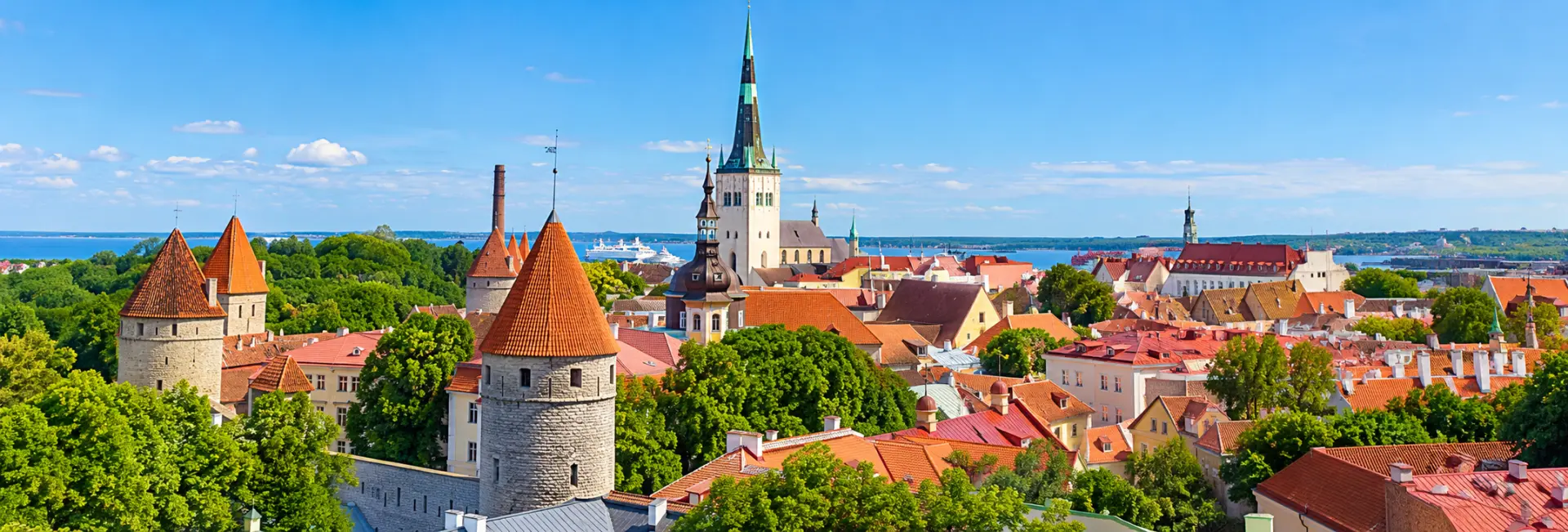
Limestone and brick Gothic architecture dominates the major buildings, from the town hall to the great parish churches. Steep roofs, pointed arches and slim towers give the skyline a distinctive medieval silhouette, which you can see best from the upper town's viewing platforms.
Later Layers
Not everything is medieval. The Renaissance façade of the House of the Blackheads, finished in the late 16th century, adds ornate decoration to a street of plainer neighbours. On Toompea, the pink Baroque castle building and the onion-domed Alexander Nevsky Cathedral show how later rulers left their own marks on the hill.
Lanes and Passages
The streets are irregular, narrow and often steeply sloped, following medieval routes rather than a planned grid. Covered passages and tucked-away courtyards link main streets, and many cellars still hold shops, galleries and cafés.
Key Areas
Town Hall Square and the Lower Town
The Lower Town is the commercial heart, centred on Raekoja plats, the market square used for trade, public announcements and celebrations since the Middle Ages. From here, streets such as Pikk, Viru and Vene fan out, lined with merchant houses, guild buildings and some of the best restaurants and craft shops in the city.
Toompea Hill
Toompea rises roughly 30 metres above the lower town and has long been the centre of power. Today it houses Estonia's parliament, embassies, the Alexander Nevsky Cathedral and the Dome Church. Its quieter streets and viewing terraces make it a good place to slow down after the busier market area below.
The Town Wall and Gates
Large portions of the 13th-to-16th-century defences survive, including towers such as Nunne, Sauna and Kuldjala, plus the twin-towered Viru Gate that now forms the main pedestrian entry from the modern centre. Walking the wall's edge gives a clear sense of how the town protected itself.
Pikk Street and Surroundings
Pikk, meaning long, was the main trade artery between the market and the harbour. It holds the Great Guild Hall, the House of the Blackheads and the Church of the Holy Spirit, along with many fine merchant façades.
Notable Landmarks
Tallinn Town Hall
Completed in its present form in the early 15th century, the town hall is widely regarded as the only surviving Gothic town hall in northern Europe. A slender tower is topped by a weather vane figure known as Old Thomas, who has watched over the square since the 16th century. In summer, visitors can climb the tower for views across the rooftops.
Town Hall Pharmacy
On the edge of the square, this apothecary has operated for centuries and is often described as one of the oldest continuously running pharmacies in Europe. It is still a working pharmacy, and the historic interior is worth a quiet look.
St. Olaf's Church
Its tall spire dominates the skyline. In the 16th century it was among the tallest structures in the world, and the current tower stands at roughly 124 metres. Climbing the tower by the narrow stairs rewards you with a panoramic view over the Old Town and the bay.
St. Nicholas' Church
Now a museum and concert venue, Niguliste holds medieval altarpieces and the famous Danse Macabre painting fragment by Bernt Notke, a haunting depiction of death leading people from every rank of society.
Alexander Nevsky Cathedral
Built in the late 19th century in a Russian Revival style, this Orthodox cathedral on Toompea has dark domes and ornate mosaics inside. It remains an active place of worship, so visitors should dress respectfully and keep voices low.
Toompea Castle and Tall Hermann
The castle complex houses the Estonian parliament, and its corner tower, Tall Hermann, carries the national flag each day. The tower and the Baroque façade facing Lossi plats are among the most photographed sights on the hill.
Fat Margaret and Kiek in de Kök
Fat Margaret is a stout 16th-century artillery tower by the sea gate, now home to a maritime museum. Kiek in de Kök, a tall cannon tower from the 15th century, holds exhibitions on the town's defences and offers access to the 17th-century bastion tunnels beneath the hill.
Ways to Experience It
Because the Old Town is small, there are many ways to approach it, depending on how much time you have and what interests you most.
- Join a guided walking tour to understand the Lower Town and Toompea divide, with local stories and context you would miss on your own.
- Wander independently with a map and let side streets lead you to hidden courtyards and passages.
- Climb the Town Hall tower or St. Olaf's tower for rooftop views, then compare them with the terraces at Kohtuotsa and Patkuli on Toompea.
- Visit museums housed in historic buildings, such as the Estonian History Museum, the Niguliste Museum or the maritime displays in Fat Margaret.
- Explore the bastion tunnels beneath Toompea on a guided visit for a different perspective on the defences.
- Eat in a medieval-style restaurant or a modern café tucked into a historic cellar.
- Walk the streets in the evening, when the lighting on the towers and walls gives the town a more atmospheric feel.
Best Time to Visit
Summer
June to August brings the longest days, open terraces on Town Hall Square and the widest range of tower and museum openings. It is also the busiest season, especially when cruise ships dock, so aim for early mornings or evenings if you prefer calmer streets.
Spring and Autumn
May, early June, September and early October offer a balance of comfortable temperatures and thinner crowds. Autumn light on the stone walls is particularly pleasing for photography.
Winter
From late November, the Christmas market fills Town Hall Square around a large decorated tree, a tradition the city traces back to 1441. Days are short and cold, but snow on the rooftops and glowing market stalls make this one of the most atmospheric times to visit. Dress warmly and wear footwear with good grip.
Time of Day
Early morning is quietest, with soft light and empty lanes. Midday is busiest, while the hour before sunset is ideal for viewpoints on Toompea.
Visitor Tips
- Wear comfortable shoes with good grip, since cobblestones are uneven and slippery in rain, snow or ice.
- Expect steep sections, especially on the lanes up to Toompea, and plan rest stops if you are travelling with young children or older relatives.
- Entering the Old Town on foot is free, but towers, museums and some churches charge entry, with seasonal hours that should be checked in advance.
- Dress modestly and be quiet inside churches, especially the Orthodox cathedral, where services may be in progress.
- Check menus and prices before sitting down at a restaurant, as places on the main square can cost more than those a street or two away.
- Cards are widely accepted, but carry a little cash for small purchases at market stalls.
- Vehicle access is restricted inside much of the district, so plan to arrive by foot, tram or taxi to the edge of the Old Town.
- Allow at least half a day to see the main sights, and a full day if you plan to enter several museums or climb towers.
FAQs about visiting Tallinn Old Town
What is Tallinn Old Town known for? +
It is known as one of the best-preserved medieval towns in Northern Europe, with a UNESCO-listed street plan, Gothic churches, a Hanseatic-era market square and long stretches of its original town wall.
How much time do I need in Tallinn Old Town? +
Half a day is enough to see the highlights on foot, but a full day gives you time to climb a tower, visit one or two museums and enjoy a long lunch. History fans could easily fill two days.
Is Tallinn Old Town free to visit? +
Yes, walking the streets and squares costs nothing. Towers, museums, tunnels and some churches charge admission, so check the official sites for current prices and opening times before you go.
What is the best time of year to visit? +
Summer offers the longest days and most open sights, while early autumn and late spring are quieter. Winter is popular for the Christmas market, which fills Town Hall Square from late November.
How do I get to Tallinn Old Town? +
The Old Town sits right next to the modern city centre, and trams and buses stop at its edges. Ferries from Helsinki arrive at a terminal within walking distance, and the airport is only a short tram or taxi ride away.
Is Tallinn Old Town suitable for kids and older visitors? +
Children usually enjoy the towers, the wall and the toy and marzipan shops, but cobbles and steep lanes can be tiring for strollers or limited mobility. Toompea in particular involves slopes, so plan routes and breaks accordingly.
What is the difference between the Lower Town and Toompea? +
The Lower Town was the merchants' commercial district centred on Town Hall Square, while Toompea was the seat of the rulers and nobility on the hill above. Today the Lower Town is lively and busy, and Toompea is quieter and home to the parliament and two major cathedrals.
What should I combine with a visit to the Old Town? +
Nearby highlights include Kadriorg Park and Palace, the Seaplane Harbour museum, the Telliskivi Creative City and the Kalamaja district. All can be reached by a short tram, bus or taxi ride.
