
Table of Contents
Overview
Toompea Castle stands on the southwestern edge of Toompea, the limestone hill that rises above Tallinn's Old Town. For more than eight centuries this spot has been the seat of whoever governed Estonia, and today it holds the Riigikogu, the country's 101-member parliament.
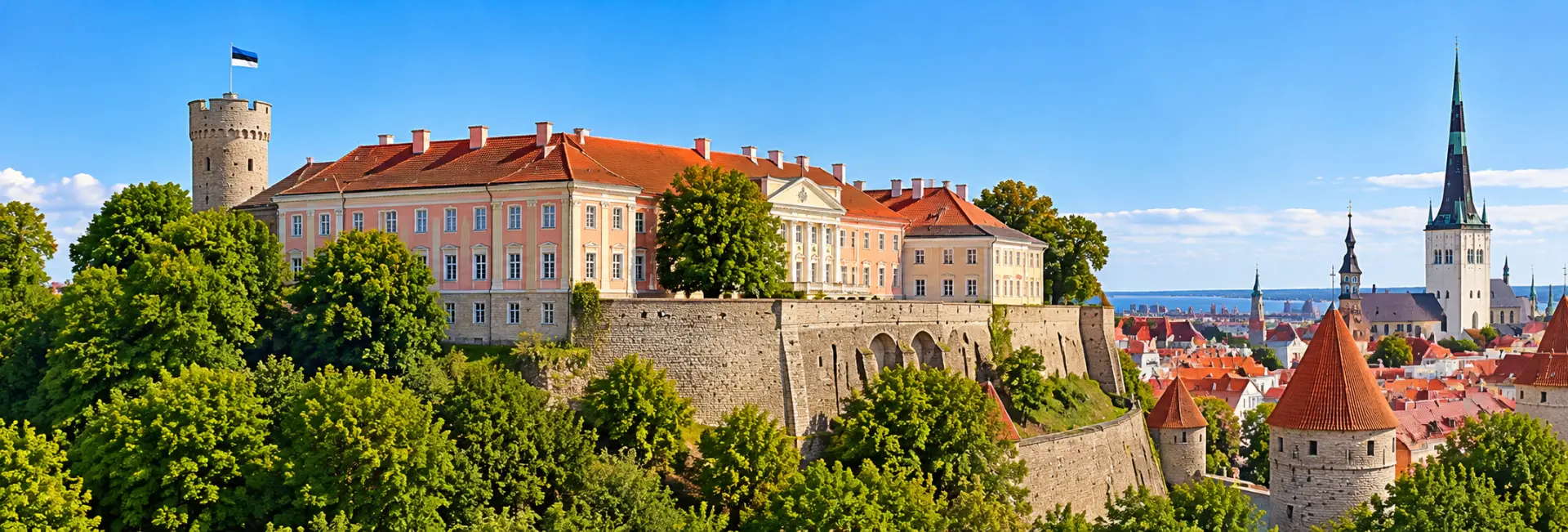
What makes the castle unusual is how many eras are visible at once. A medieval fortress wall and the tall tower known as Tall Hermann anchor one end, a graceful pink Baroque façade faces the square, and a much newer parliament building sits tucked inside the courtyard. It is both a working government building and one of the most recognisable landmarks in Estonia.
Most visitors admire it from Castle Square, but the interior can also be seen on a guided tour, which gives rare access to a functioning parliament housed within a medieval site.
History
A Fortress on the Hill
The hill was fortified long before the present castle, with an early stronghold dating back to the first millennium. In 1219 the Danish king Valdemar II captured the site, and a few years later the Brothers of the Sword raised a stone fortress here, completed in the late 1220s. From then on, control of Toompea meant control of Tallinn.
A Convent Castle Under the Orders
Over the 13th and 14th centuries the fortress grew into a square, convent-style castle with corner towers and a courtyard. Tall Hermann was begun in the second half of the 14th century and raised to its present height of 45.6 metres in the 16th century. The castle housed the commanders of the knightly orders, and the rivalry between the hilltop rulers and the merchants of the Lower Town was a defining feature of the era.
Swedish and Russian Rule
When Sweden took over in the 16th century, the castle became the seat of governors, and later the Russian Empire used it in the same way. By the 18th century the eastern wing was in poor condition, and under Catherine the Great a new governor's palace was built between 1767 and 1773 on the old foundations, giving the hill the pastel Baroque façade seen today.
Parliament and Independence
After Estonia first declared independence in 1918, the castle became the home of the country's legislature, and a purpose-built parliament chamber was added inside the courtyard in the early 1920s. Soviet occupation turned the castle into the seat of the Estonian Soviet republic's institutions. When independence was restored around 1991, the building resumed its role as the home of Estonia's parliament, and the flag on Tall Hermann became a symbol of that return.
Architecture & Notable Rooms
The Baroque Façade
The most photographed part of the castle is the long pink façade facing Lossi plats. Its symmetry, tall windows and soft colour contrast sharply with the grey limestone fortress behind it. The style belongs to the late Baroque period and was meant to give a medieval fortress the look of an imperial governor's residence.
Tall Hermann
At the southwestern corner rises Tall Hermann, the best-preserved of the castle's towers. It is a slender, stepped tower of limestone topped with a pointed roof, and from its summit the blue, black and white national flag flies throughout the year. The height and position of the tower made it a lookout and a symbol of power for centuries.
The Courtyard and Parliament Building
Inside the walls, a modern parliament building from the early 1920s occupies the courtyard. Its Expressionist style looks nothing like the Baroque front, and it was designed to give the young republic a dignified legislative chamber without demolishing the older castle. From the outside, you will not see it from the square, which makes it a pleasant surprise for guests on a tour.
Rooms Visitors Can See
Guided tours generally include the White Hall, the ceremonial space included on visitor routes, and the plenary chamber where parliament meets. Guides explain how laws are made, how the castle's rooms have changed use, and what it feels like to run a country from a medieval site.
Castle Square & Surroundings
Lossi plats
Castle Square is the open space in front of the castle and the natural starting point for any visit. Cobbled and often busy, it frames the pink façade on one side and the onion domes of Alexander Nevsky Cathedral on the other, creating one of the most distinctive scenes in Tallinn.
The Defensive Walls and Approaches
The castle's outer walls and the roads that climb to the square show how the hill was defended. Lühike jalg, or Short Leg, is a steep street leading from the Lower Town to the hilltop through an old gate, and from the walls near the entrance you can glimpse the layers of stone that made the castle difficult to attack.
Danish King's Garden
A short walk from the castle, the small Danish King's Garden sits beside a surviving section of wall and a defensive tower. It is closely tied to the story of the Danish conquest in 1219, including the popular legend that the Danish flag fell from the sky during a battle, and it offers a calm place to sit after the climb.
Cultural Significance
For Estonians, Toompea Castle is more than a pretty building. It stands for continuity across centuries of foreign rule and for the restoration of self-government in the twentieth century. The national flag on Tall Hermann has become a shorthand for the country's independence, and its presence above the hill is a deliberate statement.
The castle also reflects the story of Tallinn itself. The hilltop belonged to rulers and nobles, while the Lower Town belonged to merchants, and this division shaped local identity for hundreds of years. Even today the hill is still the centre of government, with ministries, embassies and the parliament all clustered nearby.
In the period around 1991, when Estonia was regaining independence, the hill became a rallying point for citizens, and the castle features prominently in the national memory of those events.
Visiting also offers a rare chance to see democracy at work in a heritage setting. Unlike many European castles that are now museums, Toompea still hosts debates, committee meetings and official ceremonies, so the building feels active rather than preserved. Pairing the castle with a walk through the surrounding streets helps explain why the hill, and not the harbour below, has been the centre of political life for so long.
Ways to Experience It
- Join a free guided tour of the castle, offered on weekdays and arranged in advance through the parliament, to see the White Hall and the plenary chamber.
- Watch a parliamentary session from the public gallery when parliament is sitting, subject to the current rules for visitors.
- Walk around Castle Square and the surrounding lanes at your own pace, taking in the façade, the walls and Tall Hermann from the outside.
- Combine the castle with a self-guided or small-group walking tour that covers Toompea and the Lower Town.
- Photograph the castle in early morning light, when the square is quiet and the pink façade glows.
- Stop at the nearby viewing platforms to see the castle in the context of the red rooftops below.
Best Time to Visit
Season
May to September brings the most pleasant weather for walking Castle Square and the surrounding hill, with long evenings that suit photography. This is also the busiest period, so aim for mornings if you prefer fewer crowds.
Winter
The castle is atmospheric under snow, and the hill is often quiet in the colder months. Cobbles can be icy, so allow extra time for the climb.
Interior Tours
Because tours run only on weekdays and must be booked, plan around the working week rather than a weekend visit. Parliament sessions follow their own schedule, so check the calendar if you want to watch one.
Visitor Tips
- Book interior tours well ahead through the official parliament website, because places are limited and the castle is not open for casual drop-in visits.
- Bring a valid photo ID, as security checks are standard at a working government building.
- Expect restrictions on photography and bags inside, and follow the guide's instructions.
- Check tour dates, languages and any changes before travelling, since parliamentary business can affect availability.
- Wear sturdy shoes, as the approach roads are steep and cobbled.
- The castle is described as wheelchair accessible, but it is wise to confirm arrangements when booking if you need step-free access.
- Do not expect to climb Tall Hermann, as the tower is part of the working complex and is best enjoyed from outside.
Nearby Attractions
- Alexander Nevsky Cathedral stands directly across the square, with striking domes and a richly decorated interior.
- The Dome Church (St. Mary's Cathedral), the oldest church in Tallinn, is a short walk away and holds centuries of family coats of arms.
- Kohtuotsa and Patkuli viewing platforms offer some of the best panoramas over the Old Town rooftops and the bay.
- The Danish King's Garden and nearby Maiden Tower give a quiet look at the hill's defensive history.
- Town Hall Square and the Lower Town are reachable by descending Pikk jalg or Lühike jalg.
- Kiek in de Kök, a 15th-century cannon tower, shows another side of Tallinn's defences.
FAQs about visiting Toompea Castle
What is Toompea Castle? +
It is a medieval fortress on Toompea hill that has been the seat of power in Estonia for over 800 years. Today it houses the Riigikogu, the Estonian parliament, behind a pink Baroque façade.
Can you go inside Toompea Castle? +
Yes, but only on a guided tour that must be booked in advance, and tours are normally offered on weekdays. You can also watch parliamentary sessions from the public gallery when they are on.
Is it free to visit Toompea Castle? +
Walking around the exterior and Castle Square costs nothing. Guided tours have been free of charge, but you should check the official parliament website for current terms before you plan your visit.
Can I climb Tall Hermann tower? +
The tower is part of the working parliament complex and is not usually open for general visitors. Most people admire it from Castle Square and from nearby viewpoints.
How long should I allow for a visit? +
Around 20 to 30 minutes is plenty for the exterior and the square. If you join a guided tour, allow roughly an hour including security checks and the time to walk up the hill.
How do I get to Toompea Castle? +
It is on Lossi plats at the top of the Old Town hill, reached on foot from Town Hall Square by Pikk jalg or Lühike jalg. Vehicle access is limited, so walking is the easiest option.
Is Toompea Castle accessible for visitors with limited mobility? +
The castle is described as wheelchair accessible, but the approach streets are steep and cobbled. Contact the organisers when booking if you need step-free access.
What else is close to Toompea Castle? +
Alexander Nevsky Cathedral is directly opposite, with the Dome Church and the Kohtuotsa and Patkuli viewing platforms just a few minutes away.
