
Table of Contents
Overview
The Seaplane Harbour, known in Estonian as Lennusadam, is the Estonian Maritime Museum's flagship site on Tallinn's northern waterfront. It occupies a set of enormous concrete hangars built a century ago for seaplanes, and it now holds a collection that ranges from medieval shipwreck remains to a submarine from the 1930s.
The museum is built around scale and hands-on discovery. Instead of showing objects behind glass, it puts large vessels in the middle of the hall and invites visitors to walk around them, climb aboard and look up at hulls that would normally sit in the water. Many travellers find it one of the most memorable museum visits in the Baltic region.
It is also a welcome change of pace from the medieval Old Town. The museum sits in the redeveloping Kalamaja and Noblessner area, where industrial heritage meets cafés, galleries and waterfront promenades, and it works well as a family outing or a rainy-day option.
History of the Museum
A Naval Fortress Project
The hangars were built around 1916 to 1917 for the Russian Imperial Navy, as part of Peter the Great's Naval Fortress, a chain of coastal defences designed to protect the approaches to St. Petersburg. Seaplanes were a new and promising technology at the time, and the base was conceived as a place to house and service them close to the water.
Decades of Restricted Use
After Estonia became independent, and later during the Soviet era, the complex continued to serve military purposes, and for much of the 20th century it was closed to ordinary civilians. Its restricted status helped preserve the structure but also left it neglected over time.
Restoration and Opening
In the early 21st century the hangars were restored, and the museum opened to the public in 2012. The project saved a major piece of industrial and military heritage while giving the Estonian Maritime Museum a dramatic new home for its collections.
A Renewed Exhibition
The permanent exhibition was updated in 2024 after a period of closure, with the museum working with architects and designers to make the displays more engaging for visitors. Temporary exhibitions continue to add variety to what is on show.
Architecture & Building
The Hangars
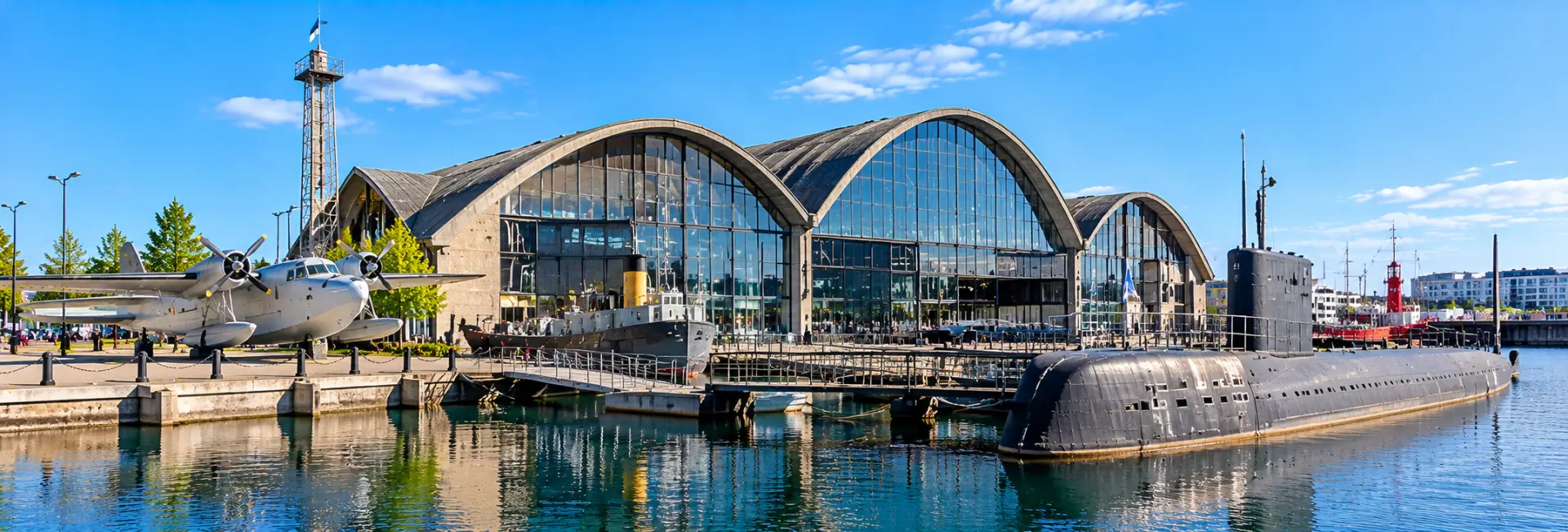
The seaplane hangars are a masterpiece of early reinforced concrete engineering. A row of domed roofs, built as thin concrete shells, covers a vast open space with no need for internal columns. The structure was among the earliest of its type and remains impressive today, both for its sweeping curves and for the way it fills the interior with light.
Space for Giants
The open interior was designed to hold aircraft, and it now has just the right proportions for displaying large objects. A submarine, an aircraft replica and several boats sit comfortably inside, and visitors can see them from several levels thanks to walkways and viewing platforms.
The Waterfront Setting
Outside, the hangars face the harbour, where historic vessels are moored. This makes the whole site feel like a working maritime place rather than a conventional museum, and it provides a strong visual link between the displays inside and the sea beyond.
Collections & Exhibits
Nearly 200 Authentic Items
The exhibition brings together around 200 original objects that tell the story of Estonian seafaring, shipping and naval defence. They range from small personal items and navigation equipment to mines, cannons and large vessels, arranged to help visitors follow the story from early shipping to modern times.
Maritime Heritage
Displays on shipbuilding, trade and the sea as a livelihood show how closely Estonian life has been tied to the Baltic. The remains of Estonia's oldest known ship are among the most striking finds and give a rare glimpse of boat-building from centuries ago.
Military and Aviation History
The collection also covers naval defence, coastal artillery and early aviation. A replica of the Short 184 seaplane, a type used in the early 20th century, recalls the original purpose of the hangars, while tanks, armoured vehicles and coastal guns show how the sea and land defences worked together.
Small Boats and Stories of Escape
A collection of small boats reflects a very different chapter, when thousands of people tried to cross the Baltic to reach the West at the end of the Second World War. These modest vessels add a personal and sobering dimension to the maritime story.
Must-See Highlights
Submarine Lembit
The star of the museum is Lembit, a submarine launched in 1936 and the pride of the Estonian Navy. It is the only surviving Estonian submarine and one of the oldest of its kind still preserved, and visitors can see the hull from below and, on guided tours, explore the cramped living and working spaces inside. The submarine remained in service for decades before being retired in 2011.
Icebreaker Suur Tõll
Moored in the harbour is Suur Tõll, a century-old steam icebreaker that once kept Baltic ports open through winter. The ship is a museum vessel in its own right, and boarding it gives an idea of how large and powerful such craft were even before modern engines.
The Hangar Hall
Simply standing inside the main hall is a highlight. The domed roof, the tall windows and the huge scale of the exhibits create a dramatic first impression, especially when seen from the upper walkways.
Interactive Zones
Simulators, an aquarium, a children's play area and activities such as folding paper aeroplanes make the museum lively for younger visitors. Families can follow a trail aimed at children, and there are spaces where visitors can try on naval uniforms for photos.
Ways to Experience It
- Explore the main exhibition at your own pace, using the maps and information panels to follow the story.
- Join a guided tour of the submarine Lembit, available in several languages by prior booking and limited to small groups.
- Board the museum ships in the harbour when they are open, which is typically in the warmer months.
- Try the simulators and hands-on stations, which are popular with children and adults alike.
- Take a break at the on-site café and browse the museum shop for maritime-themed souvenirs.
- Combine the visit with a walk along the waterfront or a cycle through Kalamaja and Noblessner.
Best Time to Visit
Any Season
Because the main exhibition is indoors, the museum works well in any weather, and it is especially useful on cold, wet or windy days. Winter visits can feel calm, with fewer crowds and plenty of room to explore the displays.
Summer
From May to August the museum has longer opening hours, and the harbour ships and outdoor areas are at their best. This is also the busiest period, so the queue at peak times can be long.
Time of Day
Arrive shortly after opening or in the late afternoon for the quietest experience. Mid-morning to early afternoon tends to be busy, particularly during school holidays and cruise ship days.
Visitor Tips
- Check the official website for current opening hours, as they change by season and the museum is closed on Mondays outside the summer period.
- Book submarine tours in advance, because spaces are limited and the tour is priced separately from general admission.
- Allow two to three hours for a full visit, or more if you plan to join a tour and try the interactive stations.
- Wear comfortable shoes, as the exhibition covers a large area and includes ramps, stairs and walkways.
- The museum is wheelchair accessible, though the submarine and some ships have narrow passages that are difficult for visitors with limited mobility.
- Bring a layer for the harbour, where the wind off the sea can be cool even in summer.
- Free parking is available next to the museum, though most visitors arrive on foot, by bus or by bike.
- Look into combined tickets and city passes if you plan to visit several Tallinn attractions.
Nearby Attractions
- The Culture Kilometre, a waterfront route between Linnahall and the Seaplane Harbour, passes cultural sites and public art.
- Patarei Sea Fortress, a former fortress and prison, stands close by and tells a darker chapter of the city's past.
- Kalamaja, a district of colourful wooden houses, offers cafés, galleries and relaxed streets.
- Noblessner, a former submarine factory area, now has restaurants, apartments and a marina.
- Telliskivi Creative City, a short ride away, is known for street art, markets and independent shops.
- Tallinn's Old Town lies roughly 15 to 20 minutes away on foot, or a short bus ride.
FAQs about visiting the Seaplane Harbour Museum
What is the Seaplane Harbour Museum? +
It is the Estonian Maritime Museum's main exhibition site, housed in historic seaplane hangars from the First World War. It holds around 200 original items, including a 1930s submarine and a century-old icebreaker.
Where is the museum and how do I get there? +
It is at Vesilennuki 6, in the Kalamaja and Noblessner area north of the Old Town. You can walk in 15 to 20 minutes, ride bus 73 or take a taxi.
How long should I spend at the Seaplane Harbour? +
Plan on two to three hours to see the main exhibition and enjoy the interactive areas. Add extra time for a submarine tour or a stroll along the waterfront.
What are the opening hours? +
In summer the museum is generally open daily, with shorter hours and a Monday closure in the cooler months. Check the official website before you go for current times and holiday changes.
Can you go inside the submarine Lembit? +
Yes, guided tours take visitors inside Lembit in small groups. Tours are booked in advance, run in several languages and cost extra on top of museum admission.
Is the museum good for children? +
Yes, it is very family-friendly, with simulators, a play area, an aquarium and activity trails. Younger children usually enjoy it, though they should be supervised around the ships and stairs.
Is the museum accessible for wheelchair users? +
The main halls are wheelchair accessible, but the submarine and some ships have narrow passages and steep steps. Contact the museum in advance to discuss your needs.
What else is nearby? +
Patarei Sea Fortress, the Culture Kilometre, Kalamaja and Noblessner are all close, and the Old Town is a short walk or bus ride away.
