
Table of Contents
Overview
Gorky Park is the best-known park in Moscow and one of the most visited, a long green strip beside the Moskva River just south of the city center. Its official name is the Gorky Central Park of Culture and Leisure, but nearly everyone simply calls it Gorky Park, and it has become a shorthand for relaxed, everyday Moscow life.
On a summer day the park fills with cyclists, skaters, joggers, families and people lounging on the lawns, with music and open-air events adding to the atmosphere. In winter much of it turns into a large ice rink. Add in sculpture, gardens, a contemporary art museum and a riverside promenade, and it makes an easy half day or longer.
For many visitors the park is a surprise. Instead of the grim image its name may suggest to some foreigners, it is a lively public space that Muscovites treat like an open-air living room, and it is one of the best places in the city to see how locals unwind.
History
Roots in an Older Garden
The park's southern end grew out of Neskuchny Garden, whose history goes back to the 18th century, when a group of private estates along the river were laid out with orchards, greenhouses and landscaped grounds. After the Revolution, the garden was nationalized and opened to the public.
A Soviet Park of Culture
The park itself opened in August 1928 on the site of an agricultural and handicraft exhibition, with the avant-garde architect Konstantin Melnikov leading its planning. It was designed as a "park of culture and leisure", a place with theaters, sports grounds, exhibitions and amusements for ordinary city dwellers, and in 1932 it was named after the writer Maxim Gorky.
Decline and Renewal
Over the decades the park gained funfair rides and, by the late Soviet and early post-Soviet years, had become run down. A large-scale renovation began in 2011, which removed many of the old attractions, opened up lawns and promenades, introduced free entry and turned the park into a modern public space. In the following years it expanded to take in Muzeon Park of Arts and part of the Sparrow Hills area.
The Park's Main Areas
The Main Entrance and Central Parterre
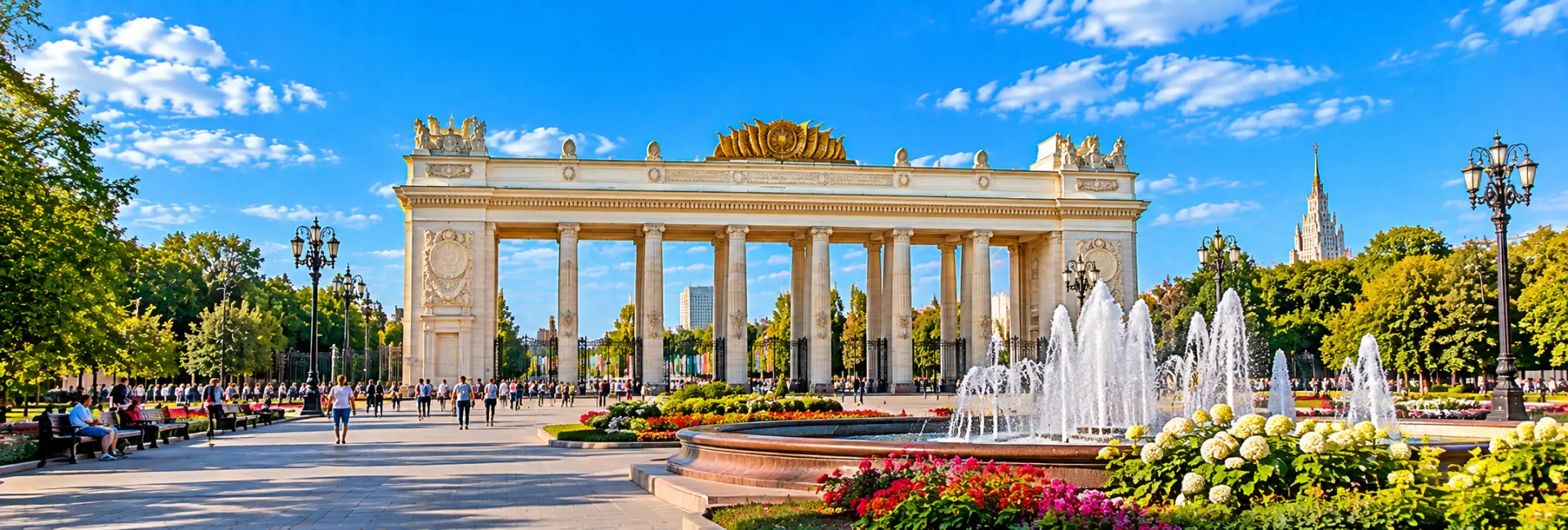
The park is entered through a grand colonnaded gateway on Krymsky Val, from which a broad central alley leads to the river. Wide paved paths, flower beds, fountains and open lawns make this the busiest and most classic part of the park, with cafes, rental stands and event spaces along the way.
Pushkinskaya Embankment
The riverside promenade runs along the Moskva River and offers views across the water, with steps down to the edge and a pier for river boats. Cyclists, skaters and strollers share the path, and the embankment is especially lively on warm evenings.
Muzeon Park of Arts
Muzeon is an open-air sculpture park with hundreds of works in stone, bronze and wood, including pieces from the Soviet era that were gathered here after being removed from public places. It is a good spot for a slow, reflective walk, and it sits beside the New Tretyakov Gallery.
Neskuchny Garden
The name means roughly "Not Boring Garden", and it is the quieter, older part of the park, with old trees, shaded paths, ponds and historic buildings. It is a good choice if you want a calmer stroll away from the crowds, and it also has sports courts and a skate park.
Sparrow Hills Edge
At the far southern end, the park merges into the wooded slopes of Sparrow Hills, giving a more natural landscape and a link toward Moscow State University and the viewpoint above the river.
Culture & Museums
Garage Museum of Contemporary Art
The Garage is one of the most visible cultural institutions in the park, a museum of contemporary art with changing exhibitions, a bookshop, a cafe and public programs. Its building, a renovated Soviet-era structure, is a destination in its own right, and the museum draws people who might not otherwise visit the park.
Gorky Park Museum
A small museum near the entrance tells the story of the park's history, with photographs and objects from its early years. It is a short, informative stop if you are interested in how the park changed from Soviet showpiece to modern public space.
Festivals and Open-Air Events
Concerts, film screenings, markets, workshops and sports events are held across the park through much of the year, especially in the warmer months. Check the park's official program before you go to see what is on.
A Place in Popular Culture
The park is mentioned in the Scorpions' 1990 song "Wind of Change", and a Russian rock band took its name from it, which helped make the park known to audiences far from Moscow.
Activities Through the Year
Summer and Early Autumn
Warm weather brings cycling, rollerblading, boat trips, outdoor yoga and dance sessions, picnics on the lawns and evening events. Bikes and other equipment can usually be rented in the park.
Winter
In winter the main alleys and ponds are turned into one of the largest ice rinks in the city, with skate rental, hot drinks and festive lighting. Even if you do not skate, the park looks beautiful under snow.
Everyday Rhythms
Beyond the big seasonal draws, the park has a steady everyday rhythm. Early risers jog along the embankment, office workers eat lunch on the benches, and in the evening people gather for classes, music and games. Spending an hour simply sitting and watching is one of the pleasures of a visit.
Spring
Spring brings flowers, the return of cafes and terraces, and fewer crowds than summer, making it a good time for a relaxed walk.
Ways to Experience It
Walk the Central Alley and Embankment
The simplest plan is to enter through the main gate, walk down the central alley to the river and then follow the embankment in either direction. This gives you a sense of the park's atmosphere in an hour or two.
Combine Art and Green Space
If you enjoy art, pair the park with the Garage Museum, Muzeon sculptures and the New Tretyakov Gallery, which are all close together. This makes a rewarding half-day or full-day itinerary.
Rent a Bike or Take a River Boat
Renting a bike lets you cover more of the park's long length, and river boats from the nearby pier offer a different view of the city's skyline.
Visit at Golden Hour
Time your walk for late afternoon or early evening, when the light turns warm along the river and the embankment is at its most atmospheric. It is a favorite time for photographs and for simply watching the city's pace slow down.
Slow Down in Neskuchny Garden
For a peaceful break, walk south into the older garden, where tree-lined paths and ponds give a very different mood from the busy main alley.
Best Time to Visit
By Season
- Late spring to early autumn: the park is at its liveliest, with greenery, events and warm evenings, though weekends can be crowded.
- Winter: ice skating and snowy scenery make a visit memorable, but dress warmly.
- Early spring and late autumn: quieter and cooler, good for a calm walk, though some attractions may be closed or limited.
By Time of Day
Weekday mornings are the calmest. Late afternoon and early evening bring the best light along the river and the liveliest crowds.
Visitor Tips
- Entry is free: the park can be enjoyed without a ticket, though some attractions, rentals and museums charge separately.
- Check the schedule: events, rentals and the ice rink operate on set seasons and hours, so confirm details on the official site.
- Choose your entrance: the main gate is on Krymsky Val, and other entrances connect with the embankment, Neskuchny Garden and the surrounding streets.
- Wear comfortable shoes: the park is large, and a full visit can involve several kilometers of walking.
- Bring layers: it can be breezy by the river, even on warm days.
- Take a break: there are cafes, food stands and seating areas throughout, so you can pace your visit.
- Getting there: the nearest metro stations are Park Kultury and Oktyabrskaya, each within walking distance of an entrance.
- Before you travel: check current entry requirements and your government's latest travel advice for Russia well ahead of time.
Nearby Attractions
New Tretyakov Gallery
Right next to Muzeon, this large gallery houses the state collection of 20th-century Russian art and is a natural partner to a day in the park.
Tretyakov Gallery
The historic main building of the national art museum lies a longer walk along the river and holds Russian art up to the early 20th century.
Cathedral of Christ the Saviour
Further along the river toward the Kremlin, the golden-domed cathedral is a landmark of the riverside route.
Sparrow Hills and Moscow State University
To the south, the hills offer a high viewpoint over the city and the university's tall main building.
Zamoskvorechye and Oktyabrskaya Area
The streets around Oktyabrskaya metro have a mix of Soviet-era architecture, modern cafes and old courtyards, and are pleasant to explore on foot before or after the park.
Krymsky Bridge
This steel suspension bridge crossing the Moskva River is a landmark in its own right and offers fine views of the park and the river.
FAQs about visiting Gorky Park
Is Gorky Park free to enter? +
Yes, entry to the park is free, though some attractions, rentals and events inside may charge fees.
Who is Gorky Park named after? +
It is named after the writer Maxim Gorky, a name it received in 1932, a few years after the park opened in 1928.
What is there to do in Gorky Park? +
You can walk, cycle, skate, take river boat trips, visit the Garage Museum and the Muzeon sculpture park, attend events and enjoy cafes and open lawns.
Is it open in winter? +
Yes. In winter, parts of the park are transformed into a large ice rink, and the snowy landscape is popular for walks.
How much time should I spend there? +
Plan on two to three hours for a relaxed visit, or longer if you add the Garage Museum, Muzeon and Neskuchny Garden.
How do I get to Gorky Park? +
Take the metro to Park Kultury or Oktyabrskaya, both of which are within walking distance of park entrances.
Is the park suitable for children? +
Yes, the park has open lawns, activities and events that suit families, but check the program for the day of your visit.
What is Muzeon? +
Muzeon is an open-air sculpture park adjoining Gorky Park, with hundreds of works including pieces from the Soviet era.
