
Table of Contents
Overview
The State Tretyakov Gallery is the foremost museum of Russian fine art in the world. Its collection runs from medieval icons to the experiments of the 20th-century avant-garde, and it includes paintings, sculpture and graphic works by generations of Russian artists, many of whom are still little known outside the country.
The gallery is not a single building but a group of sites. The historic home of the collection stands in a quiet lane on the south bank of the Moskva River, while a large modern building a short distance away presents the art of the 20th century. Together they give a rare, connected view of how Russian art developed, from sacred images to social realism and beyond.
Visitors often describe the Tretyakov as the best place in Moscow to understand Russian culture through images rather than words. It rewards slow looking, and a first visit can easily fill a whole day.
History of the Gallery
A Merchant's Collection
The gallery began in 1856, when the Moscow merchant Pavel Tretyakov started buying works by contemporary Russian artists with the aim of eventually forming a museum of national art. He and his brother Sergei amassed a collection that grew steadily, with a clear preference for realist painting and for artists who dealt with Russian life and history.
A Gift to the City
In 1892 Pavel Tretyakov donated his collection, by then about 2,000 works, together with his house to the city of Moscow. The gallery, which had already been open to visitors, became a public institution and continued to grow under the city's care, with new halls added around the original mansion as the collection expanded.
The Fairy-Tale Facade
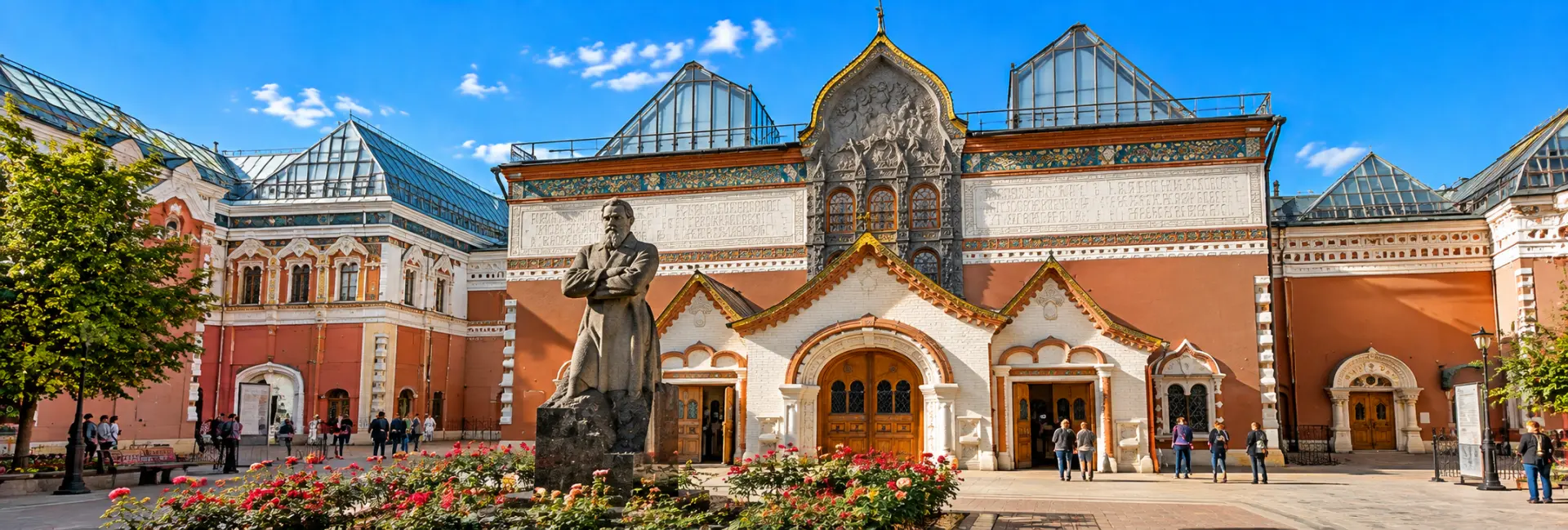
The distinctive facade of the Lavrushinsky Lane building was designed by the painter Viktor Vasnetsov in a Russian fairy-tale style and built in the early 1900s. Its decorative front, with ornamental detail inspired by medieval Russian art, has become the gallery's visual signature.
Nationalization and Growth
After the Revolution, the gallery was nationalized and became a state museum, and over the 20th century it absorbed works from other collections and expanded into neighboring buildings, including a 17th-century church. In the 1980s, a new building for 20th-century art was added on Krymsky Val and later linked with the main gallery as part of one institution.
Buildings & Architecture
The Historic Building on Lavrushinsky Lane
This is the main gallery, a long, richly decorated building whose rooms follow the sweep of Russian art from the early icons to the early 20th century. Wide stairways, high ceilings and carefully arranged halls give the galleries a classic museum feel, and the layout helps visitors follow the story in roughly chronological order.
The Church of Saint Nicholas in Tolmachi
Part of the gallery's complex is a 17th-century church that now serves as a museum church. It houses sacred art and, on occasion, hosts services and concerts, linking the collection of icons to the kind of setting where they were originally used.
The New Tretyakov on Krymsky Val
A large modern building overlooking the Moskva River and Muzeon Park holds the permanent exhibition of 20th-century Russian art. Its open halls and wide galleries suit the scale of avant-garde canvases and Soviet-era works, and it also stages large temporary exhibitions.
The New Building by the Embankment
A modern extension, opened in 2024 on the Kadashevskaya Embankment and designed by the architect Sergey Choban, adds exhibition space, restoration workshops and a public atrium. It is close to the historic gallery, making it easy to include in the same visit.
Collections & Exhibits
Icons and Early Russian Art
The gallery holds one of the world's great collections of Russian icons, covering a span of centuries from the earliest Byzantine-influenced works to the refined art of the Moscow school. The icons are an essential starting point for understanding later Russian painting, which often draws on their color, symbolism and spiritual weight.
18th and 19th Century Painting
The heart of the historic building is its 19th-century collection, including large-scale historical scenes, portraits, landscapes and the social-realist works of the Peredvizhniki, or "Wanderers", a group of artists who rejected academic conventions to paint the realities of Russian life.
Silver Age and Early Modernism
Around the turn of the 20th century, Russian art became more experimental and symbolic. The collection includes works by painters who moved between realism, symbolism and early modernism, setting the stage for the radical changes that followed.
Avant-Garde, Soviet and Contemporary Art
At the New Tretyakov, the story continues with the avant-garde, including works associated with Kazimir Malevich, Wassily Kandinsky, Marc Chagall and others, followed by socialist realism, the more restrained styles of the later Soviet decades, unofficial art and newer trends.
Must-See Highlights
The museum's rooms are crowded with famous paintings, and a full list is long. These are among the works visitors most often seek out, though displays can change because of rehabilitation, loans and rotation, so check what is on view.
- Ilya Repin, Ivan the Terrible and His Son Ivan: a dramatic and disturbing scene that has become one of the most discussed paintings in Russian art.
- Viktor Vasnetsov, Bogatyrs: three legendary heroes on horseback, a beloved image drawn from Russian folklore.
- Ivan Shishkin, Morning in a Pine Forest: a famous forest scene with playful bear cubs, painted with help from another artist.
- Vasily Surikov, Boyarynya Morozova: a monumental historical canvas about a woman exiled for her religious convictions.
- Ivan Kramskoi, Unknown Woman: an enigmatic portrait that has long fascinated viewers.
- Valentin Serov, Girl with Peaches: a luminous portrait, admired for its light and freshness.
- Mikhail Vrubel, Demon Seated: a haunting work that points toward symbolism.
- Early icons, including famous works linked to the Moscow school: central to the collection, though some may be shown elsewhere at times.
Ways to Experience It
A Chronological Walk
The historic building is arranged so that visitors can walk through Russian art roughly in order, from icons to early modern work. Following that path helps connect individual paintings to the wider story.
Add the New Tretyakov
If you have the time, a visit to the New Tretyakov turns the story into the 20th century. The two main sites are not next door to each other, so plan on a separate trip, a taxi or a walk through Muzeon Park.
Guided Tours and Audio Guides
Guided tours and audio guides are available and can be valuable here, since many of the paintings are rooted in Russian history, literature and religion that may be unfamiliar to visitors. A guide can draw connections that are not obvious from the labels alone.
Temporary Exhibitions and Special Events
The gallery stages large temporary shows throughout the year, and the museum church sometimes hosts concerts. Check the program before your visit to see what is on.
Best Time to Visit
By Season
- Autumn to spring: a good time for a museum day, particularly in cold or wet weather, with the galleries offering a warm refuge and fewer tourist crowds than in summer.
- Summer: busier, with more visitors, though the nearby parks and embankments make it easy to combine the gallery with outdoor time.
- Holidays and school breaks: expect higher visitor numbers and possible queues for popular exhibitions.
By Day and Time
Weekday mornings tend to be quietest, and the gallery usually has extended evening hours on some days, which can be a good choice if you prefer a calmer pace. Weekends and popular exhibitions draw larger crowds, so book timed tickets where possible.
Visitor Tips
- Check hours and closing day: the gallery is typically closed one day a week, and opening hours vary by site and day, so confirm on the official website.
- Know which building you need: the historic gallery on Lavrushinsky Lane and the New Tretyakov on Krymsky Val are separate sites, roughly a half-hour walk apart.
- Book ahead: buying tickets online saves time, and a combined ticket for more than one site may be available.
- Allow enough time: a thorough visit to the historic building can take several hours, and the two main sites together can fill a full day.
- Use the cloakroom: coats and large bags generally need to be left at the entrance, which also makes the galleries more comfortable.
- Photography rules: photography is permitted in many halls but restricted in some, and flash is usually not allowed, so follow signs and staff guidance.
- Getting there: for the historic gallery, the nearest metro stations are Tretyakovskaya and Novokuznetskaya. For the New Tretyakov, use Oktyabrskaya or Park Kultury.
- Before you travel: check current entry requirements and your government's latest travel advice for Russia well ahead of time.
Nearby Attractions
Muzeon Park and Gorky Park
Near the New Tretyakov, Muzeon Park of Arts is an open-air sculpture park beside the river, and Gorky Park is just beyond, offering walks, cafes and river views.
Zamoskvorechye
The quiet streets of this historic district on the south bank are lined with old churches and merchants' houses, a pleasant place to wander before or after the gallery.
Red Square and the Kremlin
The Kremlin and Red Square are a short walk across the river and make a natural complement to a day of art.
Pushkin Museum of Fine Arts
For a contrast with Russian art, this major museum of European art lies on the north bank, not far from the Kremlin.
FAQs about visiting the Tretyakov Gallery
What is the Tretyakov Gallery known for? +
It is the main museum of Russian fine art, with a collection that spans medieval icons to 20th-century avant-garde and beyond.
Is there more than one Tretyakov building? +
Yes. The historic gallery on Lavrushinsky Lane covers art up to the early 20th century, while the New Tretyakov on Krymsky Val presents 20th-century art. There are also related sites such as a museum church and memorial museums.
How much time should I allow? +
Plan on two to four hours for the historic building, and a full day if you also want to visit the New Tretyakov.
Do I need to book tickets in advance? +
It is not always required, but booking online saves time and is wise for weekends, holidays and major exhibitions. Check the official site for current options and prices.
What is the best way to get to the historic gallery? +
Take the metro to Tretyakovskaya or Novokuznetskaya, both within a short walk of the entrance.
Is the gallery open every day? +
It is typically closed one day each week, and hours differ by site, so check the official schedule before you go.
Can I take photographs? +
In many halls, yes, but without flash. Some rooms and temporary exhibitions have restrictions, so follow the posted signs.
Which works should I not miss? +
Many visitors seek out Repin's Ivan the Terrible and His Son Ivan, Vasnetsov's Bogatyrs, Shishkin's Morning in a Pine Forest and the icon collection, though displays can change.
