
Table of Contents
Overview
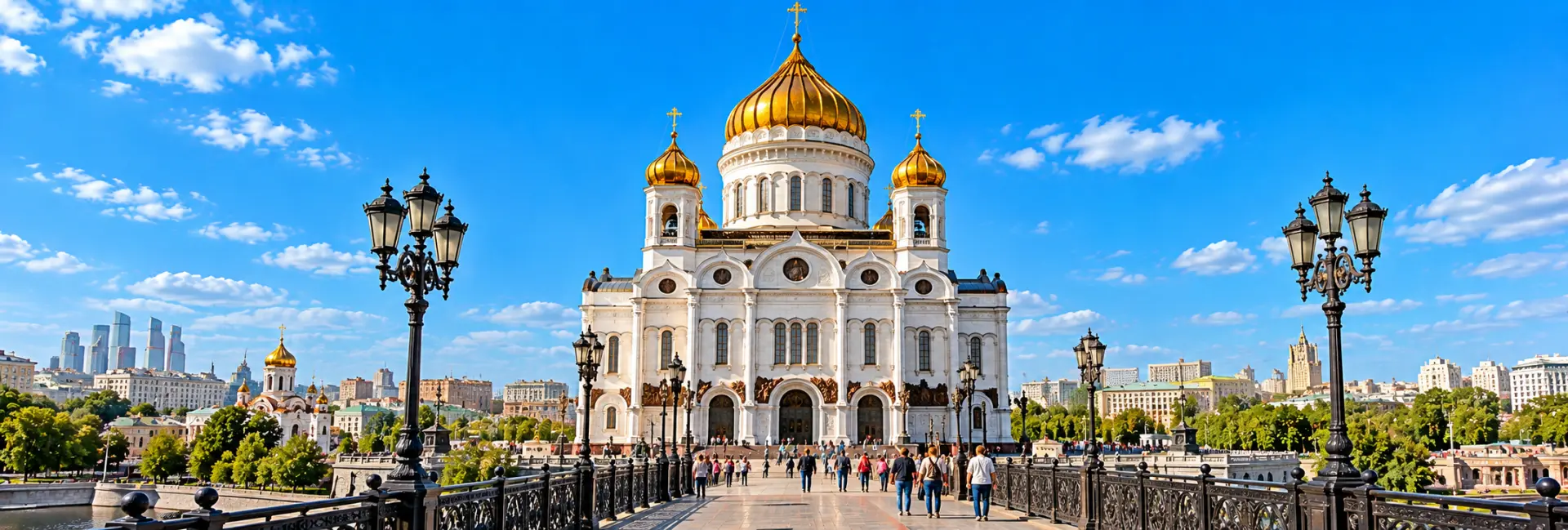
The Cathedral of Christ the Saviour is the largest Orthodox church in Russia and one of the most striking landmarks on the Moskva River. Its white walls, great golden central dome and four smaller domes rise above the embankment a short walk from the Kremlin, and the building is easy to spot from across the city.
It is also one of the youngest major landmarks in Moscow. The present cathedral was built in the 1990s and consecrated in 2000, as a faithful replica of a 19th-century church that had been demolished in 1931. That dramatic story of construction, destruction and rebuilding is as much a part of the visit as the architecture itself.
The cathedral is the main church of the Russian Orthodox Church and a working place of worship, but it also welcomes visitors who come to see its interior, its museum and the views from its upper level.
History
A Vow After 1812
The idea for the cathedral dates to December 1812, when Tsar Alexander I issued a manifesto declaring that a church would be built in thanksgiving for the deliverance of Russia from Napoleon's invasion. It was to serve as a monument to the war and to the soldiers who fought in it.
A Long Construction
The architect Konstantin Ton, who designed the cathedral in a Russian-Byzantine style, saw his plans changed more than once before work finally began in 1839 on a site beside the river. The building took decades to finish, and it was consecrated in 1883. Tchaikovsky's 1812 Overture was written in connection with the consecration and was first performed in a tent outside the unfinished cathedral shortly beforehand.
Demolition in 1931
In the Soviet period, the authorities chose the site for a vast new building, the Palace of the Soviets, and the cathedral was demolished in December 1931. The planned palace, which was to be topped by a giant statue of Lenin, was never completed because of technical problems and the outbreak of war.
From Swimming Pool to Cathedral
After the war, the empty foundation pit was turned into a large open-air swimming pool, which operated for several decades. In the early 1990s, as the Soviet Union ended, plans to rebuild the cathedral gained momentum. The pool closed in 1994, construction began, and the new cathedral rose over the next six years, funded in large part by donations from many ordinary citizens. It was consecrated on 19 August 2000.
Architecture & Design
A Replica of Ton's Design
The new cathedral closely follows the exterior of the original, with its cross-shaped plan, white stone walls, broad golden central dome and four smaller domes at the corners. Modern construction methods were used in the structure, but the visible forms and decoration were recreated from surviving drawings, photographs and records.
Scale and Height
With a height of roughly 103 meters, the cathedral is among the tallest Orthodox churches in the world. It is smaller in some respects than the original, but its mass still dominates the embankment, and the great dome is especially eye-catching when the sun catches the gilding.
Setting on the River
The cathedral stands on a raised terrace above the Moskva River, with open space on the embankment side and the busy line of Volkhonka Street on the other. The setting shows the building off well, and from several of the nearby bridges it forms a classic composition with the Kremlin towers in the distance.
Reliefs and Decoration
The exterior walls carry large sculpted reliefs depicting biblical and historical scenes, and the doors and cornices are richly ornamented. Inside, painted walls, marble finishes and decorative detail follow the original scheme, recreated by a large team of artists and craftspeople.
Cultural & Religious Significance
Seat of the Russian Orthodox Church
The cathedral is the principal church of the Russian Orthodox Church and a venue for major services and national religious events. In 2007, an act of canonical communion between the Moscow Patriarchate and the Russian Orthodox Church Outside Russia was signed in its assembly hall, an event that gave the building a role in the wider history of the church.
A Symbol of Memory and Revival
For many Russians, the cathedral stands for several things at once: a memorial to the war of 1812, a reminder of the destruction of religious buildings in the Soviet era, and a sign of the return of religious life after 1991. Views of the building differ, but its significance in national memory is hard to dispute.
A Place of Worship and Visit
Services are held regularly, and visitors are expected to treat the building as an active church. The combination of devotion and sightseeing gives the interior a distinctive atmosphere, quiet and reverent but also busy with people moving through.
Inside the Cathedral
The Main Church
The upper church is a vast, high-ceilinged space, with painted domes, gilded decoration and a grand iconostasis. The scale is often the first thing visitors notice, along with the soft light and the sense of height under the central dome.
Light and Atmosphere
Candles, incense and the glow of gilded surfaces give the interior a warm, hushed atmosphere, especially during services. Visitors often remark on the contrast between the cool white exterior and the richly colored, golden world inside.
The Lower Church and Halls
Below the main church is a smaller space used for services, and the complex also includes halls used for church councils, ceremonies and exhibitions. These areas are not always open to visitors, so access varies.
The Museum of the Cathedral
A museum within the complex tells the story of the site, from the first cathedral to the Soviet plans and the rebuilding. It includes photographs, drawings and objects that help explain the building's unusual history, including its time as a swimming pool, and a few surviving items from the original cathedral, among them an icon of Christ.
The Observation Deck
A viewing level around the cathedral, roughly 40 meters above the ground, offers wide views over the Moskva River, the Kremlin, the Pushkin Museum and the surrounding rooftops. It is a highlight for many visitors and a rare chance to see central Moscow from above.
Ways to Experience It
Admire the Exterior and the Embankment
Even without going inside, the cathedral is worth a stroll. Walk along the river embankment for classic views of the white walls and gold domes, and look back at the cathedral from the bridges for a photograph with the water in the foreground.
Take a Guided Excursion
Interior visits, the museum and the observation deck have often been organized through guided excursions, sometimes with group requirements. Check the official arrangements in advance, since access rules can change.
Attend a Service
For those interested in Orthodox worship, attending a service is a memorable way to see the cathedral in use, with chanting, candles and incense. Visitors should stand quietly at the back and follow local customs.
Cross the Footbridge
The pedestrian Patriarshy Bridge, which starts near the cathedral, leads across the river to a lively embankment area with cafes and views back toward the cathedral and the Kremlin.
Best Time to Visit
By Season
- Late spring to early autumn: pleasant weather for the embankment walk and the observation deck, with long daylight hours for photographs.
- Winter: cold but beautiful, with snow on the domes and fewer visitors, though outdoor viewing is less comfortable.
- Major church holidays: Easter and Christmas draw large crowds for services, which can be moving but also very busy, and visits for sightseeing may be limited.
By Time of Day
Mornings offer a quieter atmosphere for a visit, while late afternoon and evening bring the best light on the gold domes, and the floodlit exterior is especially striking after dark.
Visitor Tips
- Dress respectfully: it is an active church, so cover shoulders and knees, and women are expected to cover their heads inside.
- Keep quiet: loud conversation and eating are not permitted inside the cathedral.
- Photography rules: photography and video are generally not allowed in the church itself, except in designated areas such as the observation decks.
- Check access before you go: interior visits, the museum and the observation deck may require booking, tours or set time slots, so confirm the current arrangements.
- Expect security checks: allow a little extra time at the entrance.
- Be mindful of services: parts of the interior may be closed to sightseeing during worship.
- Getting there: the nearest metro station is Kropotkinskaya, with Borovitskaya and Biblioteka imeni Lenina also within walking distance.
- Before you travel: check current entry requirements and your government's latest travel advice for Russia well ahead of time.
Nearby Attractions
Pushkin Museum of Fine Arts
Just across the road, this major museum of European art is an easy complement to a visit to the cathedral.
The Kremlin and Red Square
A short walk to the northeast brings you to the Kremlin and Red Square, which together form the historic heart of Moscow.
Bolotny Island and the Embankments
Across the Patriarshy Bridge, the island and riverside paths offer cafes, views and a relaxed place to walk.
Muzeon Park and Gorky Park
Further along the river, these parks offer sculpture, green space and entertainment, and they can be combined with the nearby galleries.
Tretyakov Gallery
The national museum of Russian art lies on the south bank, an easy cultural addition to the same day.
FAQs about visiting the Cathedral of Christ the Saviour
Is the cathedral a replica? +
Yes. The current building was constructed between 1994 and 2000 as a close copy of the 19th-century cathedral that was demolished in 1931.
Why was the original cathedral demolished? +
The Soviet authorities cleared the site in 1931 to build a huge new government building, the Palace of the Soviets, which was never completed.
Can I go inside? +
Yes, the cathedral is open to worshippers and visitors, though access to some parts may be arranged through guided excursions. Check the current arrangements before you go.
Is there an observation deck? +
Yes, a viewing level around the cathedral offers views of the Kremlin, the Moskva River and central Moscow.
What should I wear? +
Dress modestly, cover shoulders and knees, and women should cover their heads. Avoid loud conversation inside.
Can I take photos? +
Photography is generally not allowed inside the church, though it is permitted in designated areas such as the observation decks.
How tall is the cathedral? +
It is roughly 103 meters high, making it one of the tallest Orthodox churches in the world.
How do I get there? +
Take the metro to Kropotkinskaya, which is a short walk from the cathedral.
