
Table of Contents
Overview
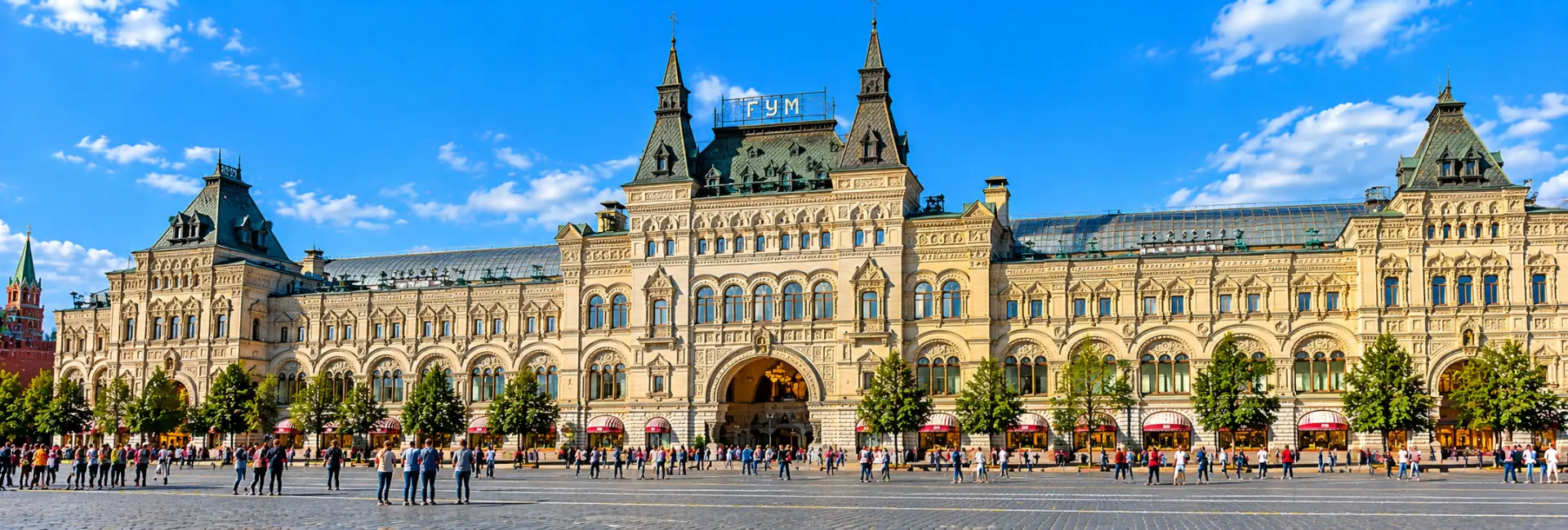
GUM is the grand shopping arcade that faces the Kremlin across Red Square. Its long, ornate facade, decorated in a style inspired by medieval Russian architecture, stretches for roughly 240 meters along the eastern side of the square, and behind it three levels of galleries sit beneath a soaring glass roof.
Many visitors come with no plan to buy anything. The building itself is the attraction, with its airy arcades, iron bridges, central fountain and balconies lined with shops and cafes. In winter it is hung with festive lights, and at night the facade glows with thousands of small lamps.
The name GUM is an abbreviation of the Russian words for "Main Universal Store". It is pronounced like the English word "goom", and it is one of the best-known names in Russian retail.
History
Centuries of Trading
The ground beside the Kremlin has been a marketplace for as long as Red Square has existed. After a fire in the 16th century, the rows of wooden stalls on the eastern side were reorganized into more orderly lines of shops, and the section nearest the Kremlin became known as the Upper Trading Rows. Over time the stalls were replaced by masonry buildings, but the area remained the commercial heart of old Moscow.
The Building of 1890 to 1893
The present building replaced an older trading complex and was built between 1890 and 1893. The architect Alexander Pomerantsev designed its facade and layout, while the engineer Vladimir Shukhov was responsible for the innovative steel-and-glass roof over the galleries. At the time, the use of such a large glazed vault was strikingly modern, and it made the building a showcase of engineering as well as architecture.
The Soviet Years
After the Revolution, the trading rows were nationalized and the building became a state department store in the 1920s. Later, during the Stalin era, it was used as office space, and in the 1930s there were even plans to demolish it to enlarge Red Square for parades, though these plans were never carried out. The building reopened as a department store in 1953 and became famous for its long queues, which sometimes stretched across the square. Its upper floor was also home to a restricted store for senior officials.
After the Soviet Union
Following the end of the Soviet period, the store was privatized and gradually transformed into a modern shopping center that keeps the old name. The abbreviation was kept but reinterpreted, so GUM now stands for "Main Universal Store" instead of the Soviet-era "State Universal Store".
Architecture & Design
The Facade
The red-and-cream front echoes the look of the Kremlin walls and the nearby State Historical Museum, helping it sit comfortably on the square. Decorative towers, arched windows and ornamental stonework recall medieval Russian architecture, giving the building a festive, almost storybook character.
Three Galleries Under Glass
Inside, three long parallel galleries run the length of the building, each covered by a barrel-shaped glass roof held up by a delicate steel lattice. Shukhov's engineering allowed the roof to be light and wide, so that daylight pours into the interior. Cast-iron bridges cross between the upper levels, and the effect is often compared to a grand 19th-century railway station.
Details Worth Spotting
Look for the decorative ironwork of the bridges, the tall arched shopfronts and the subtle shifts in roof height along the galleries. At the entrances, mosaics and carved ornaments carry echoes of older Russian church art, a reminder that the architect meant the building to feel rooted in national tradition, even though its roof is a feat of modern engineering.
The Central Fountain
At the middle of the main gallery stands a large fountain, which has become one of the building's best-loved features. Visitors often pause beside it for photographs, a coffee or simply a moment to look up at the glass roof overhead.
Shopping
A Mix of Boutiques and Brands
GUM houses a large number of shops spread across its three levels, from fashion and accessories to beauty, homeware and gifts. The mix of tenants changes over time, so what you find today may differ from what earlier visitors saw, and some international names that were once present may no longer be.
Souvenirs and Russian Products
Alongside boutiques, you can find shops selling Russian-made goods and gifts, such as chocolates, tea, nesting dolls and other traditional items. Prices tend to be higher than at markets or outside the center, but the quality and variety make it a convenient place to look.
Window Shopping
Even without buying, walking the galleries is a pleasant experience. The displays, seasonal decorations and architectural details reward a slow stroll, and the covered galleries offer a calmer pace than the open square outside.
Dining & Food
Gastronom No. 1
One of the best-known stops is the food hall known as Gastronom No. 1, which is designed to recall a grand Soviet-era grocery. It offers traditional Russian and Soviet-style products, from sweets and pastries to preserved foods, and is a popular place to buy edible souvenirs.
Cafes with a View
Several cafes and restaurants sit along the galleries and upper levels, and a few look out toward Red Square. They are a good place to rest between sights, and some offer a glimpse of the Kremlin or Saint Basil's from their windows.
Ice Cream and Snacks
Kiosks inside the arcades sell ice cream and light snacks, and visitors often treat a cone here as part of the GUM experience. It is a simple pleasure, and a good way to enjoy the surroundings without a full meal.
Cultural Significance
GUM is more than a store. Its facade is part of the classic view of Red Square, and the building is protected as a monument of federal significance in Russia. It appears in countless photographs and films of Moscow, and its glass-roofed galleries are among the most admired examples of 19th-century commercial architecture in the country.
The store also carries Soviet memory. Older Muscovites recall the lines, the shortages in other stores and the special place GUM held as a showcase department store. For visitors, that history adds another layer to a place that today feels glamorous and festive.
Ways to Experience It
Walk the Galleries
Start at one end and walk the full length of the central gallery, then loop back along an upper level to see the bridges and roof from different heights. The whole circuit can be done in under an hour, longer if you stop to shop.
Pair It with Red Square
GUM is a natural stop before or after seeing the Kremlin and Saint Basil's. It is also a handy place to warm up in winter or cool off in summer, with cafes and restrooms close at hand.
Seasonal Highlights
In winter the square in front of GUM has often hosted festive markets and an ice rink, and the building itself is richly decorated with lights. Summer brings terrace seating and long daylight hours for strolling.
Evening Atmosphere
After dark, the facade is lit up and the galleries glow, giving the whole building a warm, theatrical feel that many visitors consider the best time to see it.
Best Time to Visit
By Season
- Winter: the most atmospheric season, with festive lights and decorations and a welcome escape from the cold.
- Spring and autumn: comfortable weather for walking between GUM and the surrounding sights, with moderate crowds.
- Summer: long days and a lively square outside, though the galleries can be busier with tourists.
By Time of Day
Mornings are calmer for photos of the galleries and the fountain, while evenings are best for the illuminated facade and a relaxed dinner or dessert.
Visitor Tips
- Entry is free: you can walk in and enjoy the building without buying anything.
- Check opening hours: shops, cafes and special events have their own schedules, so confirm times for your visit.
- Expect security checks: there may be screening at the entrances, so keep bags light.
- Compare prices: souvenirs and food inside can cost more than elsewhere in the city, so look around before buying.
- Look up as well as ahead: the glass roof, bridges and balconies are the real highlights.
- Use it as a break: restrooms, cafes and places to sit make it a handy pause during a day on Red Square.
- Getting there: the nearest metro stations are Okhotny Ryad, Ploshchad Revolyutsii, Teatralnaya and Kitay-gorod, all within walking distance.
- Before you travel: check current entry requirements and your government's latest travel advice for Russia well ahead of time.
Nearby Attractions
Red Square
GUM faces the square directly, so you can step from its arcades to the Kremlin wall, Lenin's Mausoleum and the State Historical Museum in moments.
Saint Basil's Cathedral
The cathedral stands at the southern end of the square, a few minutes' walk from the nearest GUM entrance.
Kazan Cathedral
This rebuilt church at the northeastern corner of Red Square is a quiet, colorful stop close to GUM.
Nikolskaya Street and Kitay-gorod
The pedestrian street beside GUM leads into the old merchant quarter, with historic churches, cafes and shops.
Bolshoi Theatre
A short walk northwest, Russia's famous opera and ballet house is a classic addition to an evening in the center.
FAQs about visiting GUM
What does GUM stand for? +
It stands for "Glavny Universalny Magazin", meaning "Main Universal Store" in Russian. In Soviet times the first word was "Gosudarstvenny", meaning "State".
Is GUM a shopping mall or a department store? +
Today it works more like a shopping arcade with many separate boutiques, though it began as a series of trading rows and was run as a department store for much of the Soviet period.
When was GUM built? +
The current building was constructed between 1890 and 1893 to designs by Alexander Pomerantsev, with engineering by Vladimir Shukhov.
Is it free to enter? +
Yes, entry is free, and many visitors come just to admire the architecture and fountain.
What is the best time of day to visit? +
Mornings are quieter, and evenings offer the illuminated facade and a more festive atmosphere.
Is it worth visiting if I do not want to shop? +
Yes. The glass-roofed galleries, bridges, fountain and cafes make it worth a visit on their own.
Where can I get food inside? +
There are cafes and restaurants along the galleries, a food hall known as Gastronom No. 1, and kiosks selling ice cream and snacks.
How do I get there? +
Take the metro to Okhotny Ryad, Ploshchad Revolyutsii, Teatralnaya or Kitay-gorod, and walk to Red Square.
