
Table of Contents
Overview
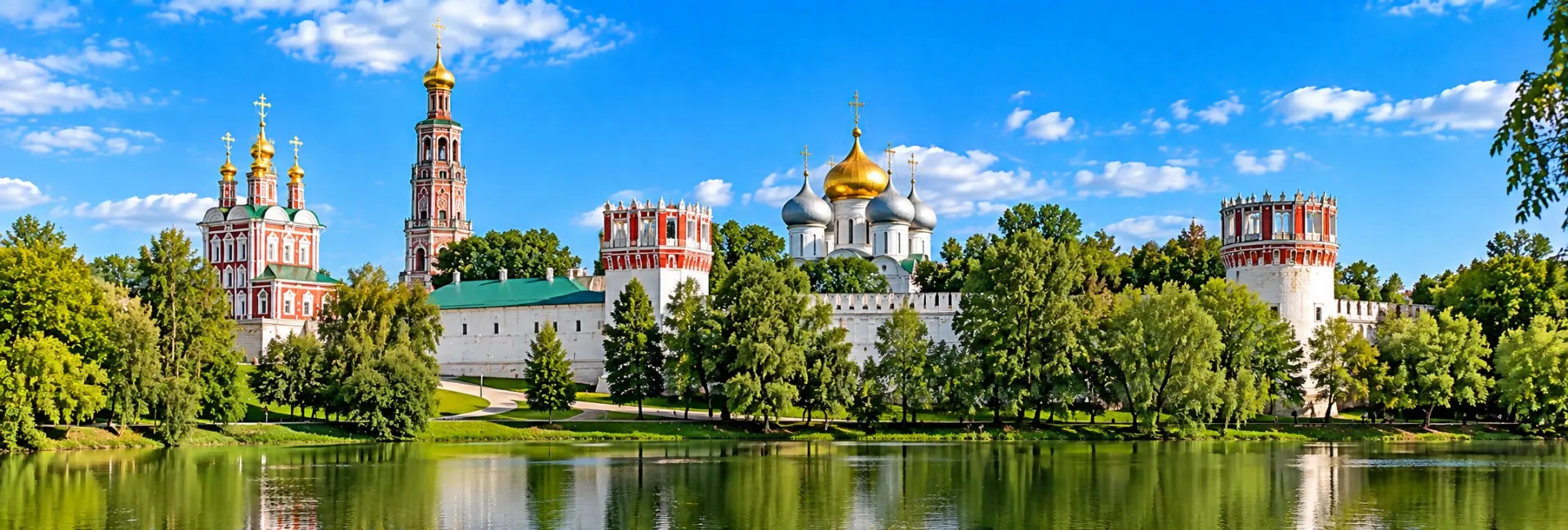
Novodevichy Convent is one of the most beautiful and best-preserved historic complexes in Moscow. Set behind high red-and-white walls in the southwest of the city, it is a compact ensemble of golden-domed churches, a soaring bell tower, gate churches and former royal chambers, reflected in a quiet pond beside it.
The name means "New Maidens'" Convent, and it is also known as the Bogoroditse-Smolensky Monastery. For centuries it was a place of retreat for women of the ruling families and the boyar elite, and it was closely tied to the story of the Russian state. It is still an active monastery today, as well as a museum.
Many visitors come to see the convent and then walk to the famous cemetery beside it, where many of Russia's most celebrated writers, composers and political figures are buried. Together, the two make a rewarding half-day outing away from the busier center.
History
Founding in 1524
The convent was founded on 13 May 1524 by Grand Prince Vasily III to give thanks for the capture of the city of Smolensk in 1514. It was dedicated to the Smolensk Icon of the Mother of God, a revered image brought from Smolensk, and its main cathedral was built in the icon's honor.
A Royal and Defensive Site
In the 16th and 17th centuries, the convent became a royal place of worship and a court monastery, receiving generous gifts of icons, manuscripts and fine objects. It also formed part of a chain of fortified monasteries around Moscow, and its walls and towers gave it an important defensive role. In the late 1590s, Boris Godunov is said to have withdrawn here with his sister, the widowed tsaritsa Irina, before being chosen as tsar.
Royal Women and Troubled Times
Many women from the ruling houses took the veil here. Among the best known is Tsarevna Sofia Alekseyevna, the half-sister of Peter the Great, who was confined in the convent after losing power. The convent was captured by a Polish force in 1610 and 1611 during the Time of Troubles, and it was occupied by the French in 1812 but survived Napoleon's retreat.
Closure and Revival
After the Revolution, the Soviet authorities closed the convent in 1922 and turned it into a museum, and from 1934 it served as a branch of the State Historical Museum. The Dormition Church was returned to believers in 1945, and in the following decades parts of the complex were restored to religious use. Today the convent is an active monastery that also hosts exhibitions in its former chambers.
Architecture & Design
Moscow Baroque
The ensemble is regarded as one of the finest examples of the Moscow Baroque, a decorative style that flourished in the late 17th century. Its churches are built of red brick with white stone details, and their forms combine older Russian traditions with rich, curving ornament. The color contrast between the red walls and the pale carved trim is one of the convent's signature looks.
Walls, Towers and Gate Churches
The convent is enclosed by a long fortified wall with towers at intervals, a reminder of its defensive past. The main entrances are marked by gate churches, including the Transfiguration Gate Church and the Intercession Gate Church, each topped with domes and decorated with ornate detail.
The Bell Tower
The tall, tiered bell tower, completed at the end of the 17th century, is one of the most graceful structures in Moscow and the dominant feature of the skyline here. Its stacked octagonal levels narrow toward a gilded cupola, and it is especially photogenic reflected in the pond.
Smolensky Cathedral
The oldest building in the convent is the Smolensky Cathedral, a six-pillared, five-domed church from the 16th century. Its design echoes the cathedrals of the Kremlin, and it was the heart of the convent's spiritual life from the beginning.
Cultural & Religious Significance
A UNESCO World Heritage Site
The Ensemble of the Novodevichy Convent was inscribed on the UNESCO World Heritage List in 2004. UNESCO recognized it as an outstanding example of the Moscow Baroque and as an exceptionally well-preserved monastic complex, closely associated with the history of the Kremlin and the Russian state.
An Active Monastery
Despite its fame as a heritage site, the convent remains a working religious community. Services are held in its churches, and nuns live and work within the walls. Visitors are guests in a place of prayer, which shapes the quiet, respectful atmosphere.
Art and Literature
The convent has inspired artists and writers for generations. It appears in Russian literature, and the painter Ilya Repin depicted Tsarevna Sofia in the convent in a famous 19th-century canvas.
Inside the Convent
Smolensky Cathedral Interior
The cathedral's interior is known for its 16th-century frescoes, which are among the finest in Moscow, and for its tall, richly carved iconostasis. The space is high and calm, with light filtering through narrow windows onto walls covered in painted scenes. The cathedral also holds a revered copy of the Smolensk icon.
Dormition Church and Refectory
The Dormition Church, joined to the refectory, is one of the most colorful buildings in the complex, with elaborate window frames and a decorated facade. It was returned to the church in 1945 and is used for services.
Tsarevna Sofia Chambers and the Museum
Parts of the complex are used for exhibitions of icons, manuscripts, church vestments and objects of applied art. The former chambers of Tsarevna Sofia and of Irina Godunova house displays that bring the history of the convent to life, and exhibitions change from time to time.
Courtyards and Gardens
Between the churches, quiet paths, trees and gardens give visitors a place to pause. The setting is peaceful even when the grounds are busy, and the views of the bell tower from the courtyards are among the best.
Novodevichy Cemetery
Next to the convent, but separated from it by a wall, lies the Novodevichy Cemetery, which opened in 1898 and became the final resting place of many notable Russians. It has its own entrance, and you leave the convent grounds to reach it, so plan to treat the two as separate visits.
Among those buried here are writers such as Anton Chekhov, Nikolai Gogol and Mikhail Bulgakov, the composer Dmitri Shostakovich, and political figures including Nikita Khrushchev and Boris Yeltsin. Many of the monuments are works of art in their own right, ranging from simple stones to elaborate sculpture.
The cemetery is a place of remembrance for families as well as a visitor attraction, so visitors are expected to behave quietly and respectfully. Check its own opening hours, rules and any ticket requirements before you go.
Ways to Experience It
Walk Around the Walls and Pond
Begin with a stroll along the pond beside the convent, which gives the classic view of the walls, towers and bell tower reflected in the water. It is a good place to take photographs, especially in calm weather.
Enter the Grounds
Entering the grounds is the best way to appreciate the scale of the ensemble and to see the churches and gardens up close. Tickets are typically needed for the cathedral and the museum exhibitions.
Join a Guided Tour
A guide can help explain the convent's history, the stories of the royal women associated with it and the symbolism of the architecture and frescoes. Tours of the convent are often combined with visits to the cemetery.
Add the Cemetery
If you are interested in Russian literature, music and history, a walk through the cemetery after the convent is a natural continuation, and many visitors find it as moving as the convent itself.
Best Time to Visit
By Season
- Late spring to early autumn: green trees, open gardens and pleasant weather make the grounds and pond especially attractive.
- Autumn: golden foliage frames the white-and-red walls, a favorite season for photographers.
- Winter: snow on the domes and walls gives the convent a fairy-tale look, though it is cold and some outdoor areas may be less accessible.
By Time of Day
Mornings are typically quieter, and the late afternoon light is especially flattering on the bell tower and the pond. Plan around services and opening hours, which can vary.
Visitor Tips
- Dress respectfully: it is an active convent, so cover shoulders and knees, and women are traditionally expected to cover their heads inside the churches.
- Keep quiet: speak softly, avoid loud conversation and follow signs and staff guidance.
- Buy tickets as needed: entry to the grounds, the cathedral and the exhibitions may be separately priced, so check what is included.
- Check photography rules: they vary by location, and photography may be restricted inside churches and some exhibition halls.
- Plan for the cemetery separately: it has its own entrance, hours and rules, and you cannot walk straight from the convent into it.
- Confirm opening times: hours differ by season and day, and some areas may close for services or events.
- Getting there: the nearest metro station is Sportivnaya, a short walk from the convent and pond.
- Before you travel: check current entry requirements and your government's latest travel advice for Russia well ahead of time.
Nearby Attractions
Novodevichy Ponds
The ponds beside the convent are a pleasant place to walk and offer the best views of the walls and towers.
Luzhniki Olympic Complex
A large sports and events complex lies a short distance away along the river bend, with a stadium and riverside paths.
Sparrow Hills and Moscow State University
The hills across the river offer a high viewpoint over the city and a close look at the university's grand main building.
Gorky Park and Muzeon
A longer journey along the river leads to Gorky Park, with its promenades, sculpture park and museums.
Tretyakov Gallery and the Center
The historic center, with the Kremlin, Red Square and the major museums, is a short metro ride away.
FAQs about visiting Novodevichy Convent
What does Novodevichy mean? +
It means "New Maidens'" or "New Convent for Women", and the convent is also known as the Bogoroditse-Smolensky Monastery.
When was it founded and why? +
It was founded in 1524 by Grand Prince Vasily III to commemorate the capture of Smolensk in 1514.
Is Novodevichy Convent a UNESCO World Heritage Site? +
Yes, it was inscribed on the UNESCO World Heritage List in 2004 as an outstanding example of the Moscow Baroque and a well-preserved monastic complex.
Is it still a working convent? +
Yes, it is an active monastery as well as a museum, and services take place in its churches.
Is the cemetery part of the convent? +
No. The Novodevichy Cemetery is next door but separate, with its own entrance, hours and rules, and you need to leave the convent grounds to reach it.
Who is buried in the cemetery? +
Notable burials include Anton Chekhov, Nikolai Gogol, Mikhail Bulgakov, Dmitri Shostakovich, Nikita Khrushchev and Boris Yeltsin.
What should I wear? +
Dress modestly, cover shoulders and knees, and women should cover their heads in the churches. Avoid loud conversation.
How do I get there? +
Take the metro to Sportivnaya and walk a short distance to the convent and pond.
