
Table of Contents
Overview
VDNKh is a sprawling exhibition park in northern Moscow, created to celebrate Soviet agriculture, industry and culture. Its name abbreviates the Russian for Exhibition of Achievements of the National Economy, and Muscovites use it for both the park and the metro station that serves it. Wide boulevards, ornate pavilions, ponds and fountains give it the feel of a miniature city built purely for show.
Nearly fifty of its buildings have cultural-heritage protection, and together with the adjoining Ostankino Park the whole territory spans roughly 325 hectares. That is larger than many small city districts, which is why first-time visitors are often surprised by the sheer scale of it.
Today VDNKh works as a public park, museum quarter and leisure destination rolled into one. You can wander its avenues for free, admire gilded sculptures, step inside space exhibits, visit an oceanarium or skate on a rink in winter. It suits history lovers, families and anyone curious about how a state once chose to present itself to the world.
History
A Showcase for the Soviet Union
The idea grew out of a smaller agricultural and industrial fair held in Moscow in 1923. The much larger All-Union Agricultural Exhibition opened its gates on 1 August 1939, after years of construction and delays. It eventually included more than 200 buildings, and its pavilions for the Soviet republics were designed in regional folk styles, following the slogan of being national in form and socialist in content. In its first season it drew more than three million visitors.
War and Reopening
The outbreak of war in 1941 shut the exhibition down. Exhibits and archives were partly evacuated, the livestock was dispersed and the grounds were put to military and farming use. It reopened in 1954 on an enlarged site of about 207 hectares, with new pavilions in neo-Muscovite and neoclassical styles, a monumental arched entrance and the fountains that now define the central squares.
From Soviet Showpiece to Struggling Fairground
In the late 1950s the complex was renamed VDNKh, reflecting its broader remit across the whole national economy. By 1989 it held more than eighty pavilions, each devoted to a field such as engineering, atomic energy, radioelectronics or space. After the state withdrew its funding in the late 1980s the site declined, and many pavilions were turned into shops and market stalls. Between 1992 and 2014 it operated under the name All-Russian Exhibition Centre.
Restoration and Revival
The original name returned in 2014, alongside a major restoration programme. Pavilions were repaired, decorative panels and sculptures were conserved, and many halls were reborn as museums, exhibition spaces and cafés. The work is ongoing, so you will still see scaffolding on some buildings.
Architecture & Design
VDNKh is widely regarded as an outstanding ensemble of architecture and urban planning from the 1930s to the 1960s, and it appears on Russia's tentative list for UNESCO World Heritage status. Its layout follows a strong central axis, with broad alleys, formal squares and symmetrical vistas that lead the eye toward fountains and grand facades.
The pavilions tell the story of changing tastes. Early republic pavilions borrow motifs from the traditional building styles of their regions, while the 1950s structures lean toward ornate Stalin-era classicism, with columns, spires, mosaics and gilded details. Later pavilions, such as the space pavilion of the 1960s, show a more modern outlook shaped by technological confidence.
Art Built Into the Buildings
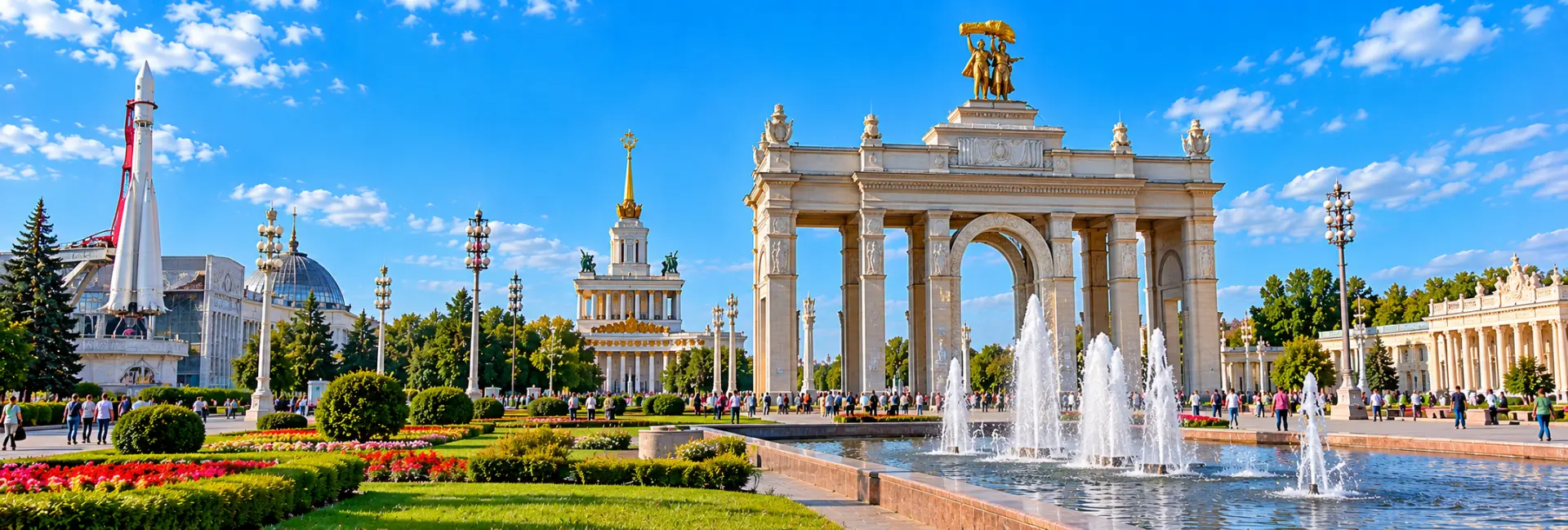
Sculpture and decoration were never an afterthought here. Many halls were covered in murals and panels and filled with statues celebrating harvests, workers and national unity. The main entrance arch is crowned by a monumental sculpture group of a tractor driver and a collective farm woman, a good place to begin appreciating how art and architecture were fused into a single message.
Key Areas & Pavilions
The Main Entrance and Central Alley
Most visitors arrive through the triumphal arch and walk the central alley, which is lined with trees, flowerbeds and some of the most elaborate pavilions. The route draws you gradually toward the heart of the park, passing the grand Central Pavilion, the former House of Peoples, restored in 2016.
Friendship of Peoples Square
This central square, once called Collective Farm Square, is framed by pavilions that originally represented individual republics. Two fountains anchor it: the golden Friendship of Peoples and the lower Stone Flower. It is the most photographed part of the park and a natural place to pause.
The Space Quarter
Near the entrance end, the Cosmos pavilion houses the Cosmonautics and Aviation Centre, and a Vostok rocket stands outside. A model of the Buran space shuttle sits close by, with an interactive experience that lets visitors try landing it in a simulator. Aircraft displayed in the open air add to the sense of a space-age fair.
Family and Leisure Zones
Beyond the formal squares you will find ponds, gardens, cafés and play areas. The Moskvarium oceanarium, one of Europe's largest inland aquariums, is a major draw for families, and a skating rink replaces the open spaces in winter.
Notable Landmarks
- Worker and Kolkhoz Woman: Vera Mukhina's soaring stainless-steel sculpture of two figures raising a hammer and sickle, first shown at the 1937 Paris World's Fair and now mounted on a replica pavilion-pedestal outside the main entrance.
- Main Arch: the monumental 1954 entrance gate topped by a tractor driver and collective farm woman, and the visual signature of the park.
- Friendship of Peoples Fountain: sixteen gilded maidens in national costumes, one for each Soviet republic of the era, circling a basin crowned with a golden sheaf of wheat, hemp and sunflowers.
- Stone Flower Fountain: a tiered fountain on the same square, inspired by classical European garden fountains and a favourite for evening photographs.
- Central Pavilion: a grand hall at the far end of the main alley, restored and used for exhibitions and events.
- Cosmos Pavilion and Vostok Rocket: a space museum and a rocket on display, celebrating Soviet and Russian achievements beyond the atmosphere.
- Buran Shuttle Complex: a full-scale shuttle model with interactive displays about the Soviet space-shuttle programme.
- Moskvarium: a large oceanarium with marine life from around the world, popular with children and rainy-day visitors.
- Pavilion 57: a modernised hall that now hosts a large historical exhibition and was among the first buildings to be renewed in the revival.
- Atom Pavilion: a former nuclear-energy showcase that now explores the history of atomic science.
Ways to Experience It
Stroll the Grounds
The simplest way to enjoy VDNKh is on foot. Walking from the main arch to Friendship of Peoples Square and then wandering the side alleys takes a couple of hours, with plenty of benches, cafés and photo spots along the way. Entering the park itself costs nothing.
Museum Hopping
For a deeper visit, choose two or three indoor attractions, such as the space exhibits, the Buran experience or the oceanarium. Some require separate tickets, and the busiest ones sell out on weekends, so booking ahead online saves time.
Seasonal Activities
Summer brings open-air events, boating and cycling around the ponds, while winter turns part of the grounds into a large skating rink, with lights and warm drinks adding a festive mood. Guided tours focusing on architecture, Soviet history or space exploration are also available and help decode the symbolism of the buildings.
Best Time to Visit
By Season
Late spring through early autumn is ideal. Gardens are in bloom, fountains operate and the long alleys are comfortable to walk. Golden light in September and early October gives the pavilions a warm glow and the trees add colour.
Winter has a distinct appeal, with snow on the pavilions and an outdoor rink, though temperatures can fall well below freezing and fountains are switched off. Pack warm layers and plan indoor stops.
By Time of Day
Weekday mornings are the calmest, which makes them best for photographs and for indoor attractions. Weekends, especially in summer and during public holidays, are far busier. Evenings are rewarding too, when the illumination on the fountains and facades gives the park a theatrical feel.
Visitor Tips
- Getting there: the VDNKh metro station is a short walk from the main entrance, and it is one of the deepest stations in the system, so expect a long escalator ride.
- Cost: access to the grounds is free, but museums, the oceanarium and special exhibitions charge separately. Check official sources for current prices and opening hours.
- Book ahead: popular interactive attractions such as the Buran complex often require advance online tickets, especially on weekends.
- Plan your day: the park is big, so pick a few priorities instead of trying to see everything. A full day is realistic only if you include several indoor attractions.
- Footwear and weather: wear comfortable shoes and dress for the season, as most of the route is outdoors with long distances between sights.
- Food and rest: cafés are scattered across the grounds, but prices near the main fountains can be higher, so consider a snack before you arrive.
- Before you travel: entry rules and government travel advice for Russia can change, so check the latest requirements for your nationality well in advance.
Nearby Attractions
VDNKh sits in the Ostankinsky District, so several sights fit easily into the same trip. The Memorial Museum of Cosmonautics, located at the base of the towering Monument to the Conquerors of Space on Prospekt Mira, is practically next door and a natural companion for anyone interested in the space exhibits.
Ostankino Park, adjoining the exhibition grounds, offers shaded paths and a quieter pace, and the Ostankino Tower rises less than a kilometre away. Nature lovers can also visit the Botanical Garden of the Russian Academy of Sciences, which lies close to the park.
To combine the visit with the city centre, take the metro back toward the Kremlin and Red Square, which are roughly ten kilometres to the south.
FAQs about visiting VDNKh
What does VDNKh stand for? +
It is the Russian abbreviation for the Exhibition of Achievements of the National Economy, the name given to the park in the late 1950s and restored in 2014.
Is VDNKh free to enter? +
Yes, the grounds are open to walk through without a ticket. Individual attractions such as museums, the oceanarium and special exhibitions charge their own admission.
How long should I spend at VDNKh? +
Allow at least two to three hours for the main alley and fountains. A full day is better if you want to visit several museums or the oceanarium.
How do I get to VDNKh? +
The easiest way is by metro to VDNKh station, which is a short walk from the main entrance. Several bus routes also serve the area.
Is VDNKh good for children? +
Yes. Open spaces, an oceanarium, interactive space exhibits and seasonal activities such as skating make it a popular choice for families.
What is the most famous sight at VDNKh? +
The golden Friendship of Peoples fountain is the best-known feature inside the park, while the Worker and Kolkhoz Woman sculpture outside the entrance is its most iconic monument.
Is it worth visiting in winter? +
Yes, if you dress warmly. The pavilions look striking in the snow and the outdoor rink adds atmosphere, though fountains are off and some outdoor areas are less comfortable.
