
Table of Contents
Overview
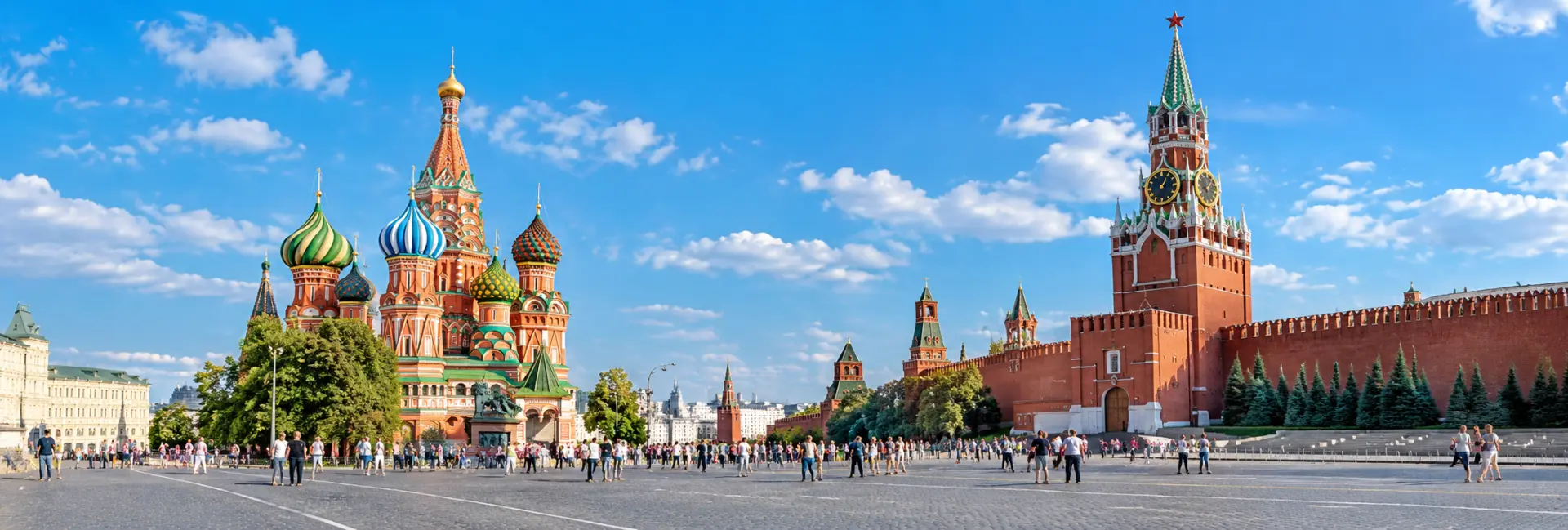
Red Square is the ceremonial heart of Moscow and one of the most recognizable public spaces on Earth. A long paved rectangle running along the eastern wall of the Kremlin, it is framed by the colorful domes of Saint Basil's Cathedral, the red-brick towers of the State Historical Museum, the glass-roofed arcades of GUM and the stark stepped form of Lenin's Mausoleum.
The square measures only about 330 meters in length and 70 meters in width, yet it has hosted coronation processions, public proclamations, executions, military parades, concerts and New Year celebrations. Few places compress so much of a nation's story into so small an area, which is why most first-time visitors to Moscow head here before anywhere else.
Despite the name, the square is not especially red. In older Russian, the word "krasnaya" meant "beautiful", and over the centuries it drifted toward its modern meaning of "red". The warm red brick of the Kremlin wall and the surrounding buildings helped the newer reading stick, and the double meaning is still part of the square's charm.
History
A Marketplace Beside the Fortress
The square took shape in the late 15th century, when Grand Prince Ivan III rebuilt the Kremlin with brick walls and towers. To reduce the risk of fire spreading to the fortress, the crowded wooden buildings on its eastern side were cleared, leaving open ground that quickly filled with traders and their stalls.
Fires still swept through the area regularly, and for a period it was known as Pozhar, roughly meaning "burnt place". By the second half of the 17th century the name Krasnaya had taken hold, and it has been used ever since.
Tsars, Proclamations and a Cathedral
For generations the square served as Moscow's public stage. Royal decrees were read aloud from a round stone platform called Lobnoye Mesto, crowds gathered for religious processions, and in 1555 work began on the cathedral that would become the city's most famous silhouette. In 1612 the square also witnessed the entry of the volunteer army led by Kuzma Minin and Prince Dmitry Pozharsky, who had driven Polish-Lithuanian forces out of Moscow.
The moat that once separated the square from the Kremlin wall was filled in during the early 19th century, giving the space the open, uninterrupted look it has today. A bronze monument to Minin and Pozharsky, unveiled in 1818, was originally placed near the center of the square.
The Soviet Era
After the capital returned to Moscow in 1918, Red Square became the stage for state ceremonies on a vast scale. Vladimir Lenin died in January 1924, and a mausoleum was built beside the Kremlin wall, first in wood and later in stone. In the early 1930s the old cobblestones were replaced with granite paving, the Minin and Pozharsky monument was moved to its present spot in front of Saint Basil's, and several historic structures, including the Kazan Cathedral and the Resurrection Gate, were demolished.
The annual parades of the Soviet period became world-famous images. One of the most dramatic took place in November 1941, when troops marched across the square and went directly to the front lines as German forces approached the capital. In 1987 the square drew global headlines again when a young German pilot landed a light aircraft nearby.
Restoration and Today
After the Soviet Union dissolved, the Kazan Cathedral and Resurrection Gate were rebuilt in the 1990s, restoring part of the square's older character. Today the space is a mix of national ceremony, tourism and public events, and it remains one of the most photographed locations in the country.
Recognition / Status
Red Square is inscribed on the UNESCO World Heritage List together with the Kremlin, under the joint listing "Kremlin and Red Square, Moscow", which was added in 1990. The listing treats the two as a single ensemble, reflecting how closely the fortress and the square developed alongside one another as the center of Russian political and spiritual life.
Beyond its formal status, the square carries enormous symbolic weight. It appears in national ceremonies, in countless works of art and literature, and in the popular imagination as shorthand for Moscow itself. Several of the buildings around it are also protected monuments in their own right, and Saint Basil's Cathedral operates as a museum under the State Historical Museum.
Layout & Architecture
A Long, Open Stage
The square runs roughly north to south, with the Kremlin wall on its western side and the long facade of GUM on the east. The State Historical Museum closes the northern end, while the southern end slopes gently down toward the Moskva River and ends at Saint Basil's Cathedral. The granite paving gives the surface a dark, slightly undulating look, and the broad open space is deliberately uncluttered so that the buildings around it dominate the view.
Layers of Russian Style
The architecture on view spans several centuries and styles. The Kremlin wall and its towers combine Italian-influenced engineering with distinctly Russian rooflines and swallowtail battlements. Saint Basil's represents the exuberant tent-roofed and onion-domed tradition of 16th-century Russian church building, while the State Historical Museum and GUM show how 19th-century architects revived those older motifs in brick, stone and decorative detail.
Lenin's Mausoleum, completed in its current form in 1930 to a design by Alexey Shchusev, adds a strikingly modern counterpoint, a terraced block of dark and red stone that sits low against the old wall.
Notable Landmarks
Saint Basil's Cathedral
Built between 1555 and 1561 on the orders of Ivan the Terrible, the cathedral commemorates the capture of Kazan. It consists of a central church surrounded by eight smaller chapels, with a tenth added in 1588 over the grave of the revered local saint Basil the Blessed. Each dome is shaped and patterned differently, and the interior is a maze of narrow passages, painted vaults and small chapels rather than one grand hall.
Lenin's Mausoleum and the Kremlin Wall
The mausoleum houses the preserved body of Vladimir Lenin and is open to the public on limited days and hours. Behind it, along the base of the Kremlin wall, lies a necropolis where many prominent Soviet figures are buried, including Yuri Gagarin, the first human in space, and Joseph Stalin.
Spasskaya Tower
Rising above the main gate in the Kremlin wall, Spasskaya Tower was built in 1491 and is topped by a clock whose chimes are among the best-known sounds in Russia. The ruby-red star on its spire was added in the 1930s, replacing the older double-headed eagle.
State Historical Museum
Opened in 1883, this red-brick building in the Russian Revival style holds an enormous collection tracing the history of the country from prehistoric times onward. Even if you do not go inside, its pointed towers and ornamental brickwork make it one of the square's most photogenic features.
GUM
Facing the Kremlin across the square, GUM opened in 1893 as a vast complex of trading arcades. Its three long galleries are covered by an elegant glass-and-steel roof engineered by Vladimir Shukhov, and the interior, with its fountain, bridges and balconies, is worth a walk even if you have no plans to shop. Cafes and food halls inside make it a convenient stop for a break.
Kazan Cathedral, Lobnoye Mesto and the Minin and Pozharsky Monument
At the northern edge stands the Kazan Cathedral, originally built in the 1630s, demolished in 1936 and rebuilt in the early 1990s. Closer to Saint Basil's, the round stone platform of Lobnoye Mesto marks the spot where decrees were once read, and the bronze statue of Minin and Pozharsky, unveiled in 1818, honors the leaders of the 1612 national militia.
Ways to Experience It
Walking the Square Yourself
The simplest way to experience Red Square is on foot, entering through the Resurrection Gate at the northern end and walking south toward Saint Basil's. Allow time to stop at each landmark, circle the cathedral for different angles, and look back from the far end to see the full sweep of the Kremlin wall.
Guided Tours
Guided walking tours are widely available and often combine the square with the Kremlin grounds, nearby streets and the metro. A good guide can bring out details that are easy to miss, such as the symbolism of the cathedral's domes or the stories behind the burials along the wall.
Museums and Interiors
If you want to go beyond the exteriors, the State Historical Museum and Saint Basil's Cathedral both offer indoor visits with ticketed entry. Pairing the square with the Kremlin museums makes for a full day of sightseeing.
Evening Atmosphere
After dark, the buildings are lit up and the crowds thin out, giving the square a calmer, more cinematic feel. Many visitors consider it just as impressive at night as by day.
Best Time to Visit
By Season
- Late spring and early summer: long days, mild weather and trees in leaf make for comfortable walking, though events may close parts of the square at times.
- Summer: warm and busy, with the longest daylight hours and a lively atmosphere around the square and nearby parks.
- Early autumn: cooler temperatures, softer light and fewer crowds make this a pleasant window for photography.
- Winter: cold and often snowy, but the festive lighting and seasonal fairs around the holidays give the square a storybook look.
By Time of Day
Early morning is usually the quietest time for photographs of Saint Basil's without heavy crowds. Midday is the busiest, while the hours after sunset reward visitors with illuminated facades and a more relaxed pace.
Visitor Tips
- Check access before you go: the square is sometimes closed for parades, rehearsals, concerts and other events, so confirm that it is open on your planned day.
- Expect security checks: there are usually checkpoints at the entrances, so carry only what you need and allow a little extra time.
- Mausoleum rules: opening days are limited, bags and cameras are typically not allowed inside, and visitors are expected to be quiet and respectful.
- Dress for the weather: the square is wide open and exposed, so winter calls for warm layers and summer for sun protection and comfortable shoes.
- Getting there: the nearest metro stations are Okhotny Ryad, Teatralnaya and Ploshchad Revolyutsii, each only a short walk away.
- Tickets and hours: confirm current opening times and ticket prices for Saint Basil's, the State Historical Museum and the Mausoleum on their official websites, as they change.
- Before you travel: check current entry requirements and your government's latest travel advice for Russia well ahead of your trip.
Nearby Attractions
The Kremlin
The fortress next door holds cathedrals, palaces and the Armoury Chamber, and is the natural companion to a visit to the square.
Alexander Garden
This long, tree-lined park runs along the Kremlin's western wall and contains the Tomb of the Unknown Soldier, offering a quieter walk after the crowds of the square.
Zaryadye Park
Opened in 2017 just behind Saint Basil's, this modern park is known for its landscaped zones, its cantilevered viewing bridge over the Moskva River and its views back toward the Kremlin.
Nikolskaya Street and Kitay-gorod
Leading away from the square, this pedestrian street and the historic quarter around it offer cafes, shops, old churches and a taste of everyday Moscow life.
Bolshoi Theatre
A short walk from the northern end of the square, Russia's most famous opera and ballet house is a classic evening outing for visitors.
FAQs about visiting Red Square
Why is it called Red Square? +
The name comes from an older meaning of the Russian word "krasnaya", which once meant "beautiful" before it came to mean "red". The red brick of the Kremlin wall and nearby buildings helped reinforce the modern reading.
Is Red Square free to enter? +
Yes, walking through the square itself is free. Separate tickets are required for indoor attractions such as Saint Basil's Cathedral and the State Historical Museum, and the Mausoleum has its own access rules.
How much time do I need? +
Most visitors spend one to two hours on the square itself, or half a day if they add Saint Basil's, GUM and the State Historical Museum.
What is the best time of day to visit? +
Early morning is typically quietest for photographs, while the evening offers illuminated buildings and thinner crowds. Midday tends to be the busiest period.
Can I go inside Saint Basil's Cathedral? +
Yes, it operates as a museum with ticketed entry, and its narrow, winding interior of small chapels is well worth seeing. Confirm current opening hours before you go.
Can I visit Lenin's Mausoleum? +
Yes, it is generally open to the public on a limited schedule, with security screening and strict rules on bags, cameras and behavior inside. Check the official schedule before planning your visit.
How do I get to Red Square by public transport? +
The metro stations Okhotny Ryad, Teatralnaya and Ploshchad Revolyutsii are each within a short walk of the entrance.
Is the square suitable for children and visitors with limited mobility? +
The surface is flat and open, so it is generally easy to explore on foot or by wheelchair, though the paving is uneven in places and there is little shade, so plan breaks.
