
Table of Contents
Overview
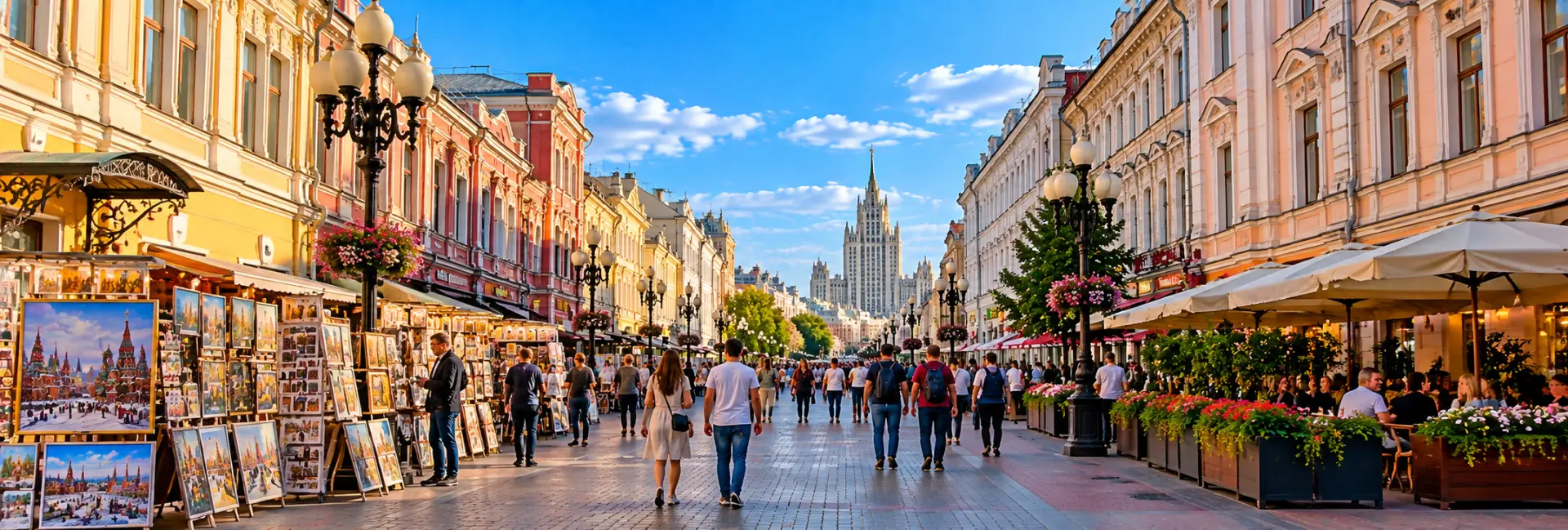
Arbat Street, usually called the Old Arbat to distinguish it from the glass-and-concrete New Arbat nearby, is a car-free promenade about one kilometre long in central Moscow. It runs southwest from Arbatskaya Square on the Boulevard Ring to Smolenskaya Square on the Garden Ring, passing a mix of nineteenth-century mansions, theatres, cafés, bookshops and souvenir stalls.
It is one of the oldest surviving streets in the Russian capital, first named in written records in 1493, yet it feels lived-in rather than preserved under glass. Aristocrats, poets, composers and rebellious teenagers have all claimed it at different moments, and each group left something behind: a museum apartment, a bronze statue, a wall covered in graffiti.
Today the Arbat is among the most walked streets in Moscow, a place to browse, listen to street musicians, watch portrait artists at work and trace Russian cultural history one doorway at a time. Plan on an unhurried hour or two for the stroll itself, and longer if you step inside its museums or catch an evening performance.
History
Origins and the Name
The Arbat first appears in written sources in 1493, in an account of a fire that began at a wooden church here and swept across much of the city. That blaze is often linked to the Russian proverb about Moscow burning down from a single kopeck candle. Even then the road mattered, because it carried traffic from the Kremlin westward toward Smolensk and onward to Poland and the rest of Europe.
Where the name comes from is still argued over. One popular theory traces it to an Arabic word for a suburb, which suits a settlement just outside the city's walls. Others suggest a Tatar word for a cart, or a Russian word meaning humped, a nod to Moscow's hills. In 1658 Tsar Alexei Mikhailovich ordered the street renamed Smolenskaya, but local people carried on saying Arbat and the official name faded.
Craftsmen, Nobles and Fire
During the 1500s and 1600s the area filled with settlements of craftsmen, soldiers and traders. By the 1700s noble families including the Dolgorukys, Golitsyns and Sheremetyevs had built private residences along the street, and it became one of the most desirable addresses in the city.
The great fire of 1812, set during Napoleon's occupation, destroyed much of the Arbat. It was rebuilt wider and increasingly lined with townhouses, and through the 1800s it attracted artists, academics and lesser gentry, building the creative, intellectual reputation it still carries.
The Soviet Years and Pedestrianisation
Under Soviet rule many senior officials lived in the neighbourhood, and the street formed part of a closely watched government route westward. Many of its churches were pulled down, and some buildings were replaced or remodelled in modern styles. When the New Arbat opened in the 1960s it absorbed the heavy traffic, leaving the older street quieter.
In 1986 the Arbat was closed to cars and became the first pedestrian zone in Moscow, complete with the decorative lanterns that still line it. During the perestroika years it turned into a gathering place for musicians, painters and youth subcultures, cementing its image as Moscow's bohemian promenade.
Architecture & Streetscape
The Arbat is not defined by a single style. Low and mid-rise buildings from the early 1800s stand beside Art Nouveau facades, Constructivist blocks from the 1920s and later infill. Most buildings are only a few storeys tall, which keeps the sky open above the street and gives it an easy, human scale compared with the grand avenues elsewhere in the city.
The ensemble is tied together by its surfaces and lighting. Large ornamental lanterns were installed in 1986 when the cars were removed, and they remain the street's visual signature, especially at dusk when they glow against the older facades. Shopfronts, theatre entrances and arched passages leading to quiet courtyards line both sides of the walkway.
The two ends of the street act as bookends. Near Arbatskaya Square, a corner building with a curved colonnade houses the Praga restaurant and marks the start of the walk. At the far end, a monumental Stalin-era skyscraper occupied by the Ministry of Foreign Affairs rises over Smolenskaya Square. Between them, side lanes such as Krivoarbatsky, Plotnikov and Denezhny preserve a calmer, more residential Moscow.
Poets, Bards & Rock Idols
A Literary Address
Few streets in Russia are as bound up with writers. Alexander Pushkin married Natalya Goncharova in 1831 and the couple lived for several months in an apartment at number 53, now a memorial museum that opened in 1986. The poet and novelist Andrey Bely spent his first twenty years in an Arbat apartment that became a memorial museum in 2000, and the opera singer Fyodor Chaliapin moved to the street in the early twentieth century.
No one is more closely identified with the street than the bard Bulat Okudzhava, who grew up in a communal apartment here and wrote tender songs about its courtyards and unhurried rhythms. His line calling the Arbat his religion or homeland is still quoted by Muscovites, and a sculpture of him stands on the street.
Theatre and Counterculture
In 1921 a student studio led by the director Yevgeny Vakhtangov staged its first performance in the building that became the Vakhtangov Theatre, now one of the country's best-known drama companies. Outside, the Princess Turandot fountain, unveiled in 1997 for Moscow's 850th anniversary, recalls the troupe's celebrated 1922 production.
The street's rebellious side survives in the Tsoi Wall in Krivoarbatsky Lane. It began in 1990 as a spontaneous tribute to Viktor Tsoi, frontman of the rock band Kino, after his death, and fans still gather to leave lyrics, paintings and messages. Guitarists playing his songs remain a familiar sound nearby.
Notable Landmarks
The Arbat packs a lot into a short distance. These are the stops most worth pausing at as you walk from east to west:
- Praga Restaurant (Arbat 2/1): the curved-colonnade corner building that announces the start of the street from Arbatskaya Square.
- Vakhtangov Theatre and Turandot Fountain (Arbat 26): a leading drama theatre with a gilded princess figure and fountain beside it, lit up in the evening.
- House with Knights (Arbat 35): a neo-Gothic mansion originally built for the Filatov family, decorated with knightly figures that make it easy to spot.
- Okudzhava Monument (near Arbat 43): a bronze tribute to the beloved bard, set among the courtyards he sang about and installed in 2002.
- Tsoi Wall (Krivoarbatsky Lane): a constantly evolving graffiti memorial to Viktor Tsoi, just off the main walkway.
- Pushkin Memorial Apartment (Arbat 53): the home of the poet and his new wife in 1831, now a museum, with a bronze statue of the couple on the street opposite.
- Ministry of Foreign Affairs Skyscraper (Smolenskaya Square): one of Moscow's Stalin-era high-rises, crowning the western end of the street.
- Scriabin Museum (Bolshoy Nikolopeskovsky Lane): the composer's former apartment, a short detour from the Arbat for music lovers.
Ways to Experience It
Walk It End to End
The simplest approach is to start at Arbatskaya Square, walk the length of the street and finish at Smolenskaya Square, where the Garden Ring and a metro station make onward travel easy. Walking it without stopping takes well under an hour, but the real pleasure is in the pauses: reading plaques, peeking into courtyards and lingering at the fountain.
Go Inside
For a deeper look, book time at one of the memorial apartments, such as the Pushkin museum, or buy tickets for an evening at the Vakhtangov Theatre. Guided walking tours focused on literature, Soviet history or the street's 1980s and 1990s counterculture are also popular and add context that signs alone do not provide.
Browse, Sketch and Snack
The Arbat's souvenir stalls sell matryoshka dolls, amber jewellery, painted boxes and Soviet-era memorabilia, and portrait artists work along the pavement. Cafés and restaurants fill the ground floors, and several side streets hide quieter places to sit down.
Best Time to Visit
By Season
Late spring through early autumn is the liveliest period, with outdoor terraces open, buskers out in numbers and the Turandot fountain usually running. Summer evenings are especially atmospheric, when the lanterns come on and the crowds slow to a stroll.
Winter is colder but has its own charm, as snow settles on the older facades and the lanterns glow against early darkness. Dress warmly and plan a museum or café stop to warm up between walks.
By Time of Day
Mornings are the quietest, ideal for photographs and for visiting museums before they fill up. Late afternoon into the evening brings the most energy, with street performers, theatre audiences and diners all sharing the same walkway. Weekends are noticeably busier than weekdays.
Visitor Tips
- Getting there: the street is served by the Arbatskaya stations at the eastern end and the Smolenskaya stations at the western end, so you can walk in either direction.
- Cost: the street itself is free to walk at any time, though individual museums and theatres charge admission and may close one day a week, so check current hours before you go.
- Eating out: restaurants directly on the main walkway are often priced for tourists, and many visitors find better value and quieter seating on the side streets.
- Souvenirs: compare prices across several stalls and shops before buying, as quality and pricing vary widely.
- Portraits: agree on the price with a street artist before they begin sketching.
- Staying safe: keep bags closed and phones secure in dense crowds, as with any popular tourist street.
- Before you travel: entry rules and government travel advice for Russia can change, so confirm the latest requirements for your nationality well in advance.
Nearby Attractions
The Arbat sits roughly 800 metres from the Kremlin walls and connects easily to several other highlights. Arbatskaya Square and the Boulevard Ring are right at the eastern end, ideal for a leisurely walk toward the Kremlin or along Nikitsky Boulevard, where the Gogol House-Museum is located.
Literature fans can extend the day with the Marina Tsvetaeva apartment museum in Borisoglebsky Lane and the Grand Ascension Church at Nikitskiye Vorota, where Pushkin married Natalya Goncharova and where a fountain now commemorates the couple. Those who want a contrast can cross to the New Arbat, whose Soviet-era towers show a very different side of the neighbourhood.
Art lovers can combine the stroll with the Pushkin State Museum of Fine Arts, a short walk toward the Kremlin.
FAQs about visiting Arbat Street
What is Arbat Street known for? +
It is Moscow's best-known pedestrian street, famous for its literary and theatrical history, street musicians, portrait artists, souvenir stalls and landmarks like the Tsoi Wall and Turandot fountain.
Is it the same as the New Arbat? +
No. The Old Arbat is the historic, car-free street, while the New Arbat is a wide, modern avenue built in the 1960s that runs roughly parallel to it.
Is Arbat Street free to visit? +
Yes, walking the street costs nothing and it is open to pedestrians at all hours. Museums and theatres along it charge their own admission.
How long should I spend there? +
Most visitors need one to two hours for a relaxed walk with a few photo stops. Add an hour or more per museum or a full evening for a theatre performance.
How do I get to Arbat Street by metro? +
Take either of the two Arbatskaya stations to reach the eastern end, or one of the Smolenskaya stations to reach the western end.
Is it good for families and visitors with limited mobility? +
The street is flat, wide and car-free, which suits families with children and most visitors who prefer a gentle walk. Individual museums and older buildings may have their own access limitations, so check with them directly.
Is the Arbat too touristy? +
It is certainly commercial, and prices in some restaurants and shops reflect that. The history, museums, architecture and surrounding side lanes still make it a rewarding visit if you look beyond the stalls.
