
Table of Contents
Overview
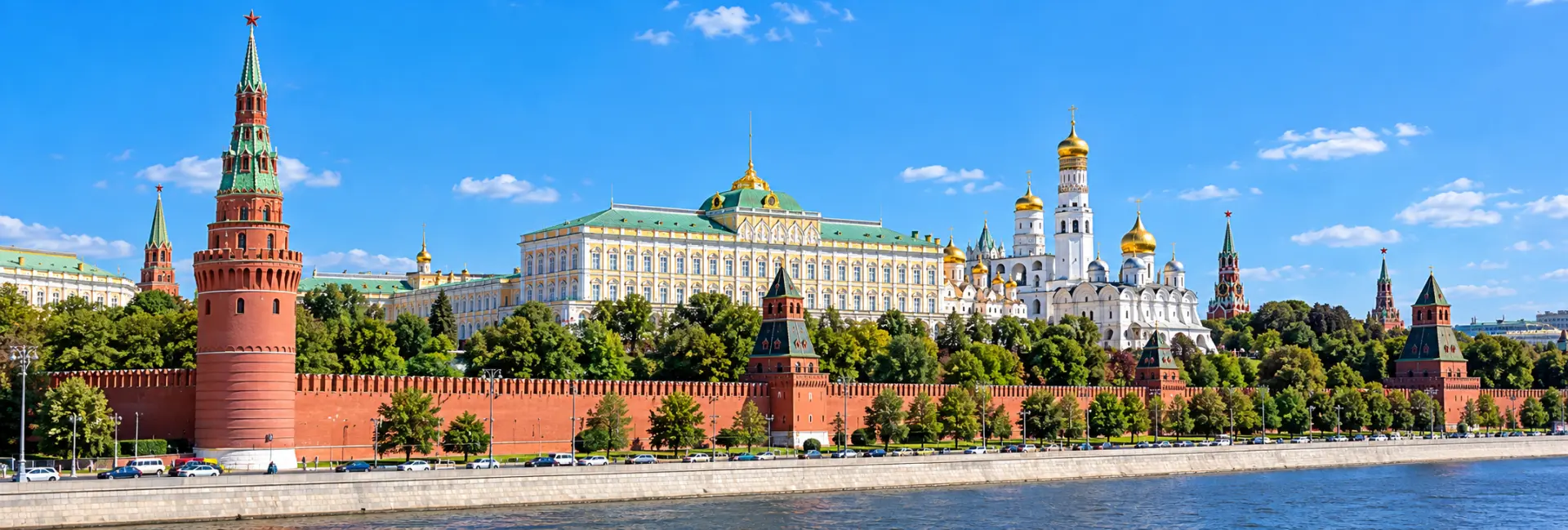
The Moscow Kremlin is a walled fortress complex standing on a hill above the Moskva River, in the very center of the city. Its triangular outline, red-brick walls and tall towers form one of the most recognizable skylines in the world, and behind those walls sit golden-domed cathedrals, palaces, a famous bell tower and a treasury museum.
The Kremlin is two things at once. It is a historic ensemble that has grown over many centuries, and it is a working seat of state power, which means that large parts of it are closed to the public. Visitors are welcomed into a carefully defined area that includes Cathedral Square, several museums and the Armoury Chamber, while the official buildings remain off limits.
The word "kremlin" simply means a fortified city center in Russian, and many other historic Russian cities have one. Moscow's, however, is the most famous by far, and it sits right beside Red Square, making the two a natural pair for any visit.
History
From Wooden Fort to White Stone
The hill above the river was settled long before Moscow became a major city. The first written mention of Moscow dates to 1147, and a timber fortress soon rose on the site. In the 14th century, under Prince Dmitry Donskoy, the wooden defenses were replaced with white limestone walls, which gave Moscow the nickname "the white-stone city".
The Brick Kremlin of Ivan III
The Kremlin took the form we recognize today in the late 15th century. Grand Prince Ivan III, determined to make Moscow the capital of a unified state, invited Italian architects and engineers to rebuild the fortress. Between roughly 1485 and 1495 the current brick walls and towers were raised, and the cathedrals and palaces inside were rebuilt or newly created in the same era.
Tsars, Capital Moves and Occupation
Moscow's rulers were crowned in the Kremlin's Dormition Cathedral for centuries, even after Peter the Great moved the capital to Saint Petersburg in the early 18th century. In 1812 the Kremlin was occupied by Napoleon's army, and retreating French forces damaged parts of the complex. Reconstruction followed, and the monumental Grand Kremlin Palace was completed in the 1840s.
The Soviet Period and After
The capital returned to Moscow in 1918, and the Kremlin once again became the seat of government. In the 1930s, ruby-red stars replaced the double-headed eagles on the tallest towers, and several historic buildings within the complex were lost. Since the late 20th century, restoration work has repaired many of the cathedrals and decorative details, and today the Kremlin combines active government use with museum functions.
Recognition / Status
The Kremlin was inscribed on the UNESCO World Heritage List in 1990, jointly with Red Square, under the listing "Kremlin and Red Square, Moscow". The inscription recognizes the two as one historic ensemble that has shaped Russian political and spiritual life for centuries.
Several of the complex's buildings are also important monuments in their own right. The cathedrals on Cathedral Square, the Armoury collection and the fortress walls are all treated as national treasures, and much of the complex is managed as a state museum preserve. It is also the official workplace of Russia's president, which explains the security measures and restricted areas visitors encounter.
Walls & Towers
The Defensive Circuit
The red-brick walls stretch for roughly 2.2 kilometers around a site of about 28 hectares, punctuated by 20 towers. The distinctive swallowtail battlements along the top, a design borrowed from northern Italian fortifications, are one of the most recognizable details of the whole ensemble.
Spasskaya Tower
The best-known tower faces Red Square. Spasskaya Tower was completed in 1491, and its great clock, with chimes that millions of Russians associate with national occasions, was installed in the 17th century. It is the symbolic main gate of the Kremlin, though it is not the one used by regular visitors.
Other Towers Worth Noticing
- Kutafya Tower: a squat, round gate tower in Alexander Garden, which serves as the main visitor entrance.
- Troitskaya Tower: the tallest of the towers, linked to the Kutafya Tower by a bridge over the old moat line.
- Borovitskaya Tower: the entrance for visitors to the Armoury Chamber, on the southwest side.
- Nikolskaya and Senate Towers: prominent along the Red Square side, with the Senate Tower rising above the Kremlin's governmental core.
Cathedral Square
The Heart of the Complex
Cathedral Square is the oldest square in Moscow and the centerpiece of any visit. It is surrounded by golden domes and white-stone facades, and it was long the spiritual and ceremonial core of the Russian state.
Dormition Cathedral
Built in the late 1470s by the Italian architect Aristotele Fioravanti, the Dormition Cathedral was the coronation church of Russian rulers. Its interior is richly painted with frescoes and an elaborate iconostasis, and it also holds the tombs of Moscow's metropolitans and patriarchs.
Annunciation and Archangel Cathedrals
The smaller Annunciation Cathedral served as the private church of the grand princes and tsars, and its floors and icons give it a more intimate feel. The Archangel Cathedral, completed in the early 16th century and blending Russian and Italian Renaissance features, is the burial place of many Moscow princes and early tsars.
Ivan the Great Bell Tower
The bell tower complex rises above the square, and the main tower is the tallest structure in the Kremlin. It was built in the early 16th century and raised to its current height around the year 1600. Access to the tower itself is not always available, so it is worth checking before you plan around it.
Palaces & Landmarks
Grand Kremlin Palace
The long yellow-and-white palace overlooking the river was built in the 1840s as an imperial residence and is now used for state functions. Its facade is a prominent presence on the Kremlin skyline, though the interior is generally closed to ordinary visitors.
Terem Palace and the Faceted Chamber
These two historic palace buildings preserve the older residential and ceremonial side of the Kremlin. The Faceted Chamber, built in the late 15th century, takes its name from the diamond-pointed stone on its exterior, while the colorful Terem Palace dates to the 17th century and housed the tsar's family.
Tsar Bell and Tsar Cannon
Two giant objects draw crowds near the Ivan the Great Bell Tower. The Tsar Bell, cast in the 18th century, is the largest bell in the world but never rang, as it cracked before it could be hung. The Tsar Cannon, cast in 1586, is an enormous bronze piece with a barrel more than five meters long, intended as a showpiece of the foundry's skill.
State Kremlin Palace and Senate
The modern State Kremlin Palace, built in 1961, is used for concerts and ballet. The 18th-century Senate building, with its green dome, is a major government building and one of the most visible neoclassical structures in the complex.
The Armoury Chamber & Museums
The Armoury Chamber
The Armoury Chamber is the Kremlin's treasury museum and one of the great collections of decorative arts in Europe. Its holdings grew from the stores of the tsars and the patriarchs, and from gifts presented by foreign ambassadors, and they include coronation regalia, royal thrones, gold and silver plate, ceremonial armor, jeweled weapons and ornate state carriages.
The collection is displayed in a 19th-century building near the Borovitskaya Tower, and a visit usually takes around two hours. A separate Diamond Fund exhibition, with famous gemstones and crown jewels, is housed in the same building and requires its own ticket.
Museums on Cathedral Square
The cathedrals themselves function as museums, and a ticket to the Cathedral Square ensemble usually covers entry to most of them. Additional exhibitions include displays of Kremlin treasures and antiquities, Russian wooden sculpture and carved church art, and temporary shows in the Patriarch's Palace and the Assumption Belfry.
Ways to Experience It
Independent Visit
Most visitors buy a ticket for the Cathedral Square ensemble and spend a morning or afternoon exploring the cathedrals, the open grounds and the bell tower area at their own pace. If you want to see the Armoury Chamber as well, book a timed session in advance and plan to walk between the two entrances.
Guided Tours
Guided tours are widely offered and can help you make sense of the complex layout, the iconography inside the cathedrals and the stories behind the objects on display. A guide can also help manage entry timing and queues, which matter more here than at most attractions.
Viewing the Kremlin from Outside
Even without entering, you can appreciate the Kremlin from several angles. Walking along the wall in Alexander Garden, crossing the bridges over the Moskva River and viewing the complex from nearby parks or waterfront promenades all offer excellent photographs of the towers and domes.
Best Time to Visit
By Season
- Late spring and early autumn: comfortable temperatures, good light and a more manageable pace make these the most pleasant months for the open-air parts of the visit.
- Summer: warm and busy, with the longest days, but with larger crowds and longer queues at security and the Armoury.
- Winter: cold, often snowy and much quieter, with golden domes set against a white landscape and shorter queues, though you will want warm clothing for the outdoor stretches.
By Time of Day
Arriving as the museums open is the best way to avoid the longest lines and enjoy the cathedrals in relative calm. Keep in mind that the Kremlin is typically closed to visitors one day a week and may close on certain event days, so plan around that.
Visitor Tips
- Use the right entrance: general visitors enter through the Kutafya Tower, while the Armoury Chamber has its own entrance at the Borovitskaya Tower, a good walk away.
- Buy tickets from official channels only: use the Kremlin museums' official website or the ticket office in Alexander Garden, as unofficial sellers are not guaranteed to be honored.
- Allow time for security: queues at the checkpoint can be substantial, so arrive well before your timed session, especially for the Armoury.
- Pack light: large bags are not permitted inside, but there is a luggage room near the Kutafya Tower.
- Dress respectfully: shorts, sleeveless tops and similar clothing may be refused entry to the cathedrals, and women are traditionally expected to cover their shoulders in the churches.
- Check photography rules: they differ by building, and photography is usually restricted inside the cathedrals and the Armoury.
- Confirm current details: opening days, hours, ticket prices and which buildings are open can change, so check the official Kremlin museums site before your visit.
- Before you travel: check current entry requirements and your government's latest travel advice for Russia well ahead of time.
Nearby Attractions
Red Square
Immediately adjacent, Red Square holds Saint Basil's Cathedral, Lenin's Mausoleum and the State Historical Museum, and is the natural partner to a Kremlin visit.
Alexander Garden
This long garden runs alongside the western wall and contains the Tomb of the Unknown Soldier, making it a peaceful place to walk before or after your visit.
Zaryadye Park
Just beyond Saint Basil's, this modern park offers landscaped zones and a viewing bridge over the Moskva River with sweeping views of the Kremlin walls.
Bolshoi Theatre
A short walk north of the Kremlin, Russia's most celebrated opera and ballet house is an easy addition to an evening plan.
Pushkin Museum of Fine Arts
A few minutes' walk to the southwest, this major museum of European art offers a cultural counterpoint to the Kremlin's Russian collections.
FAQs about visiting the Moscow Kremlin
What is the Moscow Kremlin? +
It is a fortified complex in the center of Moscow containing cathedrals, palaces, towers and museums, and it also serves as the official workplace of Russia's president.
Can anyone go inside the Kremlin? +
Yes, visitors can enter a defined public area that includes Cathedral Square, several museums and the Armoury Chamber. The government buildings and residences are closed to the public.
Where do I enter? +
General visitors enter through the Kutafya Tower in Alexander Garden, while the Armoury Chamber is reached through the separate Borovitskaya Tower entrance.
How long should I allow for a visit? +
Plan on about two to three hours for Cathedral Square and the grounds, plus roughly two more hours for the Armoury Chamber if you visit it.
Do I need to book tickets in advance? +
It is strongly recommended, especially for the Armoury Chamber, which runs timed sessions that can sell out. Buy only from the official museum website or the official ticket office.
Is the Kremlin open every day? +
No, it is usually closed one day each week and sometimes on special event days, so check the official schedule before you go.
Can I take photos inside? +
Photography is allowed in many outdoor areas, but it is commonly restricted inside the cathedrals and the Armoury Chamber. Follow the posted rules and staff instructions.
What should I wear? +
Dress modestly and comfortably. Shorts and sleeveless tops may be refused entry, and visitors to the cathedrals should cover their shoulders and keep clothing respectful.
