
Table of Contents
Overview
The Gothic Quarter, or Barri Gòtic, is the old walled heart of Barcelona, a dense tangle of narrow lanes and hidden squares wedged between La Rambla and Via Laietana. Built over the remains of the Roman colony of Barcino, it has been the city's political, religious, and social centre for roughly two thousand years, and it still houses the seat of Catalonia's regional government alongside Barcelona's City Hall. Visitors come for the Gothic-era cathedral, quiet cloistered courtyards, and Roman wall fragments tucked between shopfronts, all within a compact area that rewards slow, aimless wandering as much as any single landmark.
History
Roman Barcino
The district's street pattern traces back to the Roman colony of Barcino, founded around 15 BC, whose forum stood on the site of today's Plaça de Sant Jaume and whose defensive walls once ringed the settlement. Fragments of those walls, along with a handful of Roman columns and underground ruins, still surface among later buildings throughout the quarter.
Medieval Growth
As Barcelona became a major Mediterranean port and the capital of the Crown of Aragon during the Middle Ages, the area around the old Roman core filled in with churches, palaces, and guild houses built in the Gothic style that later gave the district its name. The Cathedral of Santa Eulàlia was begun in the 13th century, and the neighbouring squares became home to the city's key civic institutions, a role several of them still hold today. Medieval Barcelona was also home to El Call, one of Europe's largest Jewish quarters, until anti-Jewish riots in 1391 and later expulsion decrees devastated its community.
19th- and 20th-Century Restoration
Much of what visitors see today is not purely medieval: large parts of the quarter were reshaped, restored, or rebuilt during the 19th and early 20th centuries, when city planners cleared space around the Cathedral, added neo-Gothic facades and bridges, and relocated a few historic elements from elsewhere in Catalonia to reinforce the district's Gothic character. The result is a layered streetscape where genuine medieval fabric sits alongside careful, sometimes romanticised, later additions.
Architecture & Streetscape
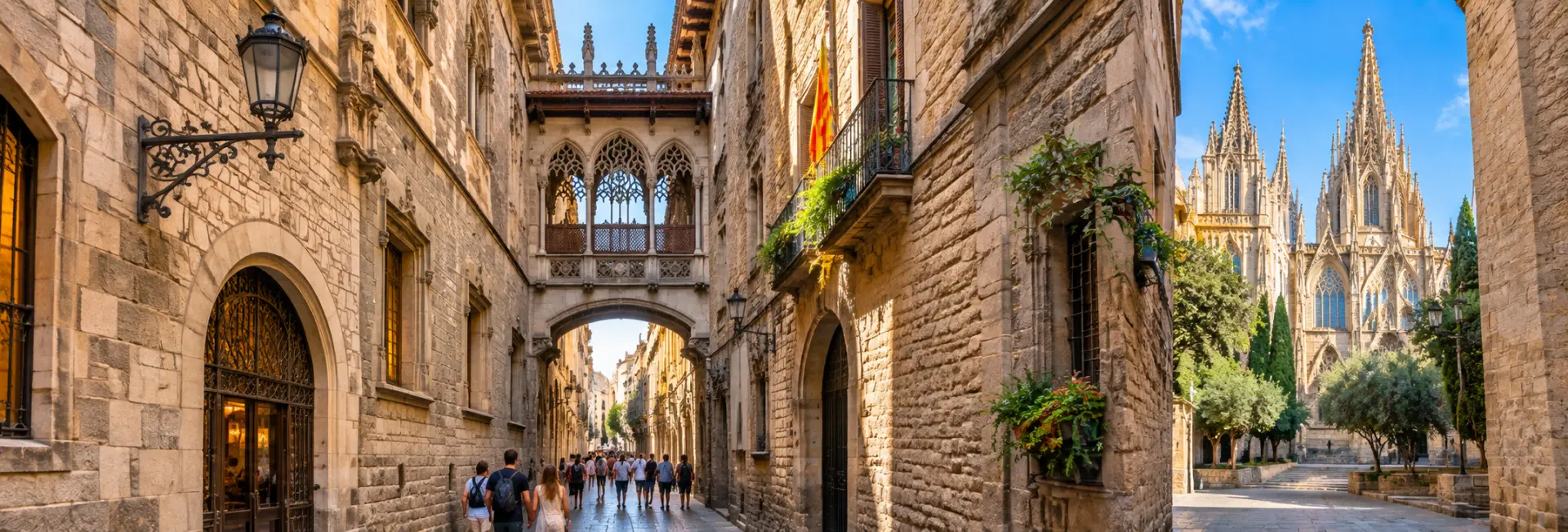
The Gothic Quarter's layout is irregular and largely pedestrian, with narrow stone streets that open unexpectedly onto small plazas rather than following a planned grid. Tall, closely packed buildings keep the lanes shaded for much of the day, while carved stone facades, pointed arches, and tracery windows mark the district's Gothic-era churches and civic buildings.
- Roman wall fragments survive at several points, including near the Cathedral and inside the Augustus Temple site on Carrer del Paradís
- Genuine medieval structures stand alongside 19th- and 20th-century restorations and neo-Gothic additions built to match the surrounding style
- Most streets are closed to private traffic, keeping the district walkable despite its narrow width
Key Areas & Squares
Plaça de Sant Jaume
The administrative heart of both the city and Catalonia, this square holds the Palau de la Generalitat and Barcelona's City Hall facing one another across the site of the old Roman forum.
Plaça del Rei
A 14th-century royal square surrounded by the former palace of the Counts of Barcelona, including the Saló del Tinell banqueting hall and the Chapel of Santa Àgata, with excavated Roman ruins running beneath it.
El Call
The compact former Jewish quarter west of Plaça de Sant Jaume, threaded with some of the district's narrowest lanes and home to the remains of a centuries-old synagogue.
Plaça Reial and Plaça Sant Felip Neri
Plaça Reial, just off La Rambla, is a grand 19th-century arcaded square with palm trees and lampposts designed by a young Antoni Gaudí, while the smaller Plaça Sant Felip Neri offers a quieter corner whose scarred walls recall bombing during the Spanish Civil War.
Notable Landmarks
- Barcelona Cathedral (Cathedral of Santa Eulàlia): the district's Gothic centrepiece, with a cloister housing thirteen resident geese
- Roman Temple of Augustus: four ancient columns preserved on Carrer del Paradís, near the old forum
- Museu d'Història de Barcelona (Plaça del Rei): built over excavated remains of Roman Barcino, including a bathhouse and wine cellars
- Pont del Bisbe: a neo-Gothic bridge over Carrer del Bisbe, added in the 1920s and now one of the quarter's most photographed spots
- La Casa de l'Ardiaca: a former archdeacon's residence blending Gothic and Renaissance elements, built against a stretch of Roman wall
Recognition & Status
The Gothic Quarter forms part of Ciutat Vella, Barcelona's protected old-town district, and its major monuments, including the Cathedral, the Roman remains, and several medieval palaces, hold individual heritage protection under Spanish and Catalan cultural heritage law. The district functions as a living neighbourhood rather than a museum piece: alongside its monuments, it remains home to residents, shops, and the city's core government buildings.
Ways to Experience It
Because its appeal lies as much in atmosphere as in individual sights, the Gothic Quarter suits slower, less structured visits.
- Self-guided wandering: the district rewards simply following narrow streets off the main squares to see what turns up
- Walking tours: guided routes typically link Plaça de Sant Jaume, Plaça del Rei, and the Cathedral with background on Roman and medieval history
- Museum visits: the Museu d'Història de Barcelona and the Cathedral's cloister offer a closer look at the district's Roman and Gothic layers
- Evening exploration: many squares and tapas bars stay lively well into the night, offering a different atmosphere than the daytime crowds
Best Time to Visit
Early morning is the quietest time to see the main squares and the Cathedral exterior before tour groups arrive, and it offers the best light for photographing the narrow streets. Visiting outside the busiest summer months of June through August generally means fewer crowds in the district's tightest lanes, where foot traffic can otherwise feel congested. Evenings bring a livelier, more local atmosphere as terraces and bars fill the smaller plazas.
Visitor Tips
- Wear comfortable shoes, since the district is walked entirely on foot over uneven, centuries-old paving
- Keep an eye on belongings in crowded lanes and squares, which are known pickpocketing spots in central Barcelona
- Step off the busiest routes between Plaça de Sant Jaume and the Cathedral to find quieter streets with far fewer visitors
- Check opening hours for the Cathedral and museums in advance, as access can be restricted during services or events
- Use the Jaume I (L4) or Liceu and Drassanes (L3) metro stations, all of which open directly into or beside the district
FAQs about visiting the Gothic Quarter
What is the Gothic Quarter known for? +
It's Barcelona's medieval old town, known for its narrow winding streets, Roman ruins, Gothic-era churches and palaces, and squares such as Plaça de Sant Jaume and Plaça del Rei.
How much time should I set aside to visit? +
A couple of hours covers the main squares and the Cathedral exterior, but many visitors spend half a day or more wandering side streets, visiting museums, and stopping at cafes along the way.
Is the Gothic Quarter actually medieval? +
Parts of it are, including sections of the Roman wall and several Gothic-era buildings, but much of the district's current appearance dates from restoration and rebuilding carried out in the 19th and early 20th centuries.
Is it free to walk around? +
Yes, the streets and squares are open to the public at no cost; only specific sites such as the Cathedral's choir and rooftop, the Museu d'Història de Barcelona, and some smaller museums charge admission.
How do I get to the Gothic Quarter? +
The Jaume I station on metro line L4 opens directly into the district, while the Liceu and Drassanes stations on line L3 sit just along its edge on La Rambla.
Is the Gothic Quarter safe for visitors? +
It's generally safe to walk, including at night, though like other busy tourist areas in central Barcelona it sees occasional pickpocketing, so keeping bags and valuables secure in crowded spots is worthwhile.
What's the best time of day to visit? +
Early morning offers the quietest streets and clearest photos, while evenings bring a livelier atmosphere as bars and restaurants around the smaller squares fill up.
What should I combine my visit with? +
The Gothic Quarter sits right beside La Rambla and the La Boqueria market, and within easy walking distance of the El Born district and the waterfront, making it easy to link into a longer day in central Barcelona.
